Sessions Court Cannot Sentence Murder Convict To "Remain In Prison Till Rest Of Their Life": Supreme Court
The Apex Court observed that prescribing punishment is a legislative function, while the power to impose a special-category sentence for a fixed period or the remainder of a convict’s life without remission is confined to the High Courts and the Supreme Court.
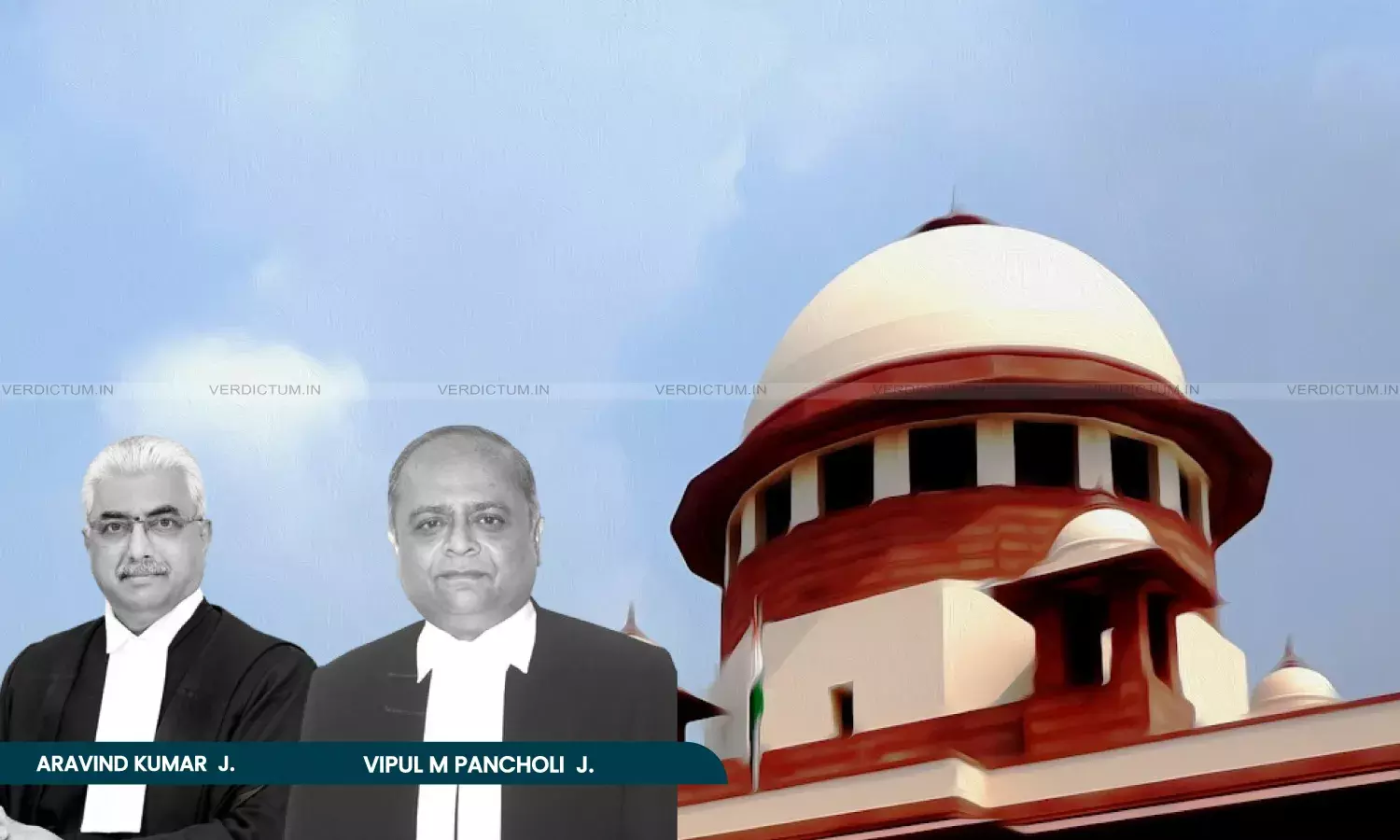
The Supreme Court has held that a Sessions Court cannot direct a murder convict to remain imprisoned for the rest of their natural life where the direction excludes the statutory powers of remission and commutation.
While affirming the conviction of two men for the murder of three persons, including two children, the Court substituted their special-category life sentences with rigorous imprisonment for 25 years without statutory remission.
The Court was hearing an appeal against a Punjab and Haryana High Court judgment affirming the appellants’ conviction under Section 302 read with Section 34 of the Indian Penal Code, 1860 and the Trial Court’s direction that they remain imprisoned for the rest of their lives.
A Bench of Justice Aravind Kumar and Justice Vipul M. Pancholi observed: “… there is no doubt that the Trial Court was competent to impose the punishment of imprisonment for life upon the appellants for the offence under Section 302 read with Section 34 IPC, however, at the same time, the Trial Court was not competent to impose a special category sentence that the appellants ‘to remain in prison till rest of their life’, which in substance and effect, excludes the statutory power of remission or commutation.”
Advocate Sampa Sengupta Ray appeared for the appellants. Additional Advocate General Vivek Jain and Advocate Siddhant Sharma appeared for the State of Punjab.
Background
The prosecution case concerned the murder of a woman and her two minor daughters near railway tracks. The victims had sustained injuries caused by sharp-edged weapons.
Three accused were prosecuted under Section 302 read with Section 34 of the Indian Penal Code, 1860. The prosecution relied upon last-seen evidence, extra-judicial confessions, recoveries pursuant to disclosure statements and forensic evidence, including fingerprints and DNA material.
The Trial Court convicted all three accused and sentenced them to rigorous imprisonment for life. It additionally directed that they remain in prison for the rest of their lives and imposed a fine.
The High Court dismissed their appeal and affirmed the conviction and sentence. However, while recording the sentence, the High Court did not examine the Trial Court’s specific direction requiring incarceration for the remainder of the convicts’ natural lives.
Two of the convicts approached the Supreme Court. At an earlier stage, the Court found no ground to interfere with their conviction but decided to examine the legality of the sentence. It also called for reports regarding their conduct in prison.
The appellants contended that Section 302 permitted either death or imprisonment for life and that the Trial Court lacked jurisdiction to create a special-category sentence excluding remission. The State relied upon the gravity of the offence and the murder of three persons, including two children, to oppose any reduction of sentence.
Court’s Observations
The Supreme Court noted that Section 302 of the Indian Penal Code, 1860 prescribes death or imprisonment for life as punishment for murder, apart from fine. Unlike certain other penal provisions, Section 302 does not expressly state that life imprisonment must continue for the remainder of the convict’s natural life.
The Court clarified that, under Sections 45 and 53 of the Indian Penal Code, 1860, imprisonment for life ordinarily means imprisonment for the remainder of the convict’s natural life. However, such a sentence remains subject to the statutory remission and commutation powers of the appropriate Government under Sections 432 to 435 of the Code of Criminal Procedure, 1973 and the constitutional powers under Articles 72 and 161.
The Court observed: “In the present case, the distinction between an ordinary sentence of imprisonment for life and a special category sentence directing that the convict shall not be released for the remainder of his natural life by excluding the statutory remission regime, is to be considered. Therefore, the question that falls for our consideration is whether a Court of Session, while imposing a sentence under Section 302 IPC, is competent to issue a direction that the convict shall remain imprisoned for the remainder of his natural life, thereby excluding or curtailing the statutory powers of remission and commutation vested in the appropriate Government.”
The Court traced the development of special-category sentencing to Swamy Shraddananda (2) v. State of Karnataka (2008), which sought to bridge the gap between death and an ordinary life sentence that might be reduced through remission.
It noted that the Constitution Bench in Union of India v. V. Sriharan alias Murugan (2016) upheld the power to impose a sentence for a specified period beyond 14 years or for the remainder of the convict’s life without remission. However, that power was confined to the High Courts and the Supreme Court and could not be exercised by a Sessions Court.
The Court observed: “The Constitution Bench affirmed the validity of such special category sentencing, however, made it clear that the power to impose a special category punishment providing for a specified period of incarceration or imprisonment till the end of the life of convict, as an alternative to death penalty, could be exercised only by the Constitutional Courts, i.e. the Supreme Court and the High Courts.”
The Court also relied on Kiran v. State of Karnataka (2025), where a Sessions Court’s direction requiring imprisonment until the end of the convict’s natural life was held to conflict with the statutory remission regime.
Referring to Ravinder Singh v. State (NCT of Delhi) (2024), the Court reiterated that special-category sentences must be restricted to grave cases and supported by cogent reasons. Such power cannot be exercised casually or merely upon request.
The Court examined legislative developments following V. Sriharan alias Murugan (2016). It noted that Parliament expressly provided under Sections 376AB, 376DA and 376DB of the Indian Penal Code, 1860 that imprisonment for life would mean imprisonment for the remainder of the offender’s natural life.
No similar language was incorporated into Section 302. The Court held that this legislative distinction could not be disregarded while interpreting the Sessions Court’s sentencing powers.
It observed: “Thus, the legislative intent to use such express language in those provisions, while retaining Section 302 IPC in its existing form, cannot be disregarded while interpreting the scope of the sentencing power under Section 302 IPC. Therefore, it would be impermissible to read into Section 302 IPC, a punishment, which the Parliament has expressly incorporated in other penal provisions and in doing so, the Sessions Court would be supplementing the punishment prescribed by the legislature.”
The Trial Court was therefore competent to impose life imprisonment but lacked authority to exclude remission by directing incarceration for the convicts’ entire natural lives.
Having found the Trial Court’s direction legally unsustainable, the Supreme Court considered the appropriate sentence in exercise of its powers as a constitutional court.
Referring to Navas alias Mulanavas v. State of Kerala (2024), it noted that the relevant considerations included the nature and gravity of the offence, the role of the accused, the period already spent in custody, prison conduct and prospects of rehabilitation.
The Court regarded the premeditated murder of three persons, including two children, and the manner in which the offence was committed as aggravating circumstances. However, it held that sentencing could not be determined solely by the nature of the crime.
The Bench observed: “We are of the view that the Court must balance the circumstances of the offence with the circumstances of the accused and thus, the sentence must be proportionate to the crime while also preserving the possibility of reformation and rehabilitation of the accused, wherever the circumstances of the case permit.”
The custody records showed that the appellants had undergone more than 11 and 12 years of actual incarceration respectively. Their conduct certificates recorded satisfactory behaviour, maintenance of discipline and compliance with prison rules.
The Court concluded: “Therefore, having regard to the gravity of the offence, the fact that three persons were killed including two minor children, the respective roles attributed to the appellants, the substantial period of incarceration already undergone by them, their satisfactory conduct during custody and the fact that the present proceedings are confined to the question of sentence, the ordinary imprisonment for life subject to the statutory remission or commutation regime would not adequately meet the ends of justice, whereas, imprisonment for the remainder of the natural life of the appellants would be disproportionate in the circumstances of the present case.”
It found that rigorous imprisonment for 25 years without statutory remission appropriately balanced these considerations.
Conclusion
The Supreme Court affirmed the appellants’ conviction under Section 302 read with Section 34 of the Indian Penal Code, 1860.
It set aside the Trial Court’s direction requiring them to remain imprisoned for the rest of their lives and substituted it with rigorous imprisonment for 25 years without statutory remission. The appeal was accordingly allowed in part.
Cause Title: Naval Kishore & Anr. v. State of Punjab (Neutral Citation: 2026 INSC 1048)