

If Payment Is Made In Accordance With Order XXI Rule 1 CPC, Liability To Pay Interest Ceases: Supreme Court Urges Law Commission To Examine Court Deposit Framework
The Court noted that where an Award-Debtor's deposit is not unconditional and freely withdrawable by the Award-Holder, interest continues to run on the sum until actual, unconditional release.

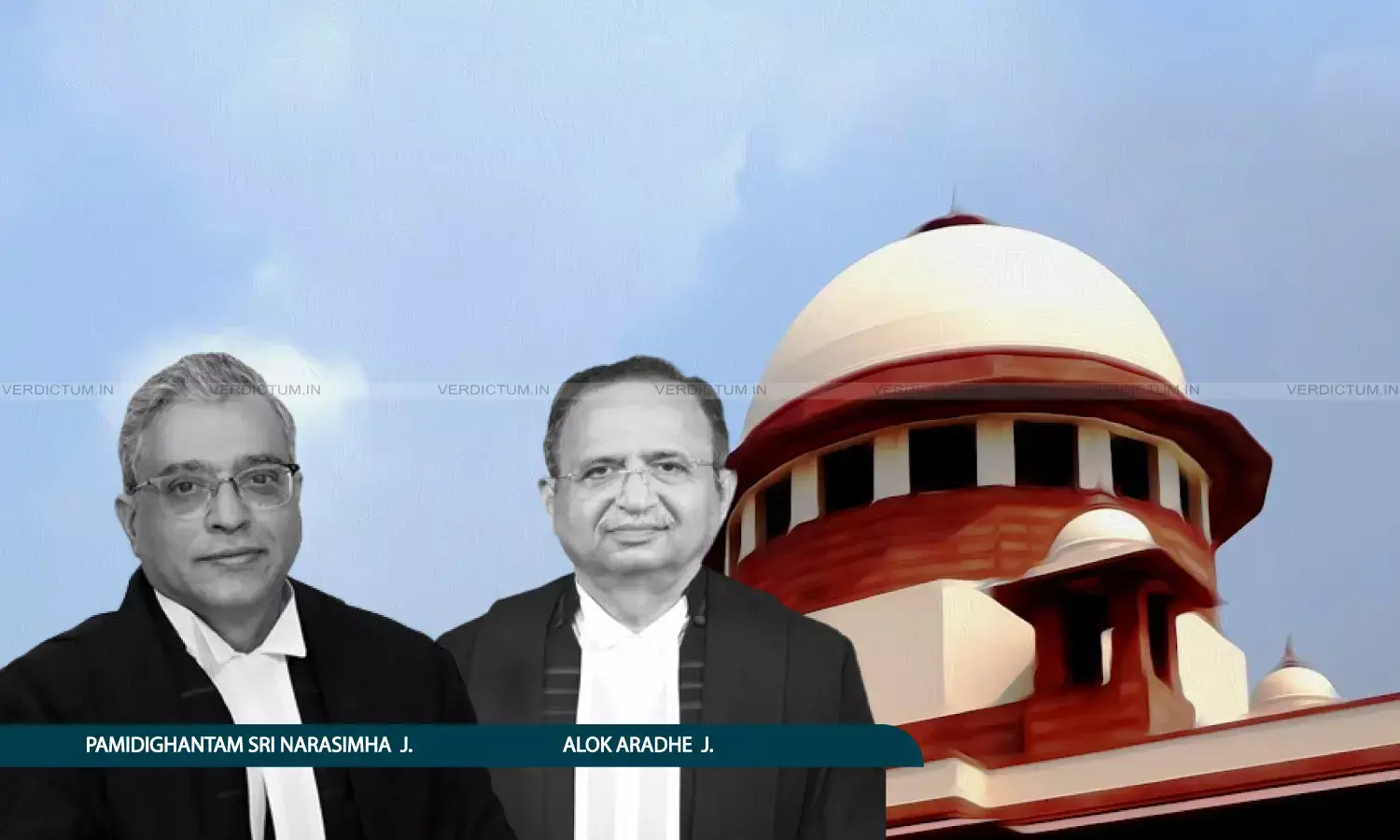
Justice Pamidighantam Sri Narasimha and Justice Alok Aradhe, Supreme Court
The Supreme Court has held that an Award-Debtor's liability to pay interest on a sum deposited to secure a stay of an arbitral award ceases only where the deposit is made in accordance with Order XXI Rule 1 of the CPC, that is, where it is unconditional and the Award-Holder is free to withdraw it. Where withdrawal is conditioned on furnishing security or otherwise resisted by the depositor, the deposit does not amount to payment, and interest continues to accrue on the outstanding sum until unconditional release actually occurs.
The Court further observed that the Arbitration and Conciliation Act, 1996 offers no clear statutory guidance on the interplay between conditional deposits and accrual of interest, and that such disputes arise with unsettling regularity. Noting a wide asymmetry across High Courts in the manner deposits are received, invested and released pending appeals, the Bench has requested the Law Commission of India to examine the issue, drawing on comparative practice from jurisdictions such as the United States and Canada, in consultation with the Reserve Bank of India and the Ministries of Finance and Law and Justice.
A Division Bench comprising Justice Pamidighantam Sri Narasimha and Justice Alok Aradhe observed, “…if payment is made by an AwardDebtor in accordance with Order XXI Rule 1 of the Code, the liability to pay interest on such deposit ceases. The appellant in the instant case did not make the deposit in consonance with Order XXI Rule 1 of the Code, and therefore, liability to pay interest did not cease…”.
“We request the Law Commission of India to examine the issues which we have highlighted and, in the process, also consider the laws which other countries have enacted. It may be necessary for the Law Commission to consult the Reserve Bank of India, Ministry of Finance and also the Nodal Ministry of Law and Justice”, the Bench said further.
Advocate Yashvardhan appeared for the appellant and Advocate Ashutosh Kumar appeared for the respondent.
The dispute arose from an arbitral award dated June 13, 2019 directing the appellant to pay approximately Rs. 1.78 crore, inclusive of interest, to the respondent. The appellant challenged the award under Section 34 of the 1996 Act and secured an interim stay conditional on depositing 50% of the principal. It deposited Rs. 73,20,003 in November 2019, and the balance of Rs. 1,53,17,792 only in April 2022, after the Section 34 petition was dismissed.
The Section 34 petition was dismissed on January 05, 2022, while an appeal under Section 37 failed and the Special Leave Petition against that order was dismissed by the Supreme Court. Throughout execution, the appellant resisted the respondent's applications for release, including opposing a conditional release against security of title deeds. Unconditional release was finally directed only on September 08, 2022, prompting the executing court, and subsequently the High Court, to hold the appellant liable for interest at 12% per annum for the entire period from the award until that date.
Placing reliance on the Constitution Bench decision in Gurpreet Singh v. Union of India (2006) 8 SCC 457 and subsequent precedents including DLF Limited & Anr. v. Koncar Generators & Motors Limited (2025) 1 SCC 343, the Court reaffirmed that Order XXI Rule 1 CPC applies to enforcement of awards under Section 36, and that interest ceases only where deposits are unconditional and freely withdrawable.
“A deposit is not synonymous with payment. A sum put beyond the debtor's own reach neither extinguishes his liability nor places it in the creditor's hands. Between the deposit of a sum in court and the final discharge of liability lies a spectrum of possibilities, attended by a corresponding degree of uncertainty. Resolving that uncertainty, in the specific context of enforcement of an arbitral award, is at the heart of this appeal. Disputes of this nature arise with unsettling regularity, yet the Arbitration and Conciliation Act, 1996 (the ‘1996 Act’), as it stands, provides no clear guidance on the interplay between conditional deposits and the accrual of interest. This lacuna cannot be ignored…”, the Bench had noted at the outset.
Finding that the appellant's deposits never met this threshold, the Court dismissed the appeal and affirmed the High Court's order, while directing the Registry to transmit the judgment to the Law Commission and concerned authorities for systemic reform.
Cause Title: National Seeds Corporation Ltd. v. National Agro Seed Corporation (India) (Neutral Citation: 2026 INSC 1017)
Appearances:
Appellant: Yashvardhan, Advocate.
Respondent: Ashutosh Kumar, Advocate.