

Use Of Word ‘Can’ In Arbitration Clause Does Not Constitute Mandatory Agreement; Leaves Option Of Recourse To Civil Courts: Supreme Court
The Court held that an arbitration clause indicating future possibility is not mandatory and requires fresh consent, not creating a binding obligation.

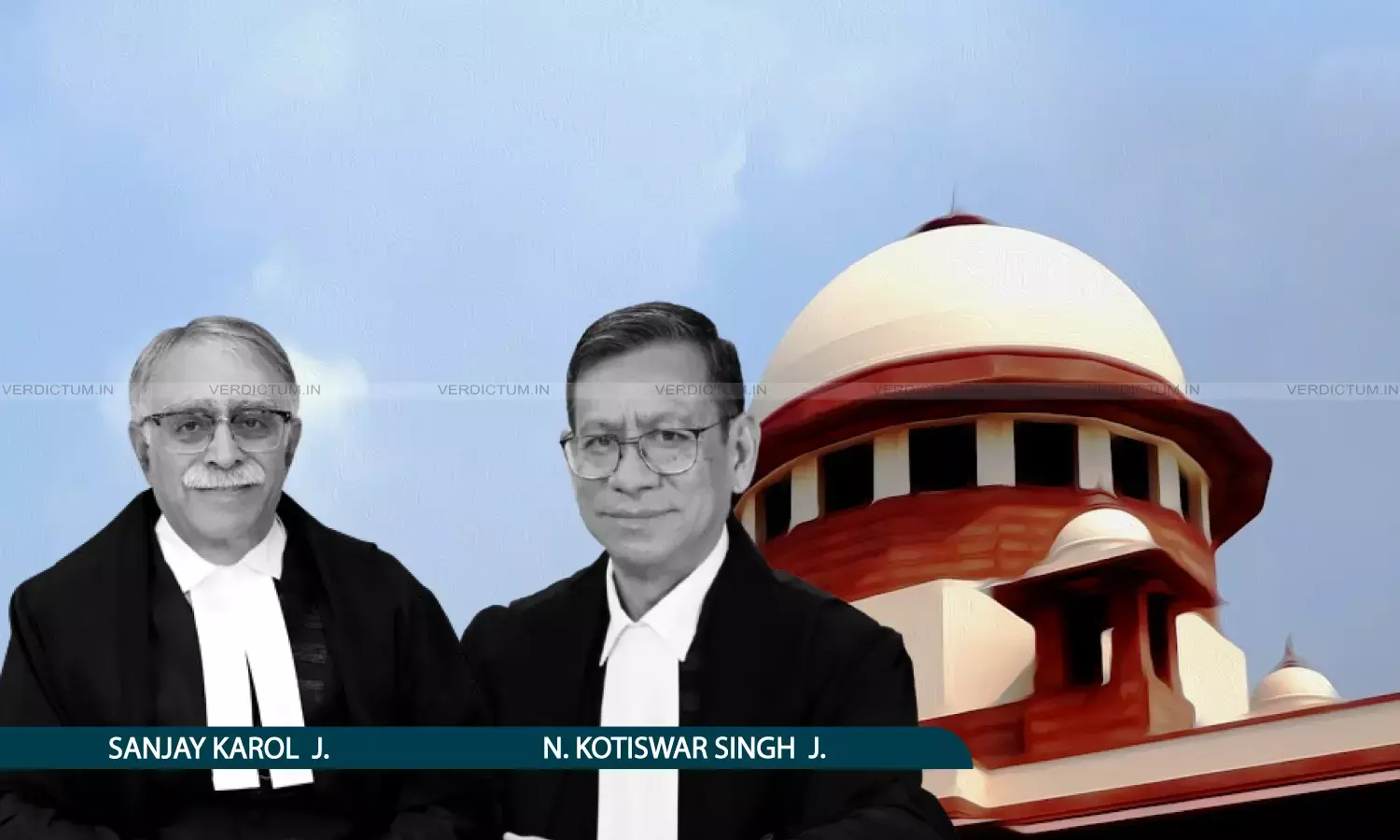
Justice Sanjay Karol, Justice N. Kotiswar Singh, Supreme Court
The Supreme Court has affirmed that for an arbitration agreement to be legally enforceable under the Arbitration and Conciliation Act, 1996, it must disclose a clear determination and obligation by the parties to refer their disputes to arbitration. The Court held that permissive language, specifically the use of the modal verb ‘can’, indicates only a factual possibility or a desire to explore arbitration as a future mode of settlement rather than a mandatory mandate.
Consequently, it held that such clauses do not qualify as valid arbitration agreements unless both parties provide fresh consensus at the time the dispute arises. It noted that for commercial entities to ensure that dispute resolution clauses utilise mandatory language, use of word ‘shall,’ is the most appropriate word which signals a mandate or obligation.
Justice Sanjay Karol and Justice Nongmeikapam Kotiswar Singh while dismissing a civil appeal arising from a dispute over freight and delivery liabilities, observed, “The clause subject matter of dispute in this appeal indicates merely the future possibility of referring disputes to arbitration and as such, it cannot be said to be a binding arbitration agreement. In other words, the possibility of arbitration being used to settle disputes is open however, for the disputes to be settled by arbitration, further agreement between the parties would be required and needless to add, such an agreement can only come into existence when both parties agree to the same…”.
Krishan Kumar, AOR appeared for the appellant and Rohan Ganpathy, AOR appeared for the respondent.
The appellant, Nagreeka Indcon Products Pvt. Ltd., a manufacturer of aluminium foil products, contracted with the respondent, Cargocare Logistics (India) Pvt. Ltd., for the transport of containers to the USA. A dispute arose regarding the delivery of a fifth container, where the appellant alleged financial loss after the respondent handed over goods to the buyer without the production of the original bill of lading or payment.
The relevant bills of lading contained Clause 25, which stated that any dispute "can be settled by arbitration in India". When the appellant invoked this clause, the respondent resisted, arguing the clause was optional and not a mandate.
Thereafter, the appellant moved the Bombay High Court under Section 11 of the Arbitration and Conciliation Act, 1996, seeking the appointment of a sole arbitrator. The High Court dismissed the application, holding that the clause did not make arbitration a compulsory choice and remained unenforceable without the affirmation of the opposing party.
The Court observed that while commercial disputes should ideally lean toward arbitration, the jurisdiction of an arbitral tribunal is derived solely from the mutual consent of the parties. Relying on the precedent in Jagdish Chander v. Ramesh Chander 2007 (5) SCC 719, the Court noted that clauses suggesting parties "can" or "may" refer disputes to arbitration require a further agreement to be reached once a dispute surfaces. Since the respondent refused to consent, Clause 25 remained a "tentative arrangement" lacking the "determination and obligation" required for a valid reference.
“…it may be observed that its use in judicial interpretative context is limited. Most often the words ‘may’ or ‘shall’ are used. Normally, the former denotes discretion but not compulsion to act, but then it is all contextual. Put differently, the authority is permitted to do something but is not required to. If it is the requirement that is to be denoted, ‘shall’ is the most appropriate word which signals a mandate or obligation”, the Bench noted.
“…it is also to be noted that principles of contractual interpretation are now well settled. The words chosen by the parties are the most reliable manifestation of the intent. The meaning of the words used in contract is not found in strict etymological propriety or popular usage of word(s) as in the subject, occasion or context in which they are used, within the contractual realm. The latin maxim ‘Ex praecedentibus et consequentibus optima fit interpretatio’ signifies this statement…The written word is, therefore, the foundation of legal obligation. To disregard or to impute an obligation or meaning which was not intended would compromise party autonomy”, the Bench observed.
Accordingly, the Court found the appeal bereft of merit and dismissed it, thereby upholding the High Court’s order.
Cause Title: Nagreeka Indcon Products Pvt. Ltd. v. Cargocare Logistics (India) Pvt. Ltd. (Neutral Citation: 2026 INSC 384)
Appearances:
Appellant: Krishan Kumar, AOR.
Respondent: Rohan Ganpathy, AOR.