Only Plaint Averments And Documents Annexed To Plaint Relevant While Deciding Order VII Rule 11 CPC Plea: Supreme Court
The Court held that where limitation is evident from the plaint itself, courts need not hesitate to reject the plaint merely because limitation may ordinarily involve mixed questions of fact and law.
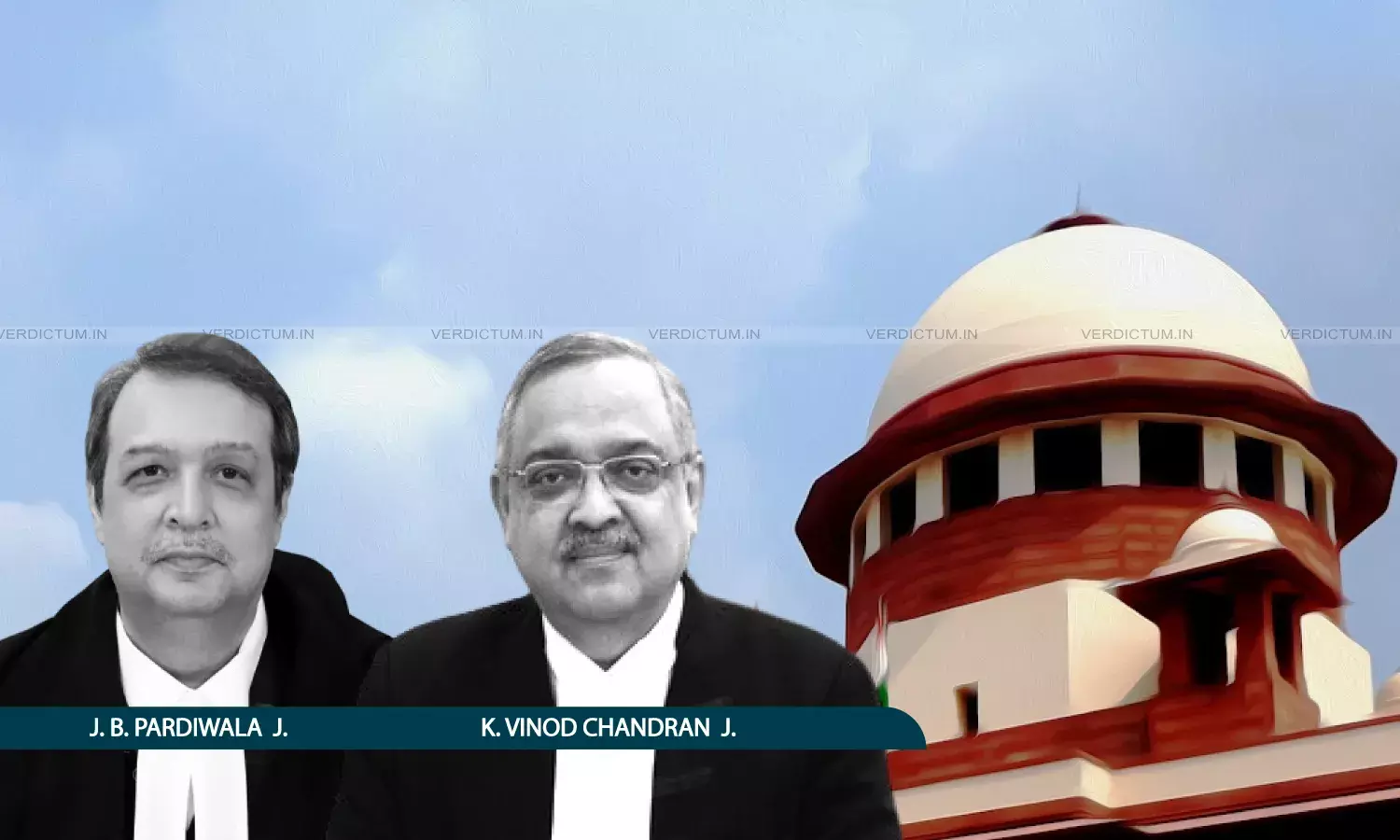
Justice J. B. Pardiwala, Justice K. Vinod Chandran, Supreme Court
The Supreme Court has reiterated that when an application for rejection of plaint is filed under Order VII Rule 11 of the Code of Civil Procedure, 1908, only the averments in the plaint and the documents annexed with it are relevant for consideration.
The Court was hearing a civil appeal against the Madras High Court’s order affirming the Trial Court’s rejection of the appellant-defendant’s application under Order VII Rule 11 CPC in a suit pending before the Additional District and Sessions Judge, Chengalpattu.
A Bench of Justice J.B. Pardiwala and Justice K. Vinod Chandran, while relying on Shri Mukund Bhavan Trust v. Shrimant Chhatrapati Udayan Raje Pratapsinh Maharaj Bhonsle (2024), reiterated that “when an application to reject the plaint is filed, the averments in the plaint and the documents annexed therewith alone are germane.”
Senior Advocate A.K. Ganguli appeared for the appellant; Senior Advocate M.S. Ganesh appeared for the respondents.
Background
The appellant was the defendant in a suit seeking division and allotment of 44% share in both the land and built-up area of the suit schedule property. The dispute arose from two joint venture agreements concerning construction of apartments on two vacant plots owned by the appellant.
The appellant sought rejection of the plaint under Order VII Rule 11 CPC on the ground of limitation. The Trial Court rejected the application, and the High Court confirmed the rejection. The respondent-plaintiff contended that limitation was a mixed question of fact and law which had to be tested at trial after evidence.
Before the Supreme Court, the appellant submitted that the joint venture had been cancelled by written communication dated 20.04.2016, followed by a lawyer’s notice and subsequent communications. The respondents resisted the plea, contending that the agreements conferred 44% share in the land and that the joint venture agreement could not be determined by unilateral cancellation.
Court’s Observations
The Court first applied the settled principle governing an application under Order VII Rule 11 CPC and held that the Court could not rely on facts outside the plaint and documents annexed to it.
The Court observed: “With the above principle in mind, we looked at the plaint. The various facts we noticed in paragraph 4, as would be evident from the records in the SLP are not germane to the consideration of the application under Order VII Rule 4, and the plaint alone has to be perused.”
On examining the plaint, the Court noted that two joint venture agreements had been entered into for construction of eight flats, and that 56% of the total super built-up area was to go to the owners while 44% of the undivided share in land and super built-up area was to go to the respondent.
The Court noted that while the respondents claimed possession over 44% of the built-up area, the actual relief sought in the suit was for division and allotment of 44% share in both land and built-up area.
The Court held: “Despite the claim of possession, the specific relief sought in the suit is division and allotment of 44% share in both the land and the built-up area as per the Joint Venture Agreements, which puts paid the contention regarding possession.”
The Court then examined the plaint paragraph setting out the cause of action. It found that the cause of action arose when the joint venture agreements were first cancelled.
The Court observed: “The cause of action, as seen from the above, according to us, arose on the first communication cancelling the Joint Venture Agreement dated 20.04.2016. The further communications between the appellant and the respondent only highlights the dispute, arising from the cancellation, and does not create a fresh cause of action in any event.”
The Court noted that even if the last relevant communication mentioned in the plaint was considered, the suit filed in October 2022 was grossly delayed.
The Court rejected the respondents’ contention that a public notice issued in 2022 created a fresh cause of action.
The Court held: “The contention of the respondent/plaintiff seems to be that on 08.06.2022, they issued a public notice cautioning third parties from purchasing the plaint schedule properties. This does not create a fresh cause of action, since the publication was in self-interest, which itself was grossly delayed.”
Having found the limitation bar apparent from the plaint itself, the Court held that the Trial Court and High Court orders rejecting the Order VII Rule 11 CPC application could not be sustained.
The Court observed: “We find absolutely no reason to sustain the order of the Trial Court and the High Court and we set aside the same.”
Conclusion
The Supreme Court allowed the appeal, set aside the orders of the Trial Court and the High Court, and rejected the plaint filed in O.S. No.632 of 2022 pending before the Additional District and Sessions Judge, Chengalpattu. Pending applications were disposed of.
Cause Title: N Asha Devi v. R Aravind Kumar & Anr. (Neutral Citation: 2026 INSC 908)
Appearances
Appellant: Senior Advocate A.K. Ganguli with Advocates P. Gopalan, T. Harish Kumar, AOR, Shubham Kothari, Aiyushi Daga, Atul Kundlia and Gowthamkumar V.
Respondents: Senior Advocate M.S. Ganesh with R. Ayyam Perumal, AOR, and Advocates Archana Sharma, B.P. Gupta, Rao Raj Bahadur Singh and A. Sai Kumar