Principle Of Finality Of Litigation Shouldn't Become An Engine Of Fraud: Supreme Court Reiterates
The Court also held that res judicata could not prevent scrutiny of a land acquisition where a detailed examination revealed previously unconsidered material indicating collusion, fraud and colourable exercise of power.
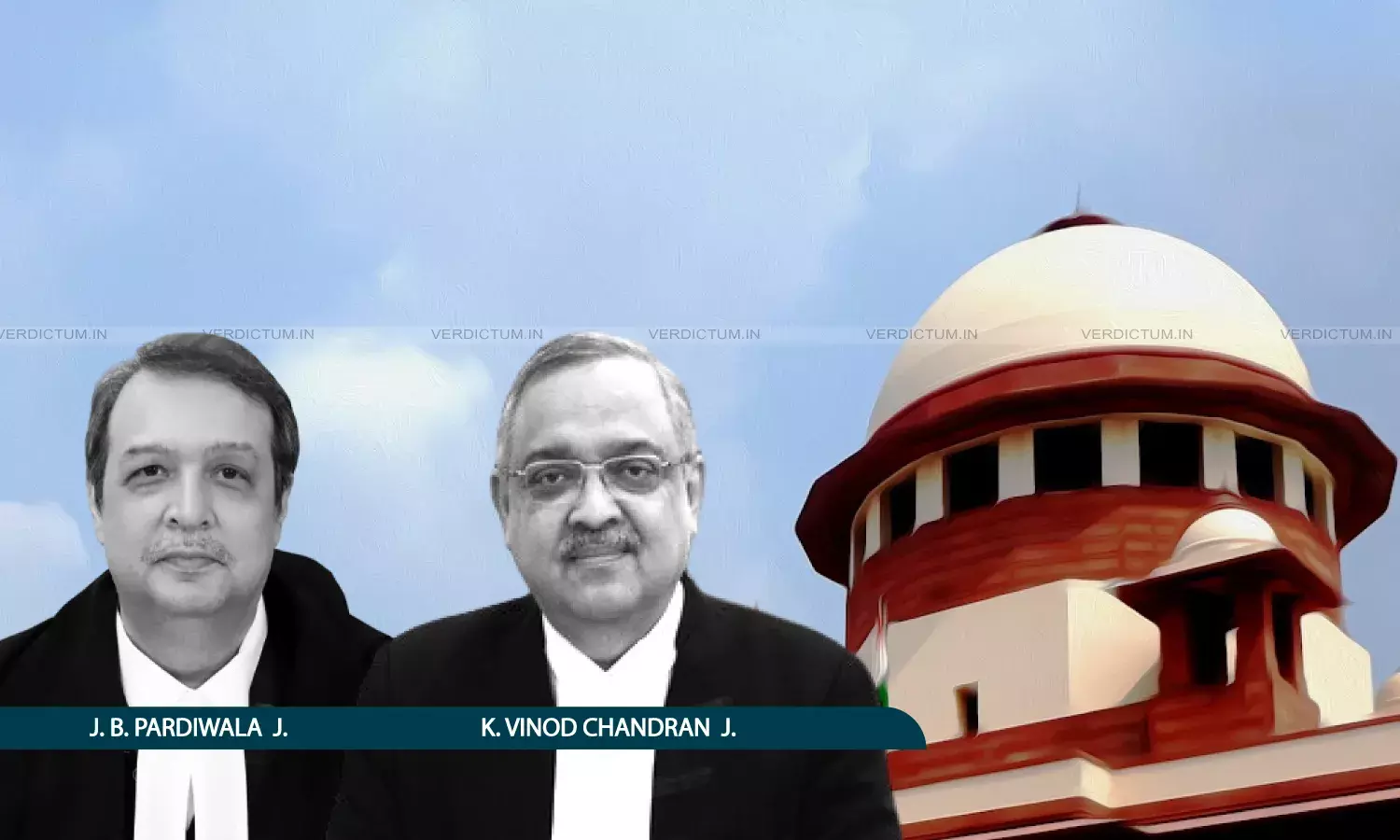
Justice J. B. Pardiwala, Justice K. Vinod Chandran, Supreme Court
The Supreme Court has reiterated that the principle of finality of litigation cannot be invoked to protect fraud by dishonest litigants. Applying the principle, the Court set aside a Karnataka High Court Division Bench judgment which had rejected landowners’ challenge to an acquisition on the grounds of res judicata and delay.
The Court was hearing appeals filed by landowners whose challenge to the acquisition of their lands for a cooperative society’s housing scheme had been rejected by the Division Bench. The Division Bench had relied upon Karnataka Gruha Nirmana Sahakara Sangha Limited v. Karithimmaiah (2001), which concerned the same acquisition.
Reiterating the principles laid down in S.P. Chengalvaraya Naidu v. Jagannath (1994), a Bench of Justice J.B. Pardiwala and Justice K. Vinod Chandran observed:
“It was categorically held that the principle of ‘finality of litigation’ cannot be pressed to the extent of such an absurdity, that it becomes an engine of fraud in the hands of dishonest litigants. Unequivocally, it was held that when the case of a person is based on falsehood, he has no right to approach the Court and can be summarily thrown out at any stage of the litigation. A litigant who approaches the Court, is bound to produce all documents executed by him which are relevant to the litigation. If he withholds a vital document in order to gain advantage, then he would be guilty of playing fraud on the Court as well as on the opposite party (sic paragraph 6). The proposition applies squarely not only to the party who initiates the litigation, but also to the party who defends it.”
Senior Advocates Kiran Suri and Basava Prabhu S. Patil appeared for the appellants. Senior Advocate Vikas Singh appeared for the cooperative society, while Senior Advocate Sanjay Hegde, assisted by Additional Advocate General Omar Hoda, appeared for the State.
Background
The acquisition arose from a cooperative society’s proposal for a housing scheme. On September 21, 1984, before cooperative-society housing schemes were brought within the definition of “public purpose”, the society entered into an agreement under which Bhagya Enterprises undertook to facilitate acquisition through the Government machinery and secure approval of the proposed layout.
In Karithimmaiah (2001), the High Court upheld the acquisition after treating a communication issued by an Under Secretary as sufficient government approval. The Supreme Court subsequently dismissed the special leave petition against that decision.
The present landowners relied upon the intermediary agreement, the G.V.K. Rao Committee report and government records to allege fraud, collusion and colourable exercise of acquisition powers. The Single Judge quashed the acquisition, but the Division Bench reversed that decision on the grounds of delay and res judicata. The society and the State relied upon the earlier adjudication, while the landowners argued that the material revealing fraud had not been considered in those proceedings.
Court’s Observations
Fraud Material Was Not Considered In Earlier Proceedings
The Court distinguished Meghmala v. G. Narasimha Reddy (2010) and A.C. Ananthaswamy v. Boraiah (2004), where the matters sought to be raised as fraud were either previously litigated or already within the concerned party’s knowledge.
The Bench observed that Karithimmaiah (2001) had proceeded on the government-approval communication without examining whether a formulated housing scheme with a proper layout had been approved. The intermediary agreement under which acquisition was to be facilitated for consideration had also not been before the Court earlier.
The Bench held: “Be that as it may, we cannot but observe that a more detailed examination has brought out facts, which clearly indicate collusion and colourable exercise of power, leading to a fraud played on the landowners, which according to us cannot be ignored, merely on the ground of res judicata.”
Referring to Kunhayammed v. State of Kerala (2000), the Court further held that the dismissal of the special leave petition against Karithimmaiah did not result in merger or transform the High Court’s ruling into a binding Supreme Court precedent under Article 141.
Finality Cannot Protect A Decision Procured By Fraud
The Court relied upon S.P. Chengalvaraya Naidu (1994) and A.V. Papayya Sastry v. Government of Andhra Pradesh (2007) to distinguish an erroneous decision from one obtained by misleading the court.
Reproducing the distinction accepted in A.V. Papayya Sastry (2007), the Bench stated: “Though a judgment would be res judicata and not impeachable from within, it might be impeachable from without. In other words, though it is not permissible to show that the court was ‘mistaken’, it might be shown that it was ‘misled’. There is an essential distinction between mistake and trickery. The clear implication of the distinction is that an action to set aside a judgment cannot be brought on the ground that it has been decided wrongly, namely, that on the merits, the decision was one which should not have been rendered, but it can be set aside, if the court was imposed upon or tricked into giving the judgment.”
Applying that distinction, the Court observed that the society and the Government had consciously suppressed material facts from the Court, resulting in the earlier decisions concerning the acquisition.
Records Revealed Fraud And Colourable Exercise Of Power
The Court observed that the intermediary agreement contemplated the use of government acquisition machinery even before cooperative-society housing schemes were statutorily recognised as a public purpose. It further noted that the G.V.K. Rao Committee had identified unavailable membership records, payments to agents and landlords, agreements with intermediaries and statements by society office-bearers that bribes had been paid to government officials.
Summarising its findings, the Bench held: “An agreement with a third party to facilitate acquisition of lands for developing a housing scheme, with an undertaking to facilitate steps under the LA Act of 1894, even before such housing schemes were brought under the nomenclature of public purpose, clearly exposes the fraud intended to be carried out.”
The Court added: “Though, the application was made by the 4th respondent Society after clause (f) was substituted in Section 3 of the LA Act, 1894, by the Act 68 of 1984 w.e.f. 24.09.1984, the cryptic consideration of the same and the absolute absence of a housing scheme with a proper layout plan placed for the approval of the Government, vitiates the acquisition and reveals the colourable exercise of power.”
Prior Approval Had To Cover The Actual Housing Scheme
Addressing the statutory approval requirement, the Court held that prior government approval for acquisition under Section 3(f)(vi) of the Land Acquisition Act, 1894 had to concern the actual housing scheme, including its layout and blueprint. Approval of the proposed extent or the society’s requisition was insufficient.
The Court also noted that Rule 18 of the Karnataka Government (Transaction of Business) Rules required approval to be formally expressed in the Governor’s name and found no formal order issued by the Minister-in-charge.
The Bench observed: “What is required is not just an approval of the extent and the mere expression of a laudable housing scheme, but housing sites demarcated for allotment to landless members with the detailed descriptive lay-out plan laid before the Government. We find no such scheme having been laid out before the Government.”
The Court separately held that a notification under Section 16(2), as introduced by the Karnataka amendment, created only a rebuttable presumption that possession had been taken. It relied upon the absence of possession mahazars and material showing that Section 47 had been invoked concerning at least part of the acquired land.
Conclusion
The Supreme Court allowed the appeals, set aside the Division Bench’s judgment and restored the Single Judge’s order quashing the acquisition. Due to the passage of time, it deleted the direction to initiate contempt proceedings against government officers and enhanced the costs to ₹50,000 for each petitioner or the combined legal representatives of an original petitioner.
The Court directed that possession be restored to the respective landowners, irrespective of whether they had challenged the acquisition. Landowners receiving possession were required to refund any government compensation received by them, without interest. Amounts received through private transactions were not made refundable.
The Court further directed that lands which could not be restored because an owner was unable or unwilling to refund government compensation must be auctioned under judicial supervision. The auction proceeds were directed to be used for victim compensation. The cooperative society was held to have no claim over the acquired lands, and all pending applications were rejected.
Cause Title: N. Arasappa v. State of Karnataka and Others (Neutral Citation: 2026 INSC 1151)
Appearances
Appellants: Senior Advocates Kiran Suri and Basava Prabhu S. Patil
Respondents: Senior Advocate Sanjay Hegde, assisted by Additional Advocate General Omar Hoda, for the State; Senior Advocate Vikas Singh for the cooperative society