

Can A Mutawalli Whose Term Has Expired Continue Waqf Proceedings By Claiming To Be Sajjadanashin? Supreme Court To Examine
The Court asked whether, without a Waqfnama, Waqf deed or custom pleaded before the Tribunal, the petitioner could represent the Dargah after accepting appointment as Mutawalli.

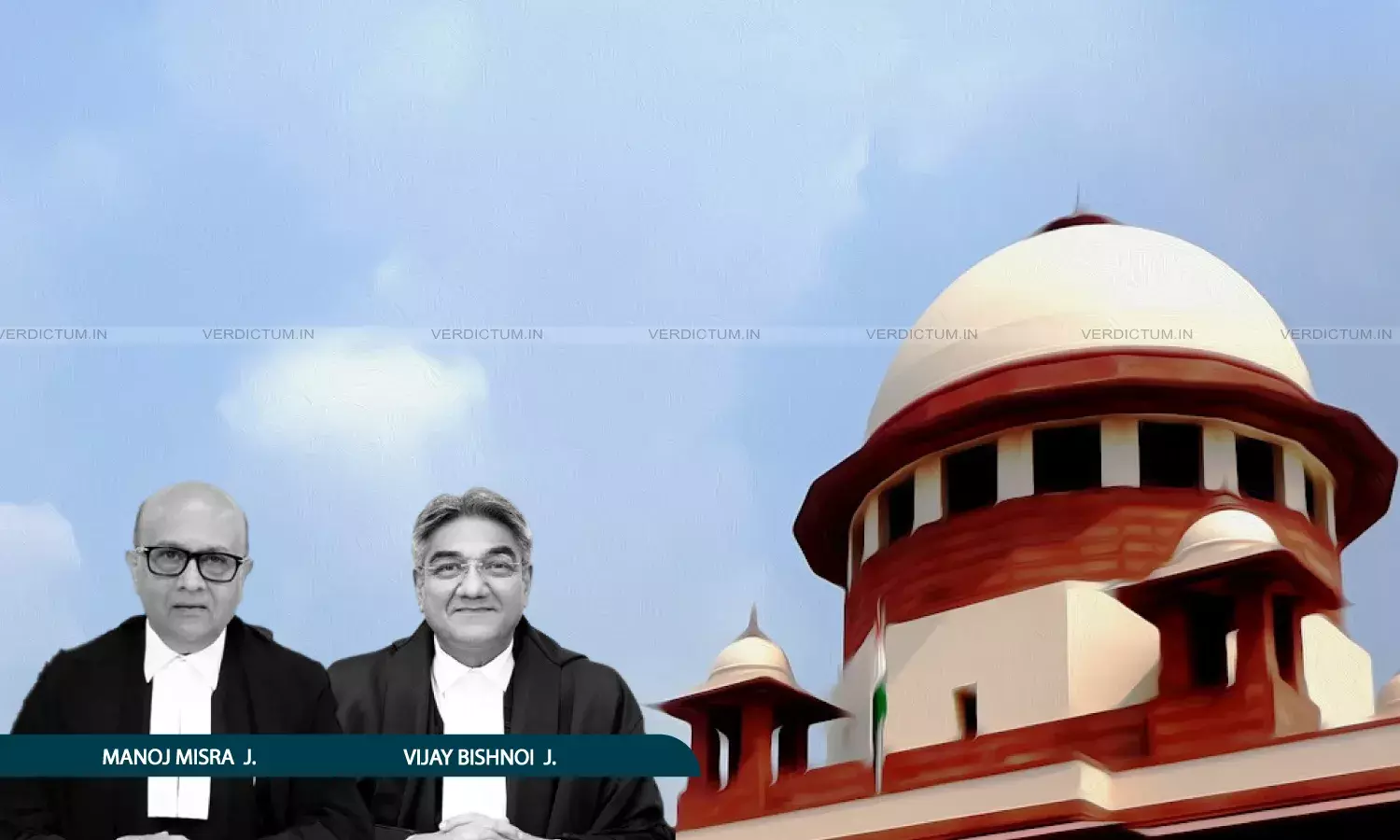
Justice Manoj Misra, Justice Vijay Bishnoi, Supreme Court
The Supreme Court will decide whether proceedings instituted in the name of a Waqf before the Waqf Tribunal can be continued by a Mutawalli whose term has expired, on the plea that he is also the Sajjadanashin of the Dargah concerned.
The special leave petition arose from a judgment of the Karnataka High Court.
The petitioner had instituted proceedings before the Waqf Tribunal claiming to be the Mutawalli of Dargah Hazrat Khalifat-UR Raheman Rehmat-Ulla-Alia as well as its Sajjadanashin. Admittedly, his term as Mutawalli, as appointed by the Board, has lapsed, and the other side raised a plea that he cannot pursue the proceedings.
The Bench of Justice Manoj Misra and Justice Vijay Bishnoi observed, “The proceedings are in the name of Waqf and not in the personal capacity of either the Sajjadanashin or the person interested in the Waqf. In such circumstances, the question which arises for our consideration is whether those proceedings can be continued by the Mutawalli whose term has expired.”
Senior Advocate Sudhanshu Choudhari appeared for the Petitioner, while Advocate-on-Record Pritha Srikumar Iyer appeared for the Respondents.
Brief Facts
The Dargah filed a suit before the Karnataka Waqf Tribunal, Kalaburagi Division. The suit sought a declaration that the suit properties were Waqf properties and that the institution was their absolute owner, with consequential reliefs of perpetual and mandatory injunction. It also sought a direction to the Karnataka State Board of Auqaf to publish the suit properties as Waqf properties. The plaint averred that Syed Shah Mustafa Quadri was not only the Mutawalli of the institution but also its Sajjada Nashin, claiming an inheritable right in the scheduled property.
While the suit was pending, defendant No.1 filed a memo stating that Syed Shah Mustafa Quadri had been appointed Mutawalli by the State Waqf Board for a period of one year, which had concluded by efflux of time. Defendant No.1 argued that he therefore could not be permitted to continue the proceedings, and sought dismissal of the suit.
The Tribunal allowed the memo and dismissed the suit, holding that Syed Shah Mustafa Quadri was no longer the Mutawalli of the institution. The institution appealed to the High Court.
Impugned High Court Judgment
Before the High Court, the appellant relied on Section 3(k) of the Waqf Act, 1995, under which the definition of a “person interested in a Waqf” includes the Sajjada Nashin, and on Section 83(2), under which any Mutawalli or person interested in the Waqf can maintain a suit to protect the institution’s interest. It also relied on a later order of the Waqf Board extending the term of Mutawallis whose terms were to expire.
The Court noted that the Board’s extension order was subject to the condition that, where an enquiry was in progress against a Managing Committee or Mutawalli, the Board would assume the functioning of the institution under Rule 54(5) of the Karnataka Waqf Rules.
The High Court held, “In that view of the matter, I am of the view that the said Syed Shah Mustafa Quadri is no more a Mutawalli and cannot be permitted to be continued to represent the plaintiff-Institution as Mutawalli.”
However, the High Court held that the Tribunal erred in dismissing the entire suit. It observed, “However, the suit is filed by the Institution, represented by its Sajjada Nashin and Mutawalli. In that view of the matter, the tribunal has committed an error in dismissing the entire suit, wherein, the suit filed by the Institution survives despite there being change of Mutawalli by the Wakf Board.”
Allowing the appeal in part, the High Court set aside the dismissal of the suit and directed that it continue in the name of the institution, represented by the Waqf Officer appointed by the Board to function as Mutawalli. It left the erstwhile Mutawalli free to implead himself as a defendant, if he so desired, to raise available contentions for protecting the institution’s interest.
Observations of the Supreme Court
Before the Supreme Court, the petitioner contended that since he had set up a plea that he is also the Sajjadanashin of the Waqf, and a Sajjadanashin has no specified term, he has a right to represent the Waqf and therefore to continue the proceedings.
The Court framed the relevant question as follows: “What is relevant to be considered is whether in absence of any Waqfnama or a Waqf deed, and in absence of any custom pleaded in the plaint/application preferred before the Tribunal by the petitioner of him being the Sajjadanashin of the Dargah concerned, having accepted his appointment as a Mutawalli, could he continue to represent the Waqf/Dargah on expiry of his term as the Mutawalli.”
Counsel for the petitioner sought time to study the matter and assist the Court on this aspect.
Accordingly, the matter is now listed on November 25, 2026.
Cause Title: Dargah Hazrat Khalifat-UR Raheman Rehmat-Ulla-Alia (Sunni Malkhed) v. Syeda Ahmedia Banu @ Ahmedunissa Begum & Ors. [SLP (C) No. 9056/2026]
Appearances:
Petitioner: Sr. Adv. Sudhanshu Choudhari, AOR K. Krishna Kumar, Adv. Preetam Shah, Adv. Aanchal Rathore
Respondents: AOR Pritha Srikumar Iyer, AOR M/s Ahmadi Law Offices, Adv. Armaan Rai, Adv. Shariq Ahmed, Adv. Sunil Kumar Verma, Adv. Tariq Ahmed, Adv. M Shaz Khan