

Civil Courts Can Decide Disputes Of Succession & Partition Involving Exclusively Non-Tribal Parties In Scheduled Areas: Supreme Court
The Supreme Court was considering a challenge made against the order passed by the Telangana High Court.

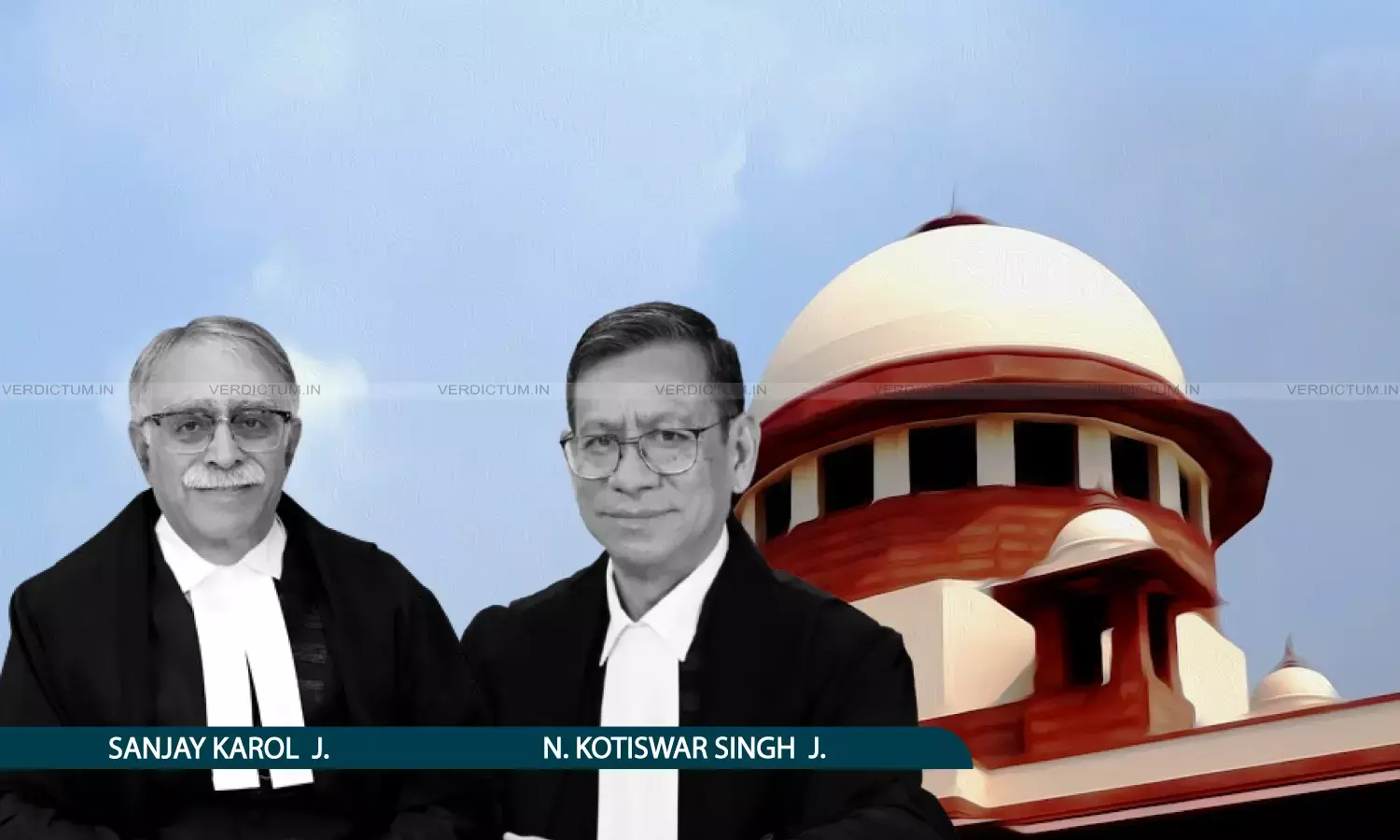
Justice Sanjay Karol, Justice N. Kotiswar Singh, Supreme Court
The Supreme Court has held that the jurisdiction of the Civil Courts can decide disputes on succession & partition involving exclusively non-tribal parties although the property is situated within scheduled areas.
The Apex Court was considering a challenge made against the order passed by the Telangana High Court by a Single Judge, setting aside the judgment in the First Appeal by the Principal Senior Civil Judge, Kothagudem, allowing the appeal suit and thereby overturning the judgment and decree which dismissed the plaintiffs' (appellants’) suit for partition and separate possession.
The Division Bench of Justice Sanjay Karol and Justice Nongmeikapam Kotiswar Singh held, “Considering these judgments and particularly the observations in VG Row supra it is clear to us that while the salutary object of protection of scheduled tribe people and their property is important and deserves to be given due importance, there is no basis for it there to be a blanket exclusion of Civil Courts in as much as, it pertains to civil disputes of succession between exclusively non-tribal parties although the property is situated within scheduled areas. We therefore hold that the Civil Court had the requisite jurisdiction to entertain the dispute. The High Court erroneously held the Civil Court not to have jurisdiction because of the exclusion of the application of the 1972 Act to the scheduled areas. In our view, the application thereof to the parties that are not in any way connected to its purpose would be incorrect use of law.”
“We clarify that the effect of the conclusion shall apply only to pending cases and those that arise in future. The jurisdiction of the Civil Courts shall stand restored in so far as civil transactions involving exclusively non-tribal parties are concerned”, it clarified.
AOR Amit Pai represented the Appellant while Amicus Curiae Vikas Bansal represented the Respondent.
Factual Background
The parties to the dispute are members of the family of a common ancestor, namely Mukkera Muthaiah, who died in 1979. Plaintiffs 1 to 5 are his grandsons (sons of Hanumanthaiah), plaintiff 6 is their mother, defendant 1 is the younger son, defendant 2 is the eldest daughter, defendant 4 is his youngest daughter of Mukkera, and third defendant is the eldest daughter’s husband. The Plaintiffs filed a civil suit after they learnt about the extent of land holdings of MM. The defendants resisted the same by filing written statements. Against the dismissal of the civil suit, the plaintiffs filed an appeal which was decreed in favour of the plaintiffs. Aggrieved thereby, the defendants filed a second appeal before the High Court. The sole point on which the finding of the First Appellate Court was overturned was the judgment of the Court in Nagarjuna Gramin Bank v. Medi Narayana (2004), which, as per the Court, had observed that from 1972 onwards, the jurisdiction of the Civil Courts was illegal and void.
Reasoning
Dealing with the aspect of reliance on judgment in Nagarjuna (Supra), the Bench noted that Nagarjuna (Supra) was a case of judicial deference to the executive/legislature, because the question involved is ordinarily within that domain, i.e., extending or taking away jurisdiction of a particular court. It was not a case of either adjudicating or returning a positive finding on a proposition of law.
Explaining the history pertaining to the protection of tribals and the tribal areas, the Bench stated that the protection of tribals and enablement for them to develop and thrive has been a clear and continuous concern specifically with respect to land.
“All of these aspects have been sought to be secured while keeping preservation of customs and tribal autonomy at the centre. It also seeks to integrate them into mainstream society, which was a pressing concern at the time of independence”, the Bench noted while also adding, “The necessary conclusion is that the notification of Scheduled Areas is specifically directed towards the people of the Scheduled Tribes living in that area. Merely because the word ‘area’ has been used, it cannot be said that any and everything that falls within that geographical area pertains to scheduled tribes.”
The Bench further stated that even if one party to the dispute would be a tribal residing in the Scheduled Areas, then the Agency Courts would retain the jurisdiction. “In that view of the matter, ‘Scheduled Areas’, although referring to a specific geographical area, cannot be taken to mean, in view of the object and intent of Schedule V to the Constitution, to be applicable to non-tribal parties”, it mentioned.
Holding that Nagarjuna (Supra) did not lay down any proposition of law, the Bench allowed the appeal, set aside the impugned judgment and restored the second appeal to the file of the High Court.
Cause Title: Mukkera Venkata Ratnam v. Vantasala China Venkateswarlu (Neutral Citation: 2026 INSC 810)
Appearance
Appellant: AOR Amit Pai, Advocates Pankhuri Bhardwaj, Tathagata Dutta, Bhavana Duhoon, Kushal Dube
Respondent: Amicus Curiae Vikas Bansal, AOR Devina Sehgal, Advocate Srikanth Varma Mudunuru