

Appellate Court Must Itself Hear Convict On Sentence After Reversing Acquittal, Cannot Relegate Matter To Trial Court: Supreme Court
The Bench noted that the appellant court carries a corresponding obligation to hear the accused on sentencing and pass sentence according to law.

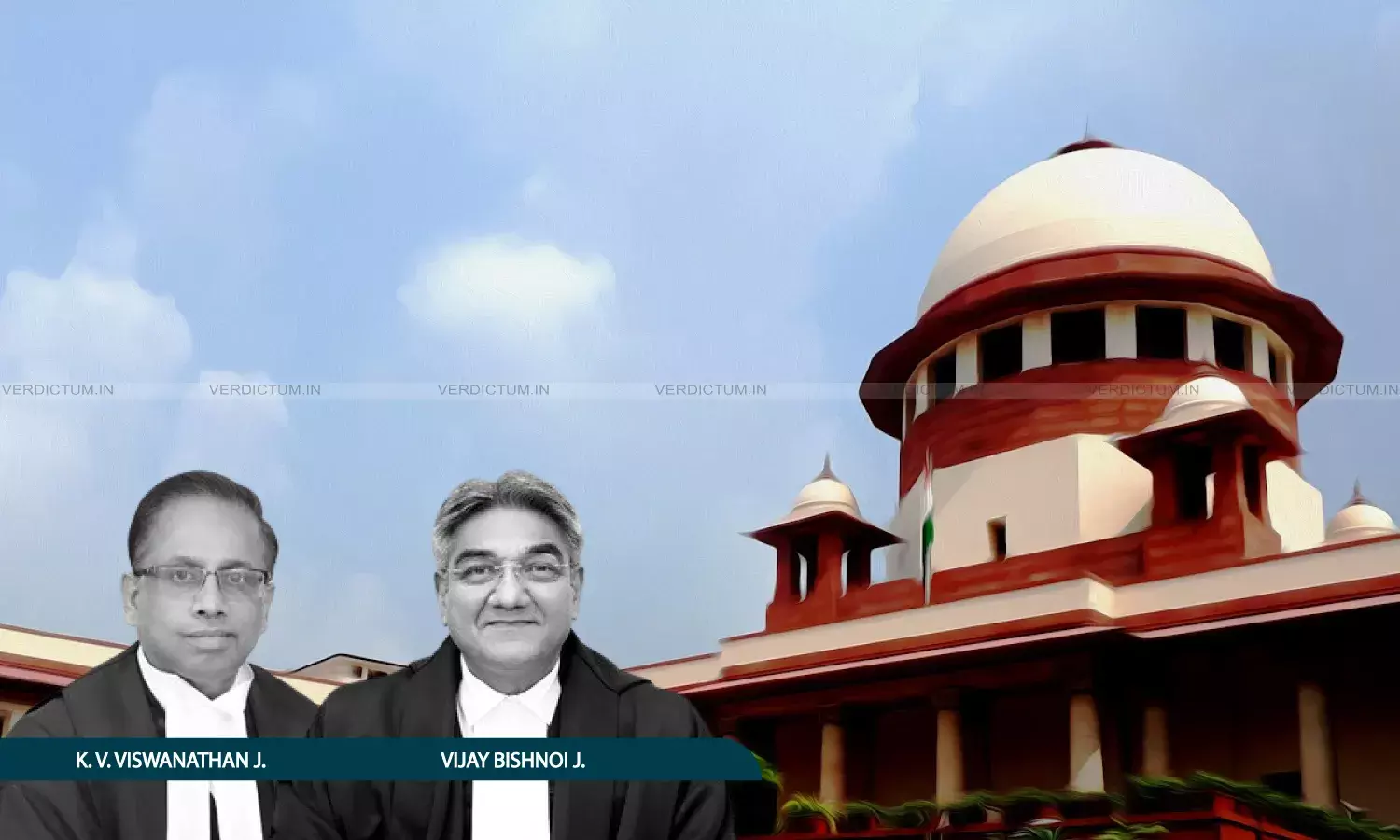
Justice K. V. Viswanathan, Justice Vijay Bishnoi, Supreme Court
The Supreme Court has held that an appellate court reversing an acquittal and convicting an accused for the first time must itself hear the convict on the question of sentence and cannot remit the matter to the trial court solely for sentencing. Holding that the High Court committed an error in directing the trial judge to impose sentence, it set aside that portion of the judgment and restored the criminal appeals to the High Court’s file.
The Court found that the procedure adopted by the High Court was legally unsustainable. Referring to Section 235(2) CrPC and Section 386(a) CrPC, the Bench held that where an appellate court records a conviction after reversing an acquittal, it carries a corresponding obligation to hear the accused on sentencing and pass sentence according to law.
A Bench of Justice K. V. Viswanathan and Justice Vijay Bishnoi passed the ruling while partly allowing appeals against a judgment of the Calcutta High Court. It observed, “…a court which convicts the accused for the first time has to hear the accused on sentence. If it is a trial court then Section 235(2), Cr.P.C., will apply. If it is the appellate court which is convicting the accused for the first time after reversing the acquittal, the appellate court has to hear the convict on sentence. The appellate court cannot relegate the matter to the court below only for the purpose of imposing a sentence after the appellate court had recorded a conviction. That will be contrary to Section 386(a), Cr.P.C., and the judgments of this Court”.
Senior Advocate Rauf Rahim appeared for the appellant and Kunal Chatterji, AOR appeared for the respondent.
The appellant had originally been acquitted by the Sessions Judge, Andaman and Nicobar Islands, of offences under Sections 376, 312 and 417 IPC.
In appeals filed by the State and the victim, the High Court reversed the acquittal, convicted him under Sections 376 and 312 IPC, and directed him to surrender before the trial court, which was asked to hear him on sentence and impose punishment.
“Not only should the appellate court not remand the matter to the trial court only for the purpose of imposing a sentence, after it finds accused guilty, it has a bounden duty to hear and impose an appropriate sentence. The appellate court which will include the High Court, in a given scenario, while recording a conviction after reversing the acquittal, should adjourn the matter to a suitable date, hear the convicts, and impose an appropriate sentence itself”, the Bench noted.
While referring to Suryamoorthi and Another v. Govindaswamy and Others (1989) 3 SCC 24, the Bench further observed, “In fact even this Court has, while convicting the accused for the first time, after recording the conviction, adjourned the matter to a particular date to hear the accused on the question of sentence…”.
Further referring to Kamalakar Nandram Bhavsar and Others v. State of Maharashtra (2004) 10 SCC 192, it said, “In fact, in yet another case, this Court after finding that the High Court while reversing the acquittal and convicting the accused did not hear the accused on the question of sentence, took upon itself to hear the accused on sentence while confirming the conviction…”.
The Court noted that the right of hearing on sentence is rooted in principles of natural justice, as sentencing requires the court to consider circumstances relevant to punishment before exercising discretion. While such hearing may be deferred to a later date, the Bench clarified that the appellate court cannot abdicate that judicial function in favour of the trial court after recording conviction.
Consequentially, it directed the High Court to fix a date, hear the convict on sentence, and thereafter pass an appropriate sentencing order in accordance with law. The Court clarified that once sentence is imposed, the appellant would remain at liberty to challenge both conviction and sentence in accordance with law.
Cause Title: Mukesh Kumar Yadav v. The State (UT Of Andaman & Nicobar Islands) Etc. (Neutral Citation: 2026 INSC 559)
Appearances:
Appellant: Rauf Rahim, Sr. Adv., Mohammed Tabraiz, Ali Asghar Rahim, Mohsin Rahim, Tania Tamanna, Shekhar Kumar, AOR, Advocates.
Respondent: Kunal Chatterji, AOR, Maitrayee Banerjee, Ajith Prasad, Rohit Bansal, Varij Nayan Mishra, Shreekant Neelappa Terdal, AOR, Advocates.