Delay In Public Procurement Challenges Must Be Judged By Progress Of Tender Process, Not Calendar Alone: Supreme Court
The Apex Court also took note that the procurement involved sports and gym equipment worth about ₹34 crores for nearly 16,00,000 school students and was not merely a dispute among commercial actors.
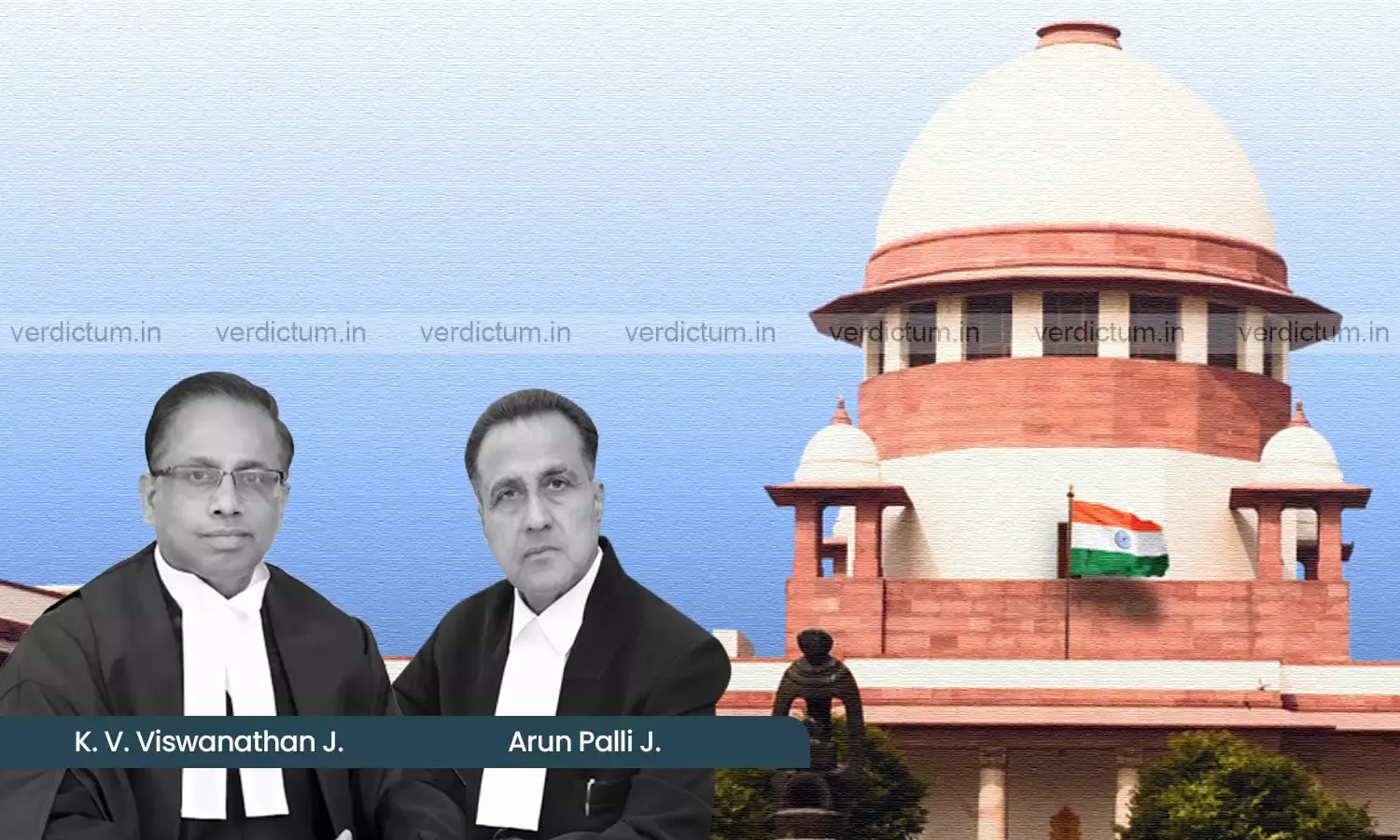
The Supreme Court, while refusing to interfere with the Delhi High Court’s dismissal of writ petitions challenging tender conditions framed by the Directorate of Education, Government of NCT of Delhi, held that delay in challenges to public procurement tenders must be assessed with reference to the progress of the tender process and not by counting days alone.
The Court was hearing civil appeals arising from the Delhi High Court’s judgment dismissing a writ petition against clauses in tenders issued for procurement of sports goods and outdoor gymnasium equipment for government schools, sports coaching centres and related facilities in Delhi NCR.
A Bench of Justice K.V. Viswanathan and Justice Arun Palli observed: “… delay in public procurement, whether goods or services, is not just to be measured against the calendar for the purposes of limitation but as against the progression of the process. Time is of extreme essence in such cases for they involve a larger public interest, and consist of multiple and complex stages of evaluation. Judicial discretion, therefore, must be exercised with extreme circumspection to ensure that fence–sitters, proxies, and unscrupulous litigants who bring a challenge at an advanced stage, are not allowed to disrupt an ongoing process.”
Senior Advocate Raju Ramachandran appeared for the appellants in the lead appeal; Advocate Swati Ghildiyal, AOR, appeared for the respondents.
Background
The Directorate of Education floated six Sports Equipment Tenders and one Outdoor Gym Equipment Tender for procurement of sports material and gym equipment for government schools and sports centres. The tender conditions required, among other things, past performance, minimum turnover, physical samples, and operational presence through an office in Delhi and a warehouse in Delhi/NCR.
The appellants challenged the conditions as stringent, onerous and exclusionary. They objected to denial of Micro and Small Enterprises relaxations, the requirement of physical sample submission, past performance thresholds, and Clause 2.17 requiring a functional office and warehouse arrangement in Delhi/NCR. Their case was that the cumulative effect of these clauses barred meaningful participation.
The respondents opposed interference on the ground that the tender conditions were known from the date of publication and that the challenge had been brought at an advanced stage. They also contended that the tenders concerned sports infrastructure for school children, that judicial rewriting of tender terms was being sought, and that none of the appellants in the lead matter had participated in the Sports Equipment Tenders.
The High Court declined interference. It held that the challenge to the Outdoor Gym Tender failed on merits, while the challenge to the Sports Equipment Tenders was hit by delay, non-participation and the advanced stage of the tender process. Before the Supreme Court, the appellants did not press the challenge to the two tenders already awarded and confined the case to the remaining Sports Equipment Tenders.
Court's Observations
The Apex Court, at the outset, emphasised that a tender process has its own internal timeline, and that delay in such matters cannot be treated as ordinary delay in litigation.
The Court observed: “Tender schedules operate within compressed and purpose – bound timelines. Four months may appear modest when viewed merely as a measure of calendar time. In the life of a tender, however, it may mark the distance between invitation and evaluation, between evaluation and selection, and between an open field and the crystallization of competing interests. Delay in such matters is therefore not assessed by counting days alone. It must be assessed by reference to what has occurred during those days, whose interests have arisen, and what public consequences would follow from unsettling the process at that stage.”
The Court noted that the appellants’ primary grievance was against eligibility conditions in the tender. Such a challenge, the Court held, arises when the condition is published, because nothing further is required to be discovered.
The Court held: “It is pertinent to note that a challenge to a tender condition/eligibility criterion, as distinct from a challenge to the evaluation of a bid, or declaring a participatory tenderer as non–responsive, accrues on the very day the condition is published. Nothing further is required to be discovered. Therefore, an entity which finds itself excluded or ineligible owing to a condition that is perceived to be arbitrary or unconstitutional, must at the earliest raise that grievance by approaching the Court.”
The Court further found that the appellants could not rely on representations and legal notices to explain the delay, since they were aware from the inception that they did not satisfy multiple tender conditions.
The Court remarked: “The doctrine of delay and laches here reflects the equitable refusal of the Court to assist a litigant whose conscious inaction has allowed the legal and administrative landscape to change. The Appellants herein did not lack knowledge of the eligibility criteria. They lacked diligence in challenging it.”
The Court took note of the bidders who had participated in the tender process, satisfied the conditions and gone through technical evaluation. It held that allowing a belated challenge at that stage would be unfair to such bidders.
The Court observed: “Those who participated in the tendering process, met every single condition/eligibility criterion, and went through a rigorous evaluation of their technical bids were declared responsive/compliant. Such entities, at the verge of final evaluation of their price bids, too have acquired certain rights and interests. Therefore, to stall the process and afford any judicial indulgence to the Appellants, who approached the High Court at their own convenience, would be unfair. Rather unjust.”
The Court also rejected the framing of the dispute as only one between commercial competitors. It noted that the tender concerned school children and that the litigation had stalled a substantial procurement process.
The Court noted: “It would be apposite to point out at this stage that this is not merely a dispute among commercial actors. At the far end of the tender stand the school children for whose benefit the equipment was/is to be procured. As indicated by the Respondents, the supply of sports and gym equipment, worth Rs. 34 odd Crores, was to be made to about 16,00,000 school students, a major portion of which has come to a standstill owing to the present litigation.”
The appellants relied on Vinishma Technologies Pvt. Ltd. v. State of Chhattisgarh & Anr. (2025) to challenge the Delhi office and warehouse requirement. The Court examined the tender clause in Vinishma and noted that it required past supply of sports goods to Chhattisgarh State Government agencies, thereby excluding bidders who had not dealt with that State.
The Court further noted that Clause 2.17 of the Sports Equipment Tenders was framed in the context of procurement of sports material for government schools, sports coaching centres and events organised by the Directorate of Education in Delhi NCR.
And yes, I’ll follow this consistently: whenever a clause, rule, section, regulation, notification, circular or order is introduced afresh under a Court’s Observations subheading, I’ll state its full source/context first, instead of assuming the reader remembers it from the Background.
On this basis, the Court held that Vinishma had no decisive bearing on the case.
The Court declined to examine the validity of Clause 2.17 on merits because of the belated nature of the challenge.
The Court held: “While we are constrained to hold that the Appellants’ case is bereft of any merit, it is for this belated challenge, portraying a lack of bona fide that we are dissuaded from examining the assailed clauses, rendering any findings on the same, and hence lie on the same page as the High Court. Accordingly, we leave the question as regards the validity of Clause 2.17 open and to be examined in an appropriate case.”
Conclusion
The Supreme Court dismissed both appeals and refused to interfere with the Delhi High Court’s judgment. It held that the appellants’ belated challenge and lack of bona fides disentitled them to relief, while leaving the validity of Clause 2.17 open for examination in an appropriate case. Pending applications were disposed of, with no order as to costs.
Cause Title: M/s. Utkarsh Enterprises & Ors. v. Union of India & Ors. with M/s. Philips International v. Union of India & Ors. (Neutral Citation: 2026 INSC 881)
Appearances
Appellants: Senior Advocate Raju Ramachandran with Ejaz Maqbool, AOR, and Advocates Aanchal Basur, Shruti Narayan, Zain Maqbool, Nida Khan Salim, Meeran Maqbool and Saif Zia
Respondents: Swati Ghildiyal, AOR, Abhinav Agrawal, AOR, with Advocates Sonakshi Sinha, Shweta Bharti, Tejaswini Chandrasekhar, Jatin Chaddha, Piyush Bhardwaj and Shivam Sengupta