

CBDT Circulars Bind Tax Authorities But Not Courts: Supreme Court
The Court also held that an office memorandum could not treat premiums from the sale of export quotas as the export incentives listed in Section 28 of the Income-tax Act, 1961, for the purpose of claiming a deduction under Section 80HHC.
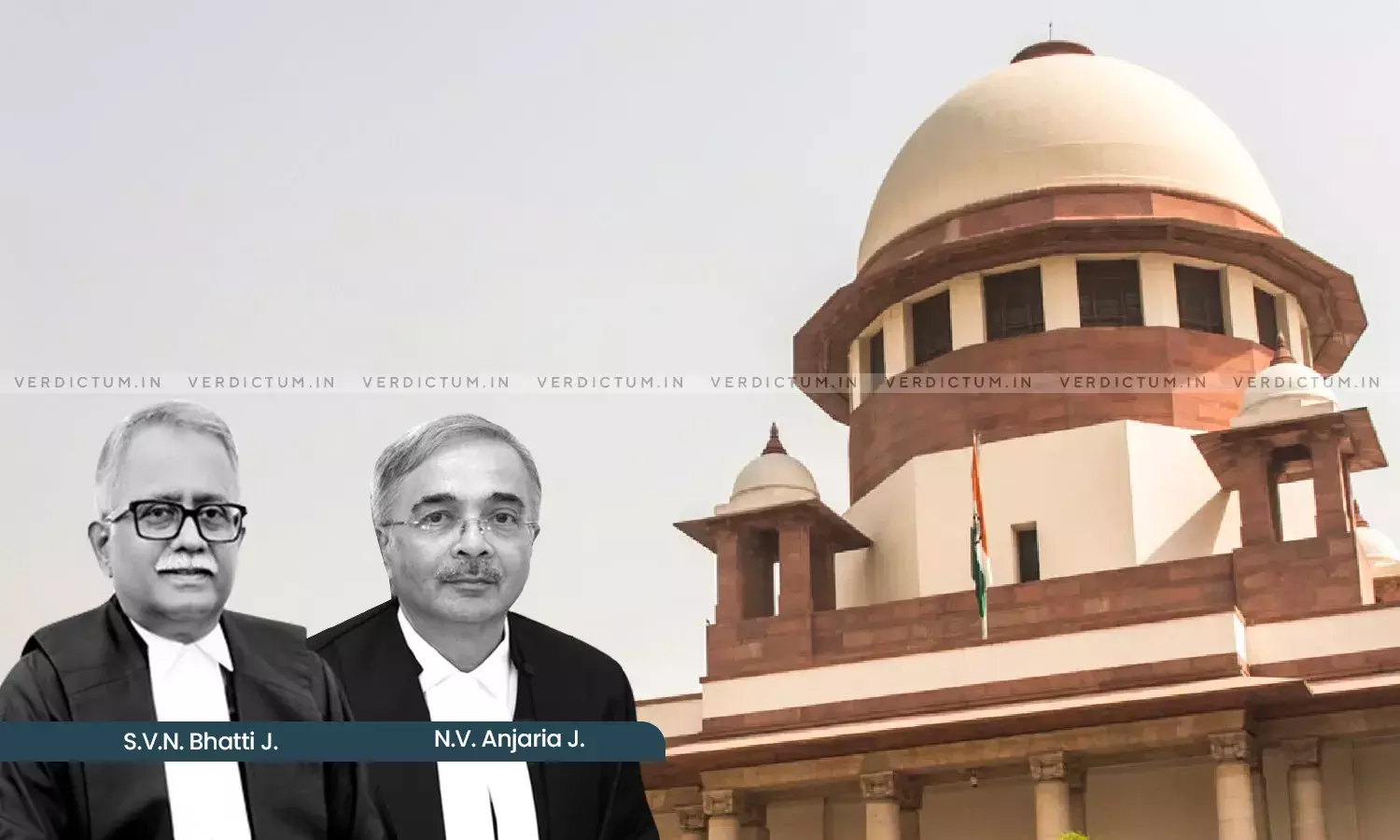
Justice S.V.N. Bhatti, Justice N.V. Anjaria, Supreme Court
The Supreme Court has held that a Central Board of Direct Taxes (CBDT) circular binds departmental officers but not the High Courts or the Supreme Court, and does not prevent the Revenue from challenging a Tribunal ruling based on a reading of the circular contrary to the statute.
Applying that principle to a claim for deduction on export-quota sale premiums, the Court upheld the Delhi High Court’s ruling against the assessee and dismissed its two appeals.
The Court was hearing the assessee’s appeals against a Delhi High Court judgment that had reversed the income-tax appellate authorities’ allowance of a deduction under Section 80HHC of the Income-tax Act, 1961, on premiums earned by selling export quotas.
A Bench of Justice S.V.N. Bhatti and Justice N.V. Anjaria, referring to CCE, Bolpur v. Ratan Melting & Wire Industries (2008), observed: “The CBDT O.M. is not binding on the Courts. The Assessee's argument, for the reasons given in Nagesh Knitwears P. Ltd. (supra), does not merit further consideration in the subject Appeals. A Constitution Bench of this Court in Ratan Melting & Wire Industries (supra) held that Circulars issued by the CBDT bind only the Administrative Departmental Authorities. They merely represent the Executive's understanding of a statutory provision and are never binding on the High Courts or the Supreme Court.
The Bench further added: “When the High Court or Supreme Court interprets a statutory provision, a conflicting Administrative Circular has no legal existence before the Court. If a circular were binding on courts, the judiciary would have to follow an Administrative Memo even when it directly violates a Parliament enactment. Further, if the Revenue were permanently barred by its own Circular from questioning a legal interpretation in Court, the Department could never appeal an erroneous Tribunal decision. Since an assessee benefiting from a circular would never appeal, the true statutory meaning could never be adjudicated by the High Courts or the Supreme Court.”
Advocate Santosh Krishnan appeared for the assessee, while Senior Counsel Arijit Prasad appeared for the Revenue.
Background
The assessee received export quotas under the Garment Export Entitlement Policy and sold surplus quota to third parties. It sought a deduction on the resulting premium under Section 80HHC of the Income-tax Act, 1961. The assessment also involved interest earned on deposits kept as margin money for bank credit facilities.
The Assessing Officer rejected the claims. The Commissioner of Income Tax (Appeals) allowed them, relying in part on a CBDT office memorandum that equated the export-quota premium with specified export incentives. The Income Tax Appellate Tribunal upheld that decision, but the Delhi High Court decided the questions in favour of the Revenue. Before the Supreme Court, the assessee’s arguments were confined to the export-quota premium claim.
The assessee contended that the memorandum bound the Department and placed the premium within the incentive categories in Section 28(iiia) to (iiic) of the Act. The Revenue argued that the memorandum could not determine eligibility contrary to the statutory provisions governing the deduction.
Court’s Observations
The Court applied the Constitution Bench ruling in CCE, Bolpur v. Ratan Melting & Wire Industries (2008): departmental circulars guide subordinate authorities but cannot bind courts interpreting a statute. It rejected the proposition that the Revenue was barred from appealing the Tribunal’s interpretation merely because the Department had issued the memorandum.
The Court explained why the Revenue could bring the question before a court: “Accepting the contention that the Revenue is precluded from challenging an interpretation contrary to its Circulars would extinguish the Revenue's valuable right of appeal. Because an assessee who benefits from a Circular will not appeal, precluding the Revenue from appealing would prevent the High Courts and the Supreme Court from ever adjudicating the question. Such an outcome would directly undermine the law declared by the Supreme Court and compromise its binding force under Article 141 of the Constitution of India.” It added that the memorandum bound Revenue officers, while the assessee could challenge it in court and the Revenue had succeeded before the High Court.
The Court noted the Delhi High Court’s finding that consideration for transferring export quotas did not fall within the categories in Section 28(iiia) to (iiie) of the Income-tax Act, 1961. Those provisions concerned, among other things, profits on the sale of import licences, government cash assistance and duty drawback. The High Court had instead classified the quota premium as a business benefit under Section 28(iv).
Addressing the memorandum’s attempt to equate those distinct receipts, the Court observed: “In essence, the CBDT O.M. creates a legal fiction by equating the export quota premium with the items mentioned in Section 28(iiia) to (iiic) of the Act, 1961. The application of a legal fiction contrary to the explicit statutory position is impermissible in law. Further, the scope for limiting legal fiction is well established in tax matters. Revenue from the sale of a quota generates horizontal revenue for the assessee but does not earn foreign exchange.”
On the High Court’s classification, the quota premium was subject to the reduction under Explanation (baa) to Section 80HHC, without the corresponding addition under the first proviso to Section 80HHC(3). The Supreme Court accepted the reasoning in CIT v. Nagesh Knitwears P. Ltd. (2012) that the premium could not be equated with the income categories specified in Section 28(iiia) to (iiie).
Applying that interpretation, the Court said: “Let us apply the same interpretative tool/standard to Sections 28(iiia) to 28(iiic) of the Act, 1961 and appreciate their meaning and scope. The result would be that the CBDT O.M. cannot come anywhere near the transactions covered by Sections 28(iiia) to 28(iiic) of the Act, 1961.”
Conclusion
Holding that the CBDT memorandum could not sustain the assessee’s deduction claim on export-quota sale premiums, the Supreme Court declined to interfere with the Delhi High Court’s judgment. Both appeals were dismissed, and any pending applications were disposed of. No separate argument was advanced before the Supreme Court on the margin-money interest issue.
Cause Title: M/s Samtex Fashions Ltd. v. Commissioner of Income Tax, New Delhi
Appearances
Appellant: Advocate Santosh Krishnan
Respondent: Senior Counsel Arijit Prasad
