

Subsequent Arrangements Made By Landlord To Secure Alternative Accommodation Can't Be Construed As Extinguishing Original Bonafide Requirement: Supreme Court
The Supreme Court was considering an appeal filed by the landlord of the subject premises assailing the judgment passed by the Bombay High Court setting aside the decree of eviction.

The Supreme Court held that the alternative arrangements made by the landlord, out of necessity during the prolonged course of litigation seeking eviction of tenant, cannot be construed as extinguishing the original bonafide requirement.
The Apex Court was considering an appeal filed by the landlord of the subject premises assailing the judgment passed by the Bombay High Court allowing a Civil Revision Application preferred by the respondent under Section 115 of the Code of Civil Procedure and setting aside the decree of eviction.
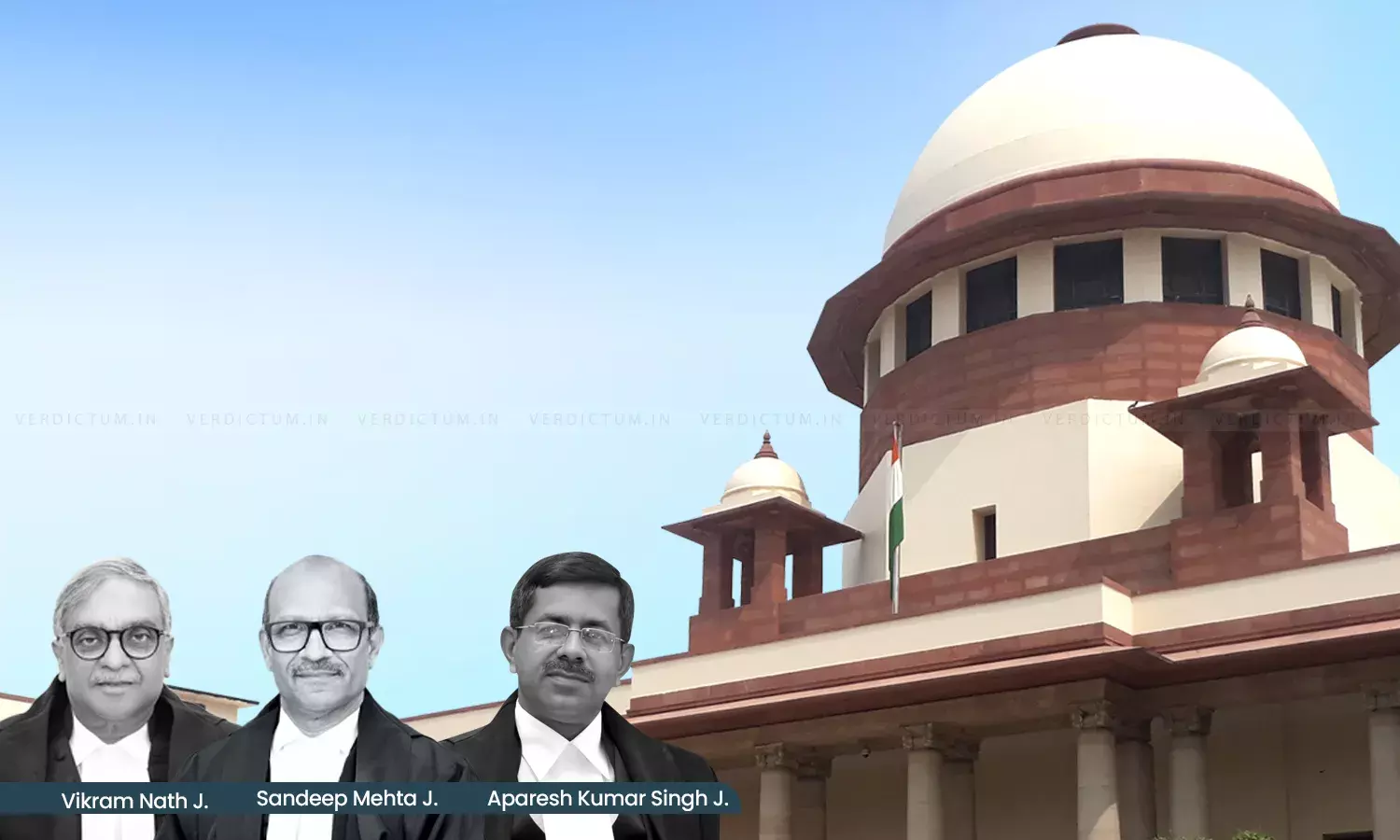
The 3-Judge Bench of Justice Vikram Nath, Justice Sandeep Mehta and Justice Aparesh Kumar Singh held, "Additionally, once the appellant-firm had specifically pleaded that the tenanted premises were required for the benefit of its partners and their respective families, the subsequent arrangements made by them to secure alternative accommodation could not, by themselves, be permitted to defeat the claim for eviction. The respondents tenants cannot rely upon such arrangements, brought about by the prolonged pendency of the proceedings, to contend that the original bona fide requirement no longer subsists."
“A question that naturally arises is therefore, when a landlord has succeeded before the courts below in eviction proceedings that have remained pending for over two decades, can the alternative arrangements made by the landlord, out of necessity during the prolonged course of litigation, be used to deny the very relief sought on the ground of bona fide requirement? In our considered view, the answer must be in the negative. Such arrangements, by themselves, cannot be construed as extinguishing the original requirement. Rather, they may well be indicative of the hardship occasioned by the prolonged denial of possession", it added.
Senior Advocate Vijay Kumar Arora represented the Appellant while AOR Vidhi Pankaj Thaker represented the Respondent.
Factual Background
The appellant is a partnership firm comprising two partners, namely, Premchand Kasturchand Jain and Mangilal Okchand Jain. While Premchand Jain, along with his family, occupied the second floor of the building, Mangilal Jain occupied the third floor. The first respondent is the legal heir of the original tenant, Yeshwant Vedak. In 1954, at the request of the original tenant, the rent receipts in respect of the subject premises were transferred in the name of his eldest son, Suryakant Yeshwant Vedak. Subsequently, in 1969, Vedak relinquished his tenancy rights in respect of the subject premises in favour of his brothers.
The appellant instituted a Suit before the Trial Court, seeking eviction of the respondent from the subject premises. The Trial Court decreed the suit and directed the respondent to hand over vacant and peaceful possession of the subject premises to the appellant. Aggrieved by the said judgment, the respondent preferred an Appeal before the Appellate Court, but the decree of eviction came to be affirmed. Aggrieved by the concurrent judgments of the Trial Court and the Appellate Court, the first respondent preferred a Civil Revision Application which came to be allowed. This led to the appellants approaching the Apex Court.
Reasoning
The Bench explained that the Rent Control Act, while affording protection to tenants against arbitrary eviction, does not intend to extinguish the legitimate proprietary interests of landlords. “The statutory protection afforded to a tenant must, therefore, be harmoniously construed with the landlord’s right to recover possession on the grounds expressly recognised by the legislature”, it added.
The Bench noted that the High Court concluded that the suit premises on the first floor were required for the residence of Mangilal, one of the partners of the appellant-firm, and his wife, on account of their ill-health. It accordingly held that, upon their demise during the pendency of the proceedings, the bona fide requirement stood extinguished. “In our considered view, this conclusion is unsustainable, both on facts and in law. The eviction proceedings were instituted by the appellant-firm in its capacity as landlord, and not by either of its partners in their individual capacity”, it added.
The Bench noted that the requirement pleaded was not confined to Mangilal and his wife, but also extended to the independent needs of the other partner, Premchand Shah, and his family.As regards Mangilal, who occupied the third floor, it was pleaded that he and his wife had been advised against climbing stairs and, therefore, required accommodation on the first floor.
“Additionally, once the appellant-firm had specifically pleaded that the tenanted premises were required for the benefit of its partners and their respective families, the subsequent arrangements made by them to secure alternative accommodation could not, by themselves, be permitted to defeat the claim for eviction. The respondentstenants cannot rely upon such arrangements, brought about by the prolonged pendency of the proceedings, to contend that the original bona fide requirement no longer subsists”, it stated.
The Bench was of the view that the subsequent demise of the second partner, Mangilal Jain, and his wife could not, by itself, extinguish the entire claim for eviction, particularly when the independent requirement of the other partner, Premchand Shah, and his family remained to be considered. “The dissolution of the appellant-firm or the acquisition of alternative accommodation during the pendency of prolonged litigation could not, by itself, defeat the eviction claim. The effect of such events must be examined in the light of the applicable statutory provisions and the circumstances in which they occurred”, it held.
Thus, allowing the appeal, the Bench considered the long-standing occupation of the subject premises by the respondent and granted them time until the expiry of one year to vacate and hand over peaceful possession of the premises to the appellant.
Cause Title: M/S. P.M. Shah and Co. v. Asmit Vijay Vedak & Ors. (Neutral Citation: 2026 INSC 1261)
Appearance
Appellant: Senior Advocate Vijay Kumar Arora, AOR Bharat Thakorlal Manubarwala
Respondent: AOR Vidhi Pankaj Thaker, AOR Anshula Vijay Kumar Grover