

Elevators As Common Carriers Owe Heightened Duty Of Care; Manufacturer, Operator And Premises Owner Jointly Liable To Safeguard Users: Supreme Court
The Apex Court upheld the NCDRC’s apportionment of liability on OTIS, MES and RAW for a fatal lift accident in which a senior officer was crushed during rescue from a malfunctioning elevator.
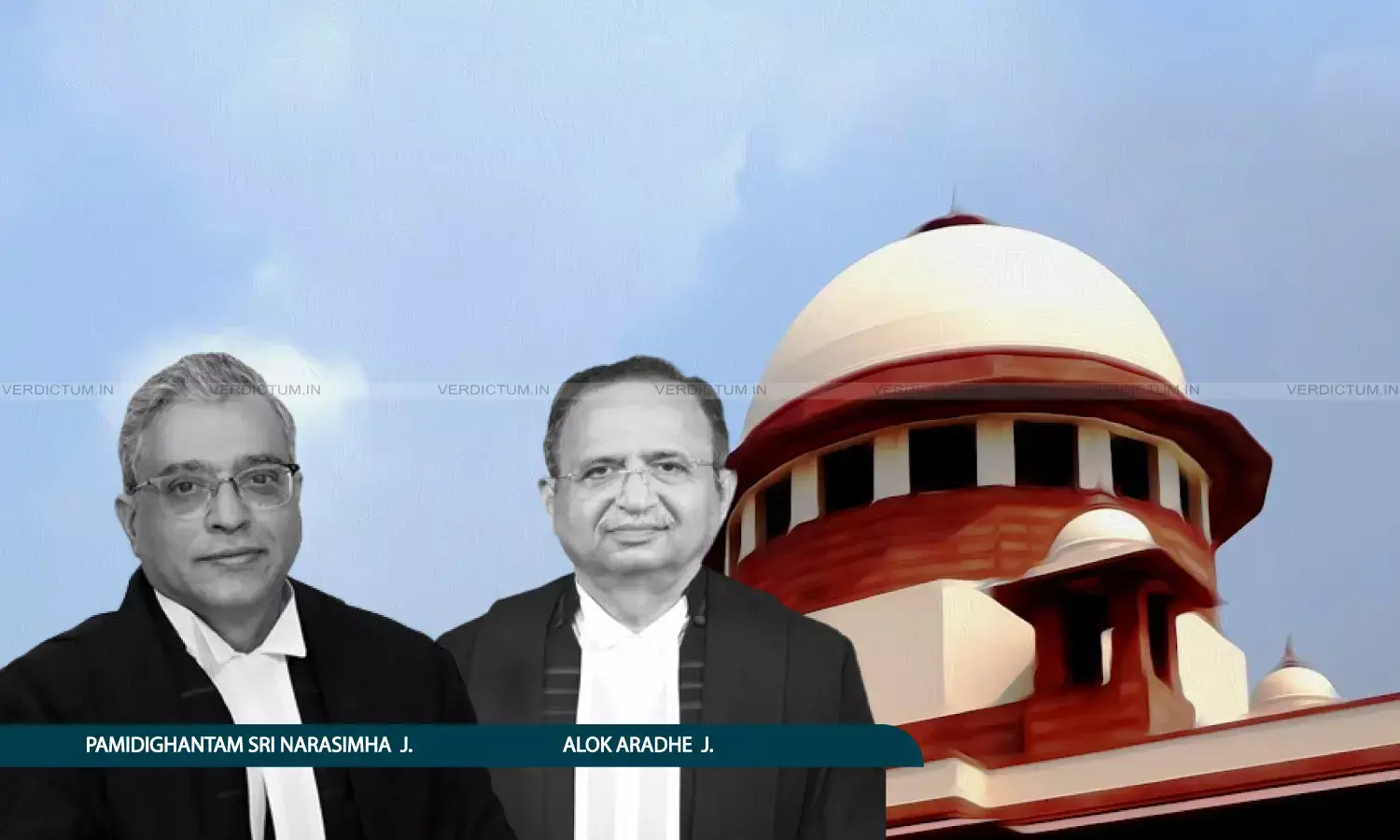
Justice Pamidighantam Sri Narasimha and Justice Alok Aradhe, Supreme Court
The Supreme Court has held that elevators must be treated as common carriers owing a heightened duty of care to passengers, and that the manufacturer, operator and owner of premises providing elevator services are joint duty bearers liable to safeguard users.
The Supreme Court also upheld the finding that OTIS Elevator Company was principally deficient in service, affirming 70% liability on OTIS, 25% on MES and 5% on RAW in a fatal lift accident at the RAW office complex.
The Court was hearing OTIS’ appeal against an NCDRC order holding OTIS, the Research and Analysis Wing and the Military Engineering Service jointly and severally liable to compensate the family of a senior officer who died after a malfunctioning lift suddenly moved downward during rescue.
A Bench of Justice Pamidighantam Sri Narasimha and Justice Alok Aradhe observed: “Given the ever-increasing usage of passenger elevators in the modern-day urbanising societies, recognising them as a mode of vertical transportation is imperative. In this transportation, passengers have no control over the conveyance and they have to entirely rely on automation or the operator as the case may be. It is not merely reasonable, but a legal necessity to impose a heightened duty to care, akin to that of common carriers in view of the intrinsic passenger vulnerability. An elevator must be construed and deemed to be a common carrier and the operator, in the wider sense must undertake greater responsibility to transport passengers from floor to floor and exit safely.”
The Bench further held: “The carrier, in the context of user of an elevator at public places will take within its sweep the manufacturer, the operator and owner of the premises provisioning its services for the users.”
Senior Advocate Gopal Sankaranarayanan appeared for OTIS, Advocate Saurabh Suman Sinha appeared for the private respondent, and Additional Solicitor General Aishwarya Bhati appeared for MES.
Background
OTIS had installed the lift in the RAW office complex at Lodhi Road, New Delhi. The lift was reserved for officers of the rank of Joint Secretary and above. MES had entered into a maintenance and repair contract with OTIS for its upkeep.
After a meeting of senior RAW officers, the lift carrying 13 occupants abruptly stopped between floors. During the rescue, when the deceased was half inside and half outside the cabin, the lift suddenly moved downward for about five to seven seconds, crushing his neck and causing his death.
The deceased’s widow and children approached the NCDRC seeking compensation from OTIS, RAW and MES. The NCDRC awarded compensation of ₹3,01,48,195 with interest, apportioning liability at 70% on OTIS, 25% on MES and 5% on RAW.
OTIS challenged the order, principally contending that the technical report attributed the accident to manual release of the brake key by MES personnel, and that OTIS had already warned MES about voltage fluctuation and recommended installation of a stabiliser.
Court’s Observations
The Court began by recognising the realities of elevator use in urban spaces, noting that passengers entering elevators place their safety entirely in a mechanical system over which they have no control.
The Court observed: “Elevators have become essential part of modern urban life. Strangers step into a small steel chamber, the doors close, and for a few moments they place their safety entirely in the hands of a mechanical system over which they have no control.”
The Court said that in public spaces, elevator safety is not merely expected but is a fundamental assurance that every elevator must provide.
The Court held that in the public-law context of providing effective restitutionary remedies, the manufacturer, operator and owner of premises must be treated as duty bearers.
The Court stated: “The burden of identifying the inter se liabilities of joint tortfeasors should not rest on the shoulders of the consumers seeking compensation for injury caused due to transportation through an elevator.”
It referred to the principle of composite negligence recognised in Khenyei v. New India Assurance Co. Ltd. (2015), under which a claimant can sue joint tortfeasors and recover damages.
OTIS relied on the technical report which attributed the downward movement of the lift to manual release of the brakes through the Brake Release Key. The Court, however, held that the report had to be viewed in the larger factual context of repeated unresolved malfunctioning.
The Court underscored: “For the purpose of determining deficiency of service and the consequential relief of compensation, it is necessary to take note of a number of incidents giving rise to the cause of action which is very different from cause of accident. That crucial distinction is lost in the submission advanced by OTIS.”
The Court noted that the malfunctioning was not isolated, but a continuing problem repeatedly brought to OTIS’ notice.
The Court found that OTIS, being both manufacturer and comprehensive maintenance contractor, had unique technical knowledge and control over the lift’s safety systems.
The Court observed: “That OTIS was simultaneously the manufacturer of the lift and its comprehensive maintenance contractor placed it in a position of unique knowledge and control over features such as the safety interlocks, the brake mechanism, and the electrical circuitry whose malfunction caused the fatal accident.”
It added that RAW and MES did not possess the technical means to independently assess or rectify such defects.
The Court noted that OTIS itself had recognised voltage fluctuation as a cause of frequent breakdowns and had recommended installation of a stabiliser for safe operation.
The Court stated: “Having itself identified the remedy, it was incumbent upon OTIS, as the party responsible under Clause 3.1 for the safe functioning of the lift, to have followed up on this recommendation, to have declined to certify the lift as fit for continued use pending installation of the stabiliser, or, at the very least, to have escalated the matter given that the breakdowns continued unabated through July and August of 2002.”
Instead, the lift continued to carry senior officers without the safeguards OTIS itself had identified as necessary.
The Court rejected OTIS’ argument that responsibility lay only with MES because the brakes were manually released.
The Court observed: “Second, and more fundamentally, the very occasion for anyone to manually operate the Brake Release Key arose because the lift, on account of a persistent and unrectified electrical malfunction, had stopped mid-operation. This vulnerability also directly flows from OTIS’s failure to rectify the defects of which it stood repeatedly informed, and for which it had itself proposed a remedy.”
The Court also noted that warning stickers inside the lift could not substitute the affirmative duty to train RAW and MES personnel in correct rescue procedure during stoppages.
The Court upheld the NCDRC’s finding that OTIS was principally deficient in service.
The Court held: “A party that undertakes the comprehensive maintenance of a machine, which is in the nature of a vehicle, owes a heightened duty of care towards its users. OTIS was not a stranger to the defect that culminated in the accident. It was cognizant of the problem, and it had itself proposed the remedy. Having done so, its failure to ensure that the remedy was implemented, or, alternatively, to render the lift safe by other means pending its installation constitutes deficiency of service.”
As to RAW and MES, the Court held that their liability was more limited. RAW had a residual duty of oversight, while MES failed to maintain attendance registers and its Machine Room was left accessible during rescue.
Conclusion
The Supreme Court dismissed OTIS’s appeal and found no infirmity in the NCDRC’s apportionment of liability at 70% on OTIS, 25% on MES and 5% on RAW.
Since OTIS’s appeal was dismissed, the Court also allowed the widow’s appeal against the NCDRC order refusing to proceed with execution, and directed the NCDRC to proceed with her execution petition in accordance with law.
Cause Title: M/s OTIS Elevator Co. (India) Ltd. v. Rashmi Handa & Others (Neutral Citation: 2026 INSC 756)
