

Controlling Authority's Power Under Gratuity Act Is Limited To Computation Of Amount Payable, Not Adjudication Of Liability: Supreme Court
The Bench held that the statutory function of the Controlling Authority is strictly confined to computing the payable amount for an "employee".

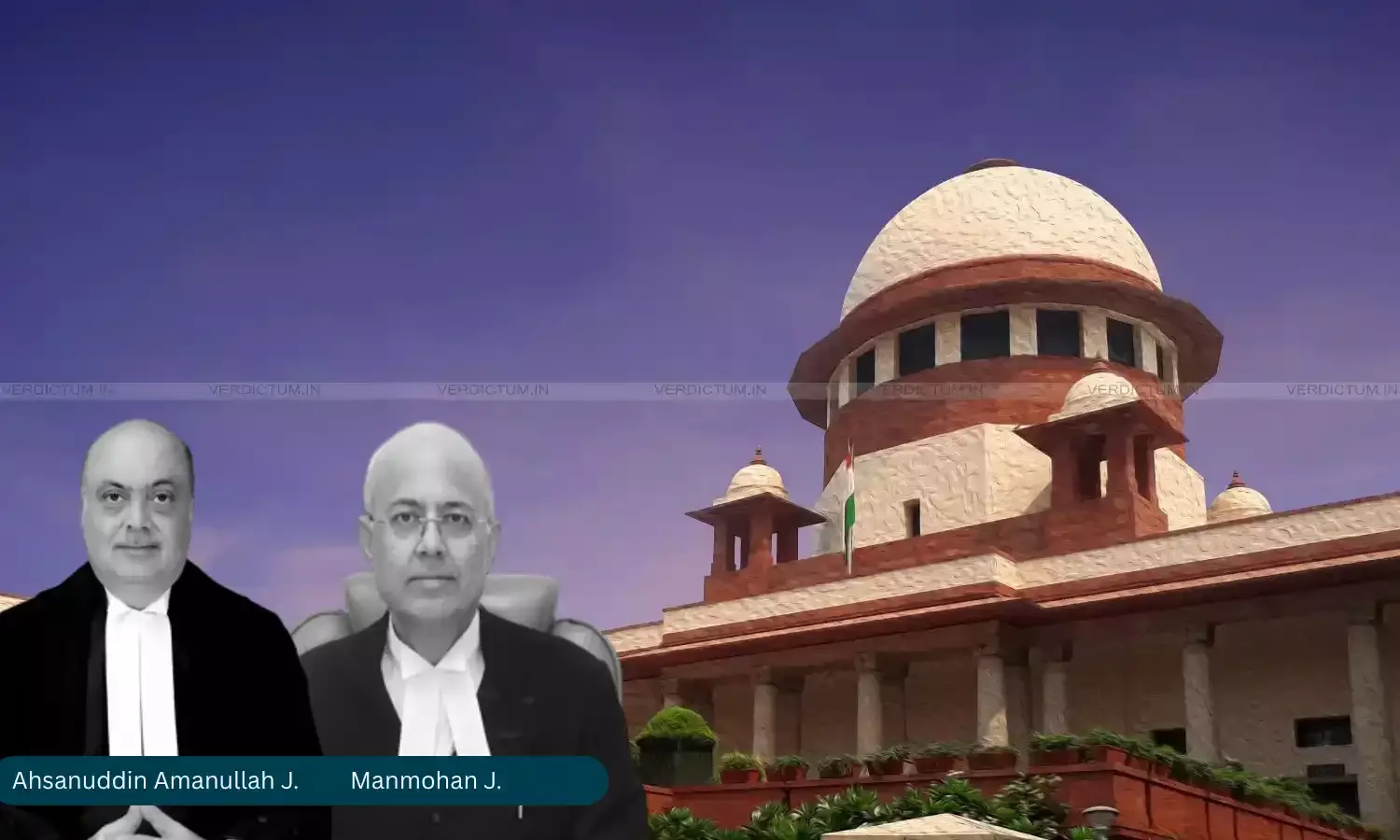
The Supreme Court has held that the Controlling Authority under the Payment of Gratuity Act, 1972, possesses no jurisdiction to determine or fasten liability upon a principal employer for the gratuity of workers engaged through an independent contractor.
Setting aside a Bombay High Court judgement, the Bench held that the statutory function of the Controlling Authority is strictly confined to computing the payable amount for an "employee", and it cannot go beyond its statutory remit to adjudicate complex liability disputes between a principal employer and contractual staff.
A Division Bench comprising Justice Ahsanuddin Amanullah and Justice Manmohan while agreeing with the submissions placed on behalf of ONGC, observed, “Having considered the matters in their entirety and in the facts and circumstances of the present cases, in our considered opinion, the order impugned cannot be sustained. We are in agreement with the submissions of the learned Solicitor General 7 that the very maintainability of the proceeding in view of the relief claimed before the Controlling Authority was not permissible. The adjudication by the Controlling Authority with regard to the liability was beyond its jurisdiction, as the only power conferred on the Controlling Authority under the statute was to compute the amount which may be payable to the concerned ‘employee’. The Appellate Authority, before whom the appellant succeeded, had rightly interfered in the matters and we find that the reversal of the order of the Appellate Authority by the High Court vide the impugned order was not justified”.
Tushar Mehta, Solicitor General appeared for the appellant while none appeared for the respondent.
The case arose from claims filed by contractual labourers who were engaged through independent contractors (such as M/s Noble Enterprises, M/s G.B. Mhatre, and M/s A.R. Naim & Sons) to work at premises owned by the state-run public sector undertaking, Oil and Natural Gas Corporation Ltd. (ONGC).
The workers approached the Controlling Authority under the Payment of Gratuity Act, claiming gratuity dues directly from ONGC as the principal employer. The Controlling Authority ruled in favour of the workers, holding ONGC liable.
While the Appellate Authority subsequently reversed this order and absolved ONGC of liability, the High Court of Bombay subsequently set aside the Appellate Authority's decision and restored the liability against ONGC. ONGC thereafter appealed the ruling to the Apex Court.
ONGC, raised three primary contentions:
- Absence of Employer-Employee Relationship: Under Section 4 of the Payment of Gratuity Act, gratuity is payable only to an "employee". The contract between ONGC and the contractor explicitly defined the engagement as an arm's-length job contract that created no employer-employee relationship with the contractor’s personnel.
- CLRA Act & Definition of "Wages": Under Section 21(4) of the Contract Labour (Regulation and Abolition) Act, 1970 (CLRA Act), a principal employer's secondary responsibility covers only "wages". Citing Clause (vi) of Section 2 of the Payment of Wages Act, 1936, the Solicitor General highlighted that gratuity payable on termination is explicitly excluded from the definition of "wages".
- Jurisdictional Limit: The Controlling Authority's mandate is restricted to calculating quantum, not deciding substrate questions of liability or extending coverage to non-employees.
Accepting the arguments of the Solicitor General, the Supreme Court held that the proceedings before the Controlling Authority were non-maintainable on the threshold point of jurisdiction. The tribunal exceeded its statutory authority by entering into the lis of determining whether ONGC was an employer.
Further that under both the CLRA Act and the Payment of Wages Act, a principal employer cannot be held automatically liable for gratuity obligations attributable to independent contractors.
The Court noted consistency with its recent precedent in Municipal Council, Nandyal Municipality v. K. Jayaram & Ors. (2025), which established that personnel sent through a contractor cannot claim an employer-employee relationship with the principal employer.
The Court, therefore, allowed the civil appeals, set aside the judgment of the Bombay High Court, and revived the order of the Appellate Authority. However, noting that ONGC had already disbursed the claimed gratuity amounts to the workers pursuant to the Apex Court's interim order dated December 15, 2023, the Bench clarified that no recovery shall be made from the workers.
Cause Title: M/S Oil And Natural Gas Corporation Ltd v. Suryakand D. Lad & Ors. (Neutral Citation: 2026 INSC 1019)