

Disallowing Amount Not Treated As Allowance By Assessee Is Impermissible Under Income Tax Act: Supreme Court
The Supreme Court was considering an appeal filed by an assessee who was aggrieved by the redetermination of the net taxable income.

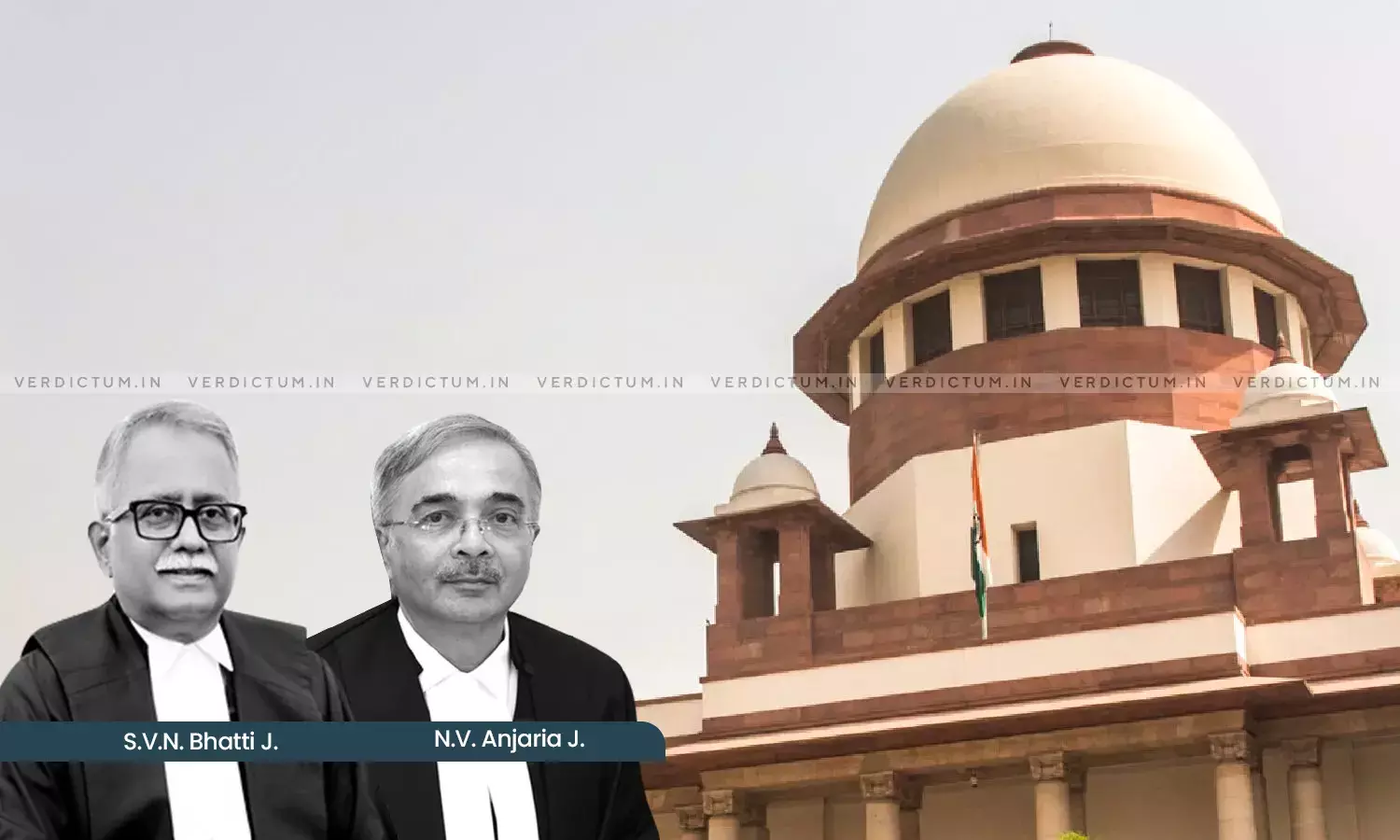
Justice S.V.N. Bhatti, Justice N.V. Anjaria, Supreme Court
While setting aside an order of the Assessing Officer, the Supreme Court has held that disallowing an amount not treated as an allowance by the Assessee is impermissible under the Income Tax Act, 1961.
The Apex Court was considering an appeal filed by an assessee who was aggrieved by the redetermination of the net taxable income.
The Division Bench of Justice S.V.N. Bhatti and Justice N. V. Anjaria held, “The AO's Order would have merited acceptance if it had stated reasons with reference to the accounts/Return filed by the Assessee, how the entry is factored in, and how the net taxable income is affected negatively. Disallowing an amount not treated as an allowance by the Assessee is impermissible under the Act, 1961. The negative impact on the taxable income stated by the Assessee should have been taken into account; i.e., by factoring in this entry, the income has come down, and therefore the tax has come down. The Revenue, having failed to show where and how the Assessee claimed the allowance in the books of account, ought not to disallow such amount. The AO's order is illegal and was rightly interfered with by the CIT (Appeals) and the Tribunal.”
Advocate Sanjeev Kumar Singh represented the Appellant while Additional Solicitor General S Dwarakanath represented the Respondent.
Factual Background
M/s. Lakshmi Sugar Mills Company Limited/Assessee, the Appellant, manufactures crystal sugar using the vacuum pan process and, as a by-product, produces molasses. The subject Appeal concerned the Return filed for the Assessment Year 2005-06 corresponding to the Financial Year 2004-05. In the Return, filed under Section 139(3) of the Income Tax Act, 1961, the Appellant declared a net loss of Rs 28,36,167. The Tax Auditor’s Report in Form 3CD, noted that the excise duty leviable on the closing stock of sugar and molasses is Rs. 2,80,56,430. The Assessee followed the standard mercantile accounting method. After accounting for Rs 2,10,64,447, the Auditor showed an unpaid balance of Rs 69,91,983 as payable towards excise duty. The Assessing Officer (AO) issued Notices under Sections 143(2) and 142(1) of the Act, 1961.
The AO rejected the Assessee's reply and passed an Order under Section 143(3), adding Rs 69,91,983 under Section 43B read with Section 145A on the ground that unpaid excise duty on closing stock must be added to the returned income. As per the Audit Report, the total excise duty leviable on closing stock was Rs. 2,80,56,430, of which Rs. 2,10,64,447 had been paid, leaving an outstanding balance of Rs 69,91,983. Since the Assessee failed to furnish proof of payment of the remaining Rs 69,91,983 before filing the Return, the AO disallowed the amount under Section 43B read with Section 145A and added it to the returned income. It rejected the Assessee's plea that Section 43B could apply only to amounts debited to the Profit & Loss Account.
Aggrieved by the Assessing Officer's redetermination of net taxable income, the Assessee filed an Appeal before the Commissioner of Income Tax (Appeals), New Delhi. During the pendency of the Appeal, the Assessee placed additional evidence under Rule 46A of the Income Tax Rules, 1962. The disallowance was held legally unsustainable, and the AO was directed to delete the addition of Rs 69,91,983. The Revenue preferred an Appeal before the ITAT, Delhi Bench (Tribunal), challenging the CIT (Appeals) Order. The CIT(Appeals)'s Order was confirmed, and the Revenue’s appeal was dismissed. The Revenue carried the matter in Appeal under Section 260A on the issue of whether the ITAT erred in deleting the addition of Rs.69,914,983 made by the Assessing Officer under Section 43B read with Section 145A of the Act on account of Excise Duty. Through the impugned Order, the Revenue's Appeal was allowed. Hence, the Appeal came to be filed at the instance of the Assessee.
Reasoning
The Bench held that the AO committed a serious error of fact by disallowing Rs 69,91,983 under Section 43B of the Act and adding it to the value of the closing stock and the Assessee's taxable income. The Bench noted that the Assessee was following the Standard Accounting System and the Assessee had not routed the disputed entry through the Profit and Loss Account, more so without actually paying the excise duty.
The Bench explained that Section 43B allows allowance of expenses only in the year in which the sum is paid. “...the actual payment on accrual method paid beyond 31st March but before the Tax Return date is accepted, then notwithstanding the payment beyond 31st March, is still allowable as expense of the Financial Year for which Return is filed. To wit, a statutory payment made on 01.08.2005 for the liability accrued prior to 31.03.2005 can still be claimed in the subject Financial Year. Conversely, if statutory dues are not paid before the ITR date, no amount can be claimed as an allowable expense”, it added.
Considering that the amount was neither paid nor, for accounting purposes, treated as payable, except for the remark in the Tax Audit Report, the Bench held that no other basis existed to disallow Rs.69,91,983.
The Bench held that the Revenue, having failed to show where and how the Assessee claimed the allowance in the books of account, ought not to disallow such amount. Holding that the AO's order was illegal and was rightly interfered with by the CIT (Appeals) and the Tribunal, the Bench set aside the impugned order and allowed the appeal.
Cause Title: M/S. Lakshmi Sugar Mills Co. Ltd. v. Commissioner of Income Tax, Delhi -II (Neutral Citation: 2026 INSC 1162)
Appearance
Appellant: Advocates Sanjeev Kumar Singh, Memoon Zehra, AOR Siddhartha Chowdhury
Respondent: Additional Solicitor General S Dwarakanath, AOR Sudarshan Lamba