

State’s Delay Denied Supplier Effective Opportunity To Retest Disputed Drug Sample: Supreme Court Quashes Blacklisting Of Medicine Supplier
The Court quashed blacklisting of drug firm for three years and debarment of product for two, as authorities skipped mandatory second-laboratory test under tender terms and batches expired before retesting.

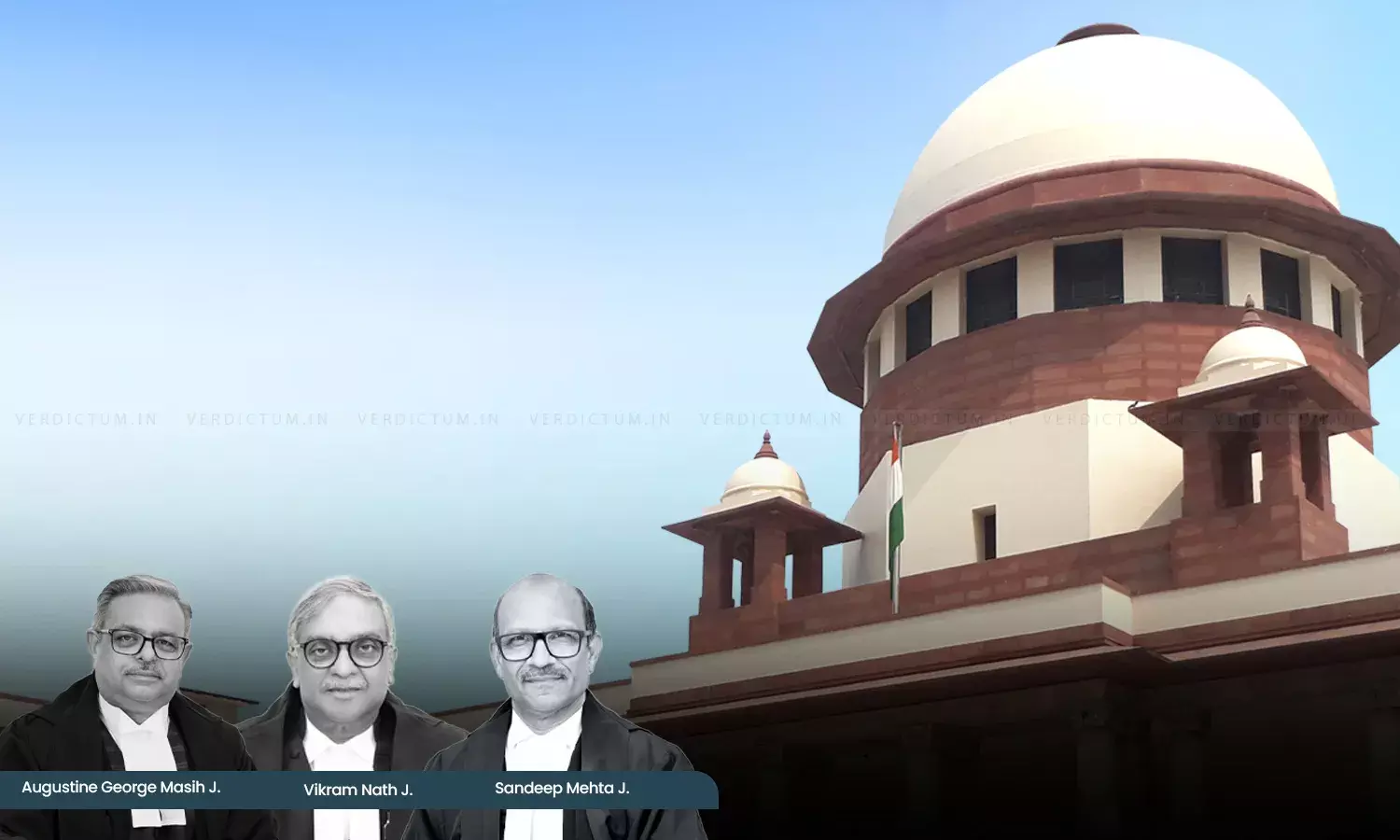
Justice Vikram Nath, Justice Augustine George Masih, Justice Sandeep Mehta, Supreme Court
The Supreme Court has held that where a supplier is deprived of an effective opportunity to have a disputed drug sample retested by another laboratory, because of delay attributable to the State or its instrumentalities, adverse action founded on the disputed analysis cannot be sustained. The Court applied this principle to administrative and contractual blacklisting, not only to prosecutions under drugs legislation.
Accordingly, the Court quashed the three-year blacklisting of a medicine supplier and the two-year debarment of one of its products by the Madhya Pradesh Public Health Services Corporation. The Corporation had acted on a single laboratory report declaring four batches Not of Standard Quality, without drawing the second sample that the tender document made mandatory. The Court also faulted the High Court for making the quashing contingent on a retesting that was never carried out and had become impossible once the batches expired.
A Bench of Justice Vikram Nath, Justice Augustine George Masih and Justice Sandeep Mehta observed, “…The underlying principle finds expression in the safeguards contemplated under Section 25(3) and (4) of the Drugs and Cosmetics Act, 1940. The Court held that where delay predominantly attributable to the State or its instrumentalities results in the loss of an effective opportunity to have a sample retested by a superior laboratory, the adverse action founded upon the disputed analysis cannot be sustained. The principle is relevant to the present controversy, having regard to the express procedure prescribed under Clause 6 of Annexure IX and the subsequent loss of an effective opportunity for re-testing…”.
Senior Advocate Siddharth Bhatnagar appeared for the appellant and Senior Advocate S.K. Gangele appeared for the respondent.
The appellant, M/s JPEE Drugs, supplies medicines to Government hospitals. Under a tender floated for district hospitals in Madhya Pradesh, it supplied Ascorbic Acid tablets and Ethambutol Hydrochloride tablets. In September 2024, the Corporation issued a show-cause notice after test reports declared three batches of the former and one batch of the latter Not of Standard Quality. The firm said the drugs had failed because of improper storage and handling after supply. Under the tender terms, one failed batch meant debarment of the product for at least two years, and three failed batches meant blacklisting of the firm for at least three years.
The Corporation’s Managing Director passed orders within a week of the notice, recording that no reply had been received, although the firm said it had replied within the time allowed. The orders debarred Ethambutol for two years, blacklisted the firm for three years and directed recovery of batch values. A further order rejected the firm’s representation. The firm’s writ petition before the Madhya Pradesh High Court was disposed of in October 2025. The High Court found the action flawed for non-compliance with Clause 6 of Annexure IX of the tender document, but directed fresh samples to be tested at the Central Government Laboratory and left the blacklisting to depend on the result. Review petitions by both sides were dismissed in February 2026. The firm then approached the Supreme Court, which stayed the blacklisting in May 2026.
The Court noted that Clause 6 required a second sample from the same batch to be sent to another laboratory, with blacklisting to follow only on confirmation. This was admittedly not done, and the State’s counsel could not dispute it. It held the High Court was not justified in deferring the quashing once it had found the procedure breached. The retesting ordered within fifteen days had not happened even after more than six months, and all four batches had since expired. The direction for retesting, the Court said, had lost its purpose and stood frustrated by efflux of time.
The Court citing, Medipol Pharmaceutical India Pvt. Ltd. v. PGIMER (2021) 11 SCC 339, reiterated that a person penalised on a Government Analyst’s report holds a valuable right, reflected in Section 25(3) and (4) of the Drugs and Cosmetics Act, 1940, to have the sample tested by a superior laboratory. It held the principle fully applicable, though the case arose from administrative and contractual action. The firm had been denied an effective opportunity to controvert the reports, and the later expiry of the batches made that opportunity nugatory. The Court concluded that the procedural infirmity, together with the irretrievable loss of retesting, rendered the blacklisting and debarment unsustainable.
Cause Title: M/s JPEE Drugs v. State of Madhya Pradesh and Others (Neutral Citation: 2026 INSC 1143)
Appearances:
Appellant: Siddharth Bhatnagar, Senior Counsel.
Respondent: S.K. Gangele, Senior Counsel.