

Provisional Assessment Order Under Electricity Act Unsustainable If Inspection Report Lacks Finding And Evidence Of Theft: Supreme Court
The Bench noted that a writ petition against a provisional assessment order under Section 135 is maintainable as statutory appeal under Section 127 lies only against a final order.

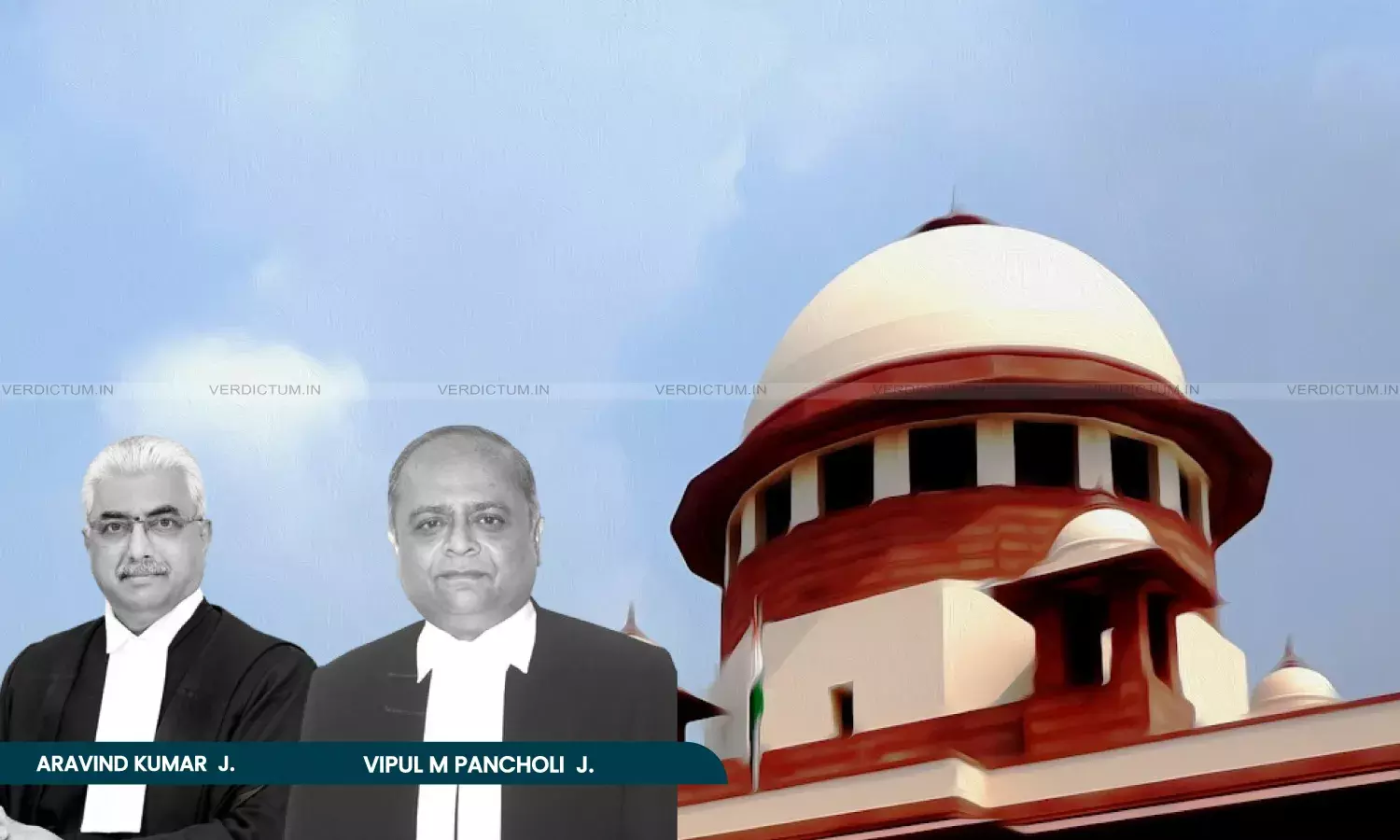
The Supreme Court held that a provisional assessment order issued under Section 135 of the Electricity Act, 2003 cannot be sustained unless the underlying inspection report explicitly records a finding of theft and details the evidence collected. The Court clarified that suspicion, regardless of its strength, cannot replace strict proof in allegations of electricity theft.
The Bench further held that a writ petition under Article 226 of the Constitution of India is maintainable against a provisional assessment order. Section 127 of the Electricity Act provides a statutory appeal only against a final assessment order, leaving consumers without an alternative statutory appellate remedy at the provisional stage.
A Division Bench comprising Justice Aravind Kumar and Justice Vipul M. Pancholi observed, “It is essential that in order to hold a person or a legal entity responsible for the theft of electricity, the theft has to be first detected in the course of inspection. The inspection report must reveal that theft was detected and the details of such evidence must also be recorded therein. As noted above, in the present inspection report, no details or evidence of theft of electricity were noted. Further, there was no subjective satisfaction of the authorized officer either. Only if the inspection report records a finding on the theft of electricity and gives details of the evidence collected during the inspection which unerringly disclose theft of electricity, the provisional assessment order can be sustained. Such a finding of theft must be apparent on a bare reading of the report. If the report is of such a nature that upon bare reading of the same, one cannot construe the basis of theft, then in such a thorough investigation would be required to ascertain whether theft took place or not and the inspection officer will not be allowed to visit penalties upon the consumer in the name of theft only on the basis of such a provisional report that has no legs to stand on”.
“It stands established that though not explicitly mentioned, Section 127 applies as much to Section 135 as it does to Section 126. It is clear as daylight that the provision for statutory appeal under Section 127 of the Electricity Act is only with regards to a final order of assessment and not a provisional order. Since the Act does not provide for a statutory appeal against a Provisional Assessment Order, the Writ Petition against the same is maintainable”, the Bench said.
Senior Advocate Navaniti Prasad Singh appeared for the petitioner and Advocate Kumar Anurag Singh appeared for the respondents.
M/s. Himadri Steel Pvt. Ltd., a private limited company, was granted an electrical connection under High Tension Special Service Tariff with a contract demand of 3000 KVA. Following a surprise inspection on September 26, 2017, official authorities lodged an FIR alleging offences under the IPC and the Electricity Act, 2003, and disconnected the power supply. Subsequently, on September 29, 2017, a Provisional Assessment Order determining a liability of ₹3,23,71,524/- towards loss caused due to theft of electricity was issued under Section 135.
The petitioner challenged the Provisional Assessment Order before the Jharkhand High Court and a Single Judge Bench allowed the writ petition on September 5, 2018, holding that the inspection report lacked conclusive evidence of theft. On appeal, a Division Bench reversed this decision on August 8, 2025, holding the writ petition non-maintainable due to alternative remedies. Aggrieved, the consumer approached the Supreme Court via Special Leave Petition.
The Court distinguished between "unauthorised use of electricity" under Section 126 and "theft of electricity" under Section 135. Section 126 operates as a civil remedy for malpractices where mens rea is not essential, whereas Section 135 requires the twin tests of actus reus and mens rea (dishonest intent) proved beyond reasonable doubt.
Examining the inspection report, the Court noted that all plastic seals were intact and no material evidence was seized from the premises, violating Regulation 11.8 of the Jharkhand Electricity Supply Code Regulations, 2015. The Court rejected the state's argument that action was justified to protect state revenue, cautioning that arbitrary powers based on vague reports cannot be permitted.
Accordingly, the Court allowed the appeal, set aside the judgment of the Division Bench and restored the order of the Single Judge dated September 5, 2018, with no order as to costs.
Cause Title: M/s. Himadri Steel Pvt. Ltd. v. Jharkhand Urja Vikas Nigam Limited & Ors. (Neutral Citation: 2026 INSC 851)
Petitioner: Navaniti Prasad Singh, Sr. Adv., Vaibhav Niti, AOR, Madhavi Agrawal, Dhananjay Pathak, Madhur Mahajan, Advocates.
Respondents: Kumar Anurag Singh, Tulika Mukherjee, AOR, Zain A. Khan, Ekta Bharati, Dev Aaryan, Mohd. Abran Khan, Advocates.