

IBC Regime Doesn’t Provide For Determination Of Liability Or Its Quantification: Supreme Court
The appellant had approached the Supreme Court challenging an order of the National Company Law Appellate Tribunal (NCLAT) restoring the Company Petition to the file of the National Company Law Tribunal (NCLT).

While observing that the approved Rehabilitation Scheme (RS) under the Sick Industrial Companies (Special Provisions) Act, 1985 (SICA) would be binding on all concerned, i.e., the unsecured creditors, the Supreme Court has observed that the regime of the Insolvency & Bankruptcy Code (IBC) does not provide for determination of liability or quantification thereof, whereby the creditor could have sought crystallisation of its dues thereunder.
The appellant had approached the Apex Court challenging an order of the National Company Law Appellate Tribunal (NCLAT) restoring the Company Petition to the file of the National Company Law Tribunal (NCLT).
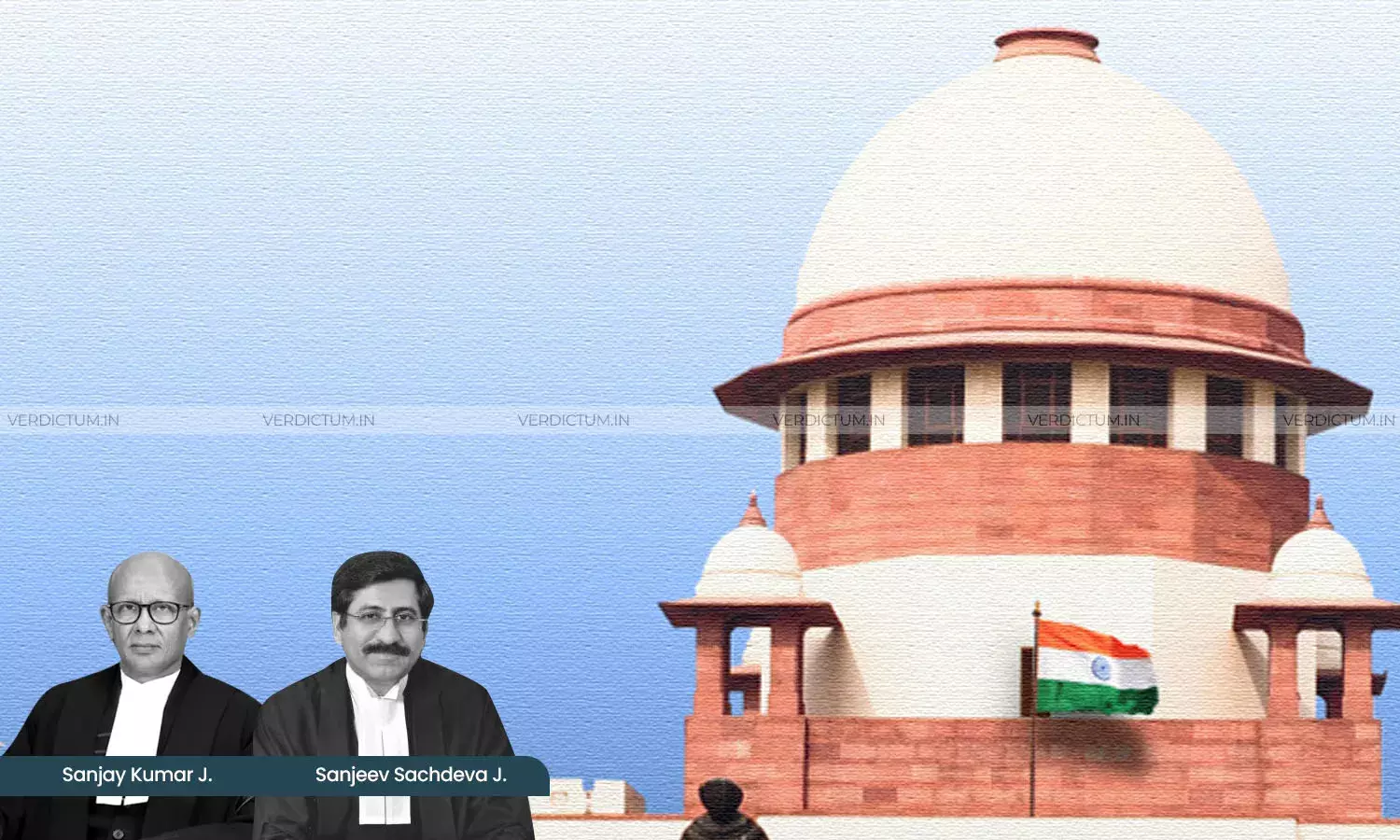
The Division Bench of Justice Sanjay Kumar and Justice Sanjeev Sachdeva held, “In the light of the aforestated edicts, the option given under Clause 11.11 to unsecured creditors to wait till the scheme worked itself out or for seven years and thereafter agitate their claim for their full dues was not valid. Once the DRS was sanctioned, the approved RS was binding on all concerned, i.e., the unsecured creditors and the unsecured creditors in waiting, and there was no possibility of reopening the issue after the scheme worked itself out or after seven years, thereby putting the appellant, which stood rehabilitated, at the risk of becoming sick again.”
“Admittedly, the STC did not initiate any steps to have its dues crystalized and straightaway proceeded to issue a notice under Section 8 of the IBC for its entire dues. The regime of the IBC does not provide for determination of liability or quantification thereof, whereby the STC could have sought crystallization of its dues thereunder. Therefore, the STC was not entitled to seek payment of 25% of its dues in five annual instalments from 2015 onwards”, it added.
Senior Advocate Shyam Divan represented the Appellant while Additional Solicitor General N. Venkataraman represented the Respondent.
Factual Background
A Company Petition was filed by the State Trading Corporation of India (STC), the respondent, under Section 9 of the Insolvency and Bankruptcy Code, 2016 , seeking to initiate corporation insolvency resolution process (CIRP) against Ganesh Benzoplast Ltd., the appellant. The appellant had sought reference under Section 15(1) of the Sick Industrial Companies (Special Provisions) Act, 1985 , before the Board for Industrial and Financial Reconstruction (BIFR) due to erosion of its net worth. The BIFR declared the appellant a sick industrial unit in terms of Section 3(1)(o) of the SICA and appointed an operating agency for formulating a Draft Rehabilitation Scheme (DRS).
The National Company Law Tribunal, Mumbai Bench, disposed of the company's petition, directing the appellant to pay a sum of ₹2,18,88,421 within a time frame to the STC. This amount was stated to constitute 25% of the principal dues of the STC. Aggrieved by this order, the STC filed a Company Appeal before the National Company Law Appellate Tribunal, Principal Bench, New Delhi. The NCLAT allowed the appeal and restored Company Petition to the file of the NCLT for deciding the case afresh in accordance with law. Aggrieved by such restoration, the appellant filed the appeal.
Reasoning
On a perusal of the facts of the case, the Bench noted that NCLAT was of the opinion that the bone of contention between the parties was with regard to treatment of the dues of the STC and it was observed therein that an unsecured creditor had two options under the approved Rehabilitation Scheme (RS) namely, to accept 25% of its principal dues in instalments or, if it did not accept the scaled-down value of its dues, wait till the rehabilitation scheme worked itself out or seven years and agitate for its dues thereafter.
The Bench held that the reasoning of the NCLAT failed to take note of the fact that the STC issued a demand notice, well within the seven years under the so-called second option in Clause 11.11 of the RS sanctioned by the Delhi High Court. Further, the NCLAT also lost sight of the fact that the options were available only to an ‘unsecured creditor’ and not to claimants under the category of ‘contingent liabilities’.
“It was only upon crystallization of such a claim that a contingent liability could be treated as an unsecured debt. Admittedly, there was no crystallization of the STC’s claim, whereby it could call itself an ‘unsecured creditor’. Therefore, be it viewed from any angle, at the point of time that the STC issued a demand notice and even when it filed a company petition, it did not act as per Clause 11.11 of the RS. Further, though the NCLAT deemed it fit to wonder why the STC’s claim was treated as a contingent liability, the inescapable fact remains that the STC itself accepted such categorization and never challenged it. It was, therefore, too late in the day for it to claim otherwise or raise that issue”, it added.
The Bench further stated that the option given under Clause 11.11 to unsecured creditors to wait till the scheme worked itself out or for seven years and thereafter agitate their claim for their full dues was not valid. “Once the DRS was sanctioned, the approved RS was binding on all concerned, i.e., the unsecured creditors and the unsecured creditors in waiting, and there was no possibility of reopening the issue after the scheme worked itself out or after seven years, thereby putting the appellant, which stood rehabilitated, at the risk of becoming sick again”, it stated.
The Bench noted that the STC’s claim for non-submission of C-Forms stood decimated by submission of the forms by the appellant and only the other two claims relating to export transactions and domestic transactions remained and, taking the same into account, the NCLT quantified the amount at ₹2,18,88,421. Considering that no dispute has been raised with regard to such quantification and the STC itself accepted this amount, the Bench held that nothing remained to be adjudicated in the company petition filed under Section 9 of the IBC, as the maximum amount that the STC could have realised, in terms of the approved RS, was already paid to it pursuant to the NCLT’s order.
“The NCLAT, therefore, erred in overlooking this crucial fact and in allowing the STC’s appeal against the said order…”, the Bench held while allowing the appeal and restoring the order of the National Company Law Tribunal.
Cause Title: M/s. Ganesh Benzoplast Ltd. v. The State Trading Corporation of India (Neutral Citation: 2026 INSC 1223)
Appearance
Appellant: Senior Advocate Shyam Divan, AOR Purti Gupta, Advocates Henna George, Sunidhi Sah, Pooja
Respondent: Additional Solicitor General N. Venkataraman, Senior Advocate Uday Gupta, Advocates Shivani Lal, Ajay Sharma, Unmukt Gera, AOR Parminder Singh Bhullar