

Disputed & Unadjudicated Claim For Damages Can’t Be Treated As Debt Presently Due In Cross Contract Recovery Cases: Supreme Court
The Supreme Court was considering three appeals arising out of the orders whereby the writ petitions instituted by a partnership firm were dismissed.

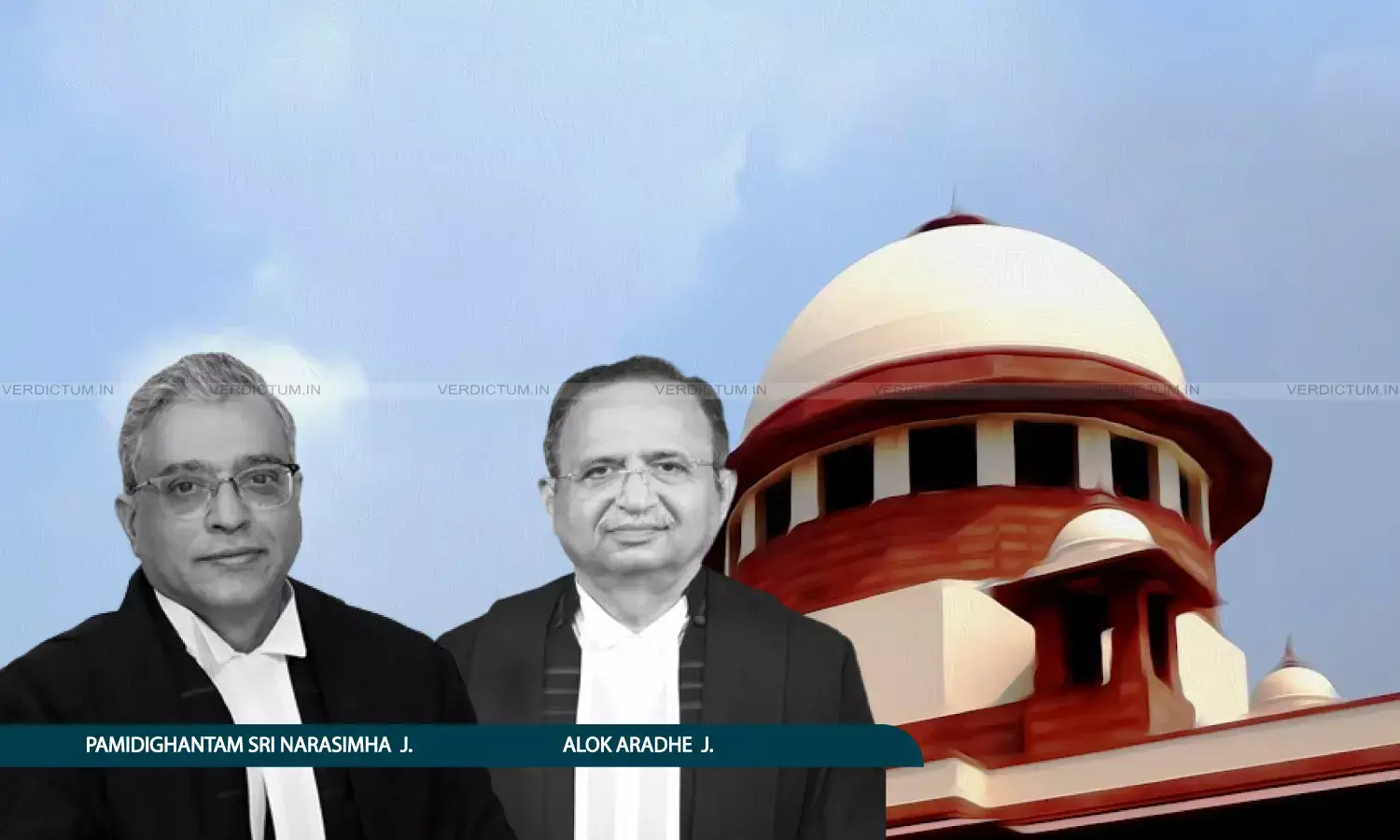
Justice Pamidighantam Sri Narasimha and Justice Alok Aradhe, Supreme Court
While quashing a recovery order in a cross-contract case, the Supreme Court has held that until the alleged overpayment is established in accordance with law, it remains, a disputed and unadjudicated claim for damages and not a debt presently due.
The Apex Court was considering three appeals arising out of three orders whereby three writ petitions instituted by M/s Awadhesh Singh Gautam, a partnership firm (appellant), were dismissed.
The Division Bench of Justice Pamidighantam Sri Narasimha and Justice Alok Aradhe held, “Clause 4.1 incorporates within itself, certain principles of natural justice. As already noticed, the recovery order was passed without notice, consent and sanction, and no other clause, nor any provision of law, permits the amount said to be due under the earlier works to be adjusted against sums payable under a separate and subsisting contract without the contractor's consent. Until the alleged overpayment is established in accordance with law, it remains, a disputed and unadjudicated claim for damages and not a debt presently due ; and a party to a contract cannot, merely because it also holds amounts otherwise payable under it, treat such a claim as though it were an ascertained debt and appropriate those amounts in satisfaction of it. Therefore, the recovery effected by the recovery order was not only in contravention of the conditions prescribed in the clause but also in flagrant violation of principles of natural justice.”
Senior Advocate Gaurav Aggarwal represented the Appellant while Additional Advocate General Bishwajit Dubey represented the Respondent.
Factual Background
The appellant was granted three works pursuant to notices inviting tenders issued by the Chhattisgarh Rural Road Development Agency (CGRRDA) under the Pradhan Mantri Gram Sadak Yojana (PMGSY), for which work orders came to be issued (subsequent works). Having executed approximately 40% of the work under each of the subsequent works, the appellant raised running bills. Complaints of irregularity in execution of the earlier works led the Collector, South Bastar, Dantewada, to constitute a five-member committee. The committee found that although Rs 3,55,82,055 had been paid to the appellant, the value of work actually executed was only about Rs 1,54,75,938, disclosing an excess payment of Rs 2,01,06,117. It recommended recovery of the said sum, blacklisting of the appellant, a probe into its other works, and departmental action against the concerned officers of the CGRRDA.
The Collector, directed the Tehsildar to recover Rs 2,01,06,117 from the appellant. The Tehsildar issued a demand note under Section 146 of the Chhattisgarh Land Revenue Code, 1959. The demand note was assailed in a writ petition. The High Court quashed it. Meanwhile, upon a complaint by an Assistant Engineer of CGRRDA, a First Information Report came to be registered against Awadhesh Singh Gautam, partner of the appellant firm, and officers of CGRRDA, for offences under Sections 420, 467, 468, 471, 409 and 120-B of the Indian Penal Code. The Executive Engineer-cum-Member Secretary, Project Implementation Unit K-01, passed the recovery order by which a sum of Rs 84,17,003 was blocked out of amounts currently payable to the appellant, to be recovered by deduction from the three subsequent works.
Three writ petitions came to be filed assailing the recovery order and seeking release of the amounts deducted. By the impugned common order, the High Court held that the relief claimed was contingent upon adjudication of disputed questions of fact, which could not be undertaken in proceedings under Article 226 of the Constitution, and dismissed the writ petitions, reserving liberty to the appellant to pursue alternate remedy as may be available in law.
Reasoning
Taking note of the General Conditions of Contract, the Bench noted that Clause 53.1(ii) is attracted only where a contract is terminated for the contractor's fundamental breach of its defects-liability and five-year maintenance obligations under Clause 32, and only to the extent the assessed cost of rectification exceeds what can be recovered from the security deposit and performance security of that very contract; recourse to dues under other State works follows only in that residual contingency. “There is nothing on record to show that either the earlier works or the subsequent works were ever terminated, still less terminated on the ground of breach of defects-liability or maintenance obligations under Clause 32”, it added.
Considering that recovery was resting on an allegation of manipulation of measurement books during execution, a ground altogether distinct from post-completion default in defect-liability maintenance, the Bench stated, “Clause 53.1(ii) is thus not attracted, and the cross-contract mechanism it contains cannot be pressed into service to sustain the recovery order.”
The Bench held that the recovery order neither referred to the Integrity Pact nor recorded any finding that it stood violated. “It cannot, therefore, be said that the recovery has in fact been made under Clause 7(iv) of the Integrity Pact”, it added. The Bench further held that none of the clauses relied upon by the respondents, whether read singly or cumulatively, authorisesd either the deduction of the disputed amount from the three subsequent contracts, or the manner in which it was effected.
According to the Bench, the High Court fell into error on the ground that the relief claimed was contingent upon resolution of disputed questions of fact touching the earlier works, which could not be gone into under Article 226 of the Constitution. “The question before it was whether the respondent-State was justified in appropriating that very disputed amount from money admittedly payable to the appellant under the three subsequent contracts, contracts that have nothing to do with the earlier works”, it stated.
Decision
Thus, allowing the appeals, the Bench quashed the recovery order. “The respondents are directed to release to the appellant the sum of Rs.84,17,003/- (Rupees Eighty-Four Lakh Seventeen Thousand and Three only), together with interest thereon at the rate of 6% per annum from 27.09.2025 till the date of actual payment”, it ordered.
Cause Title: M/S Awadhesh Singh Gautam v. State of Chhattisgarh & Ors. (Neutral Citation: 2026 INSC 1072)
Appearance
Appellant:Senior Advocate Gaurav Aggarwal, Advocates Harshwardhan Parganiha, Anshul Rai, S.k Pandey, Chandrashekhar A Chakalabbi, Awanish Kumar, Abhinav Garg, Ojaswa Pathak, Mallika Ranjan, Rajan Parmar, Varnik Kundaliya, Jatin, Garima, Amanpreet Singh, Rahul Singh Latwal, Abhijeet Kumar, Raunaq Singh, Harshit Sharma, Manubha Shankar, AOR M/S. Dharmaprabhas Law Associates
Respondent: Additional Advocate General Bishwajit Dubey, Standing Counsel Vinayak Sharma,, Advocates Vivek Sharma, Yashvardhan Shah, Akshit Awasthi, AOR Ravinder Kumar Yadav, Advocates Aayush Dogra, Ayush Dogra