

Anti-Suit Injunction Restraining Spouse From Pursuing Foreign Matrimonial Proceedings Ordinarily Unwarranted At Inchoate Stage: Supreme Court
The Apex Court added that an anti-suit injunction is not a routine remedy and must be granted sparingly, taking into account judicial comity and whether the foreign proceedings are oppressive or vexatious.
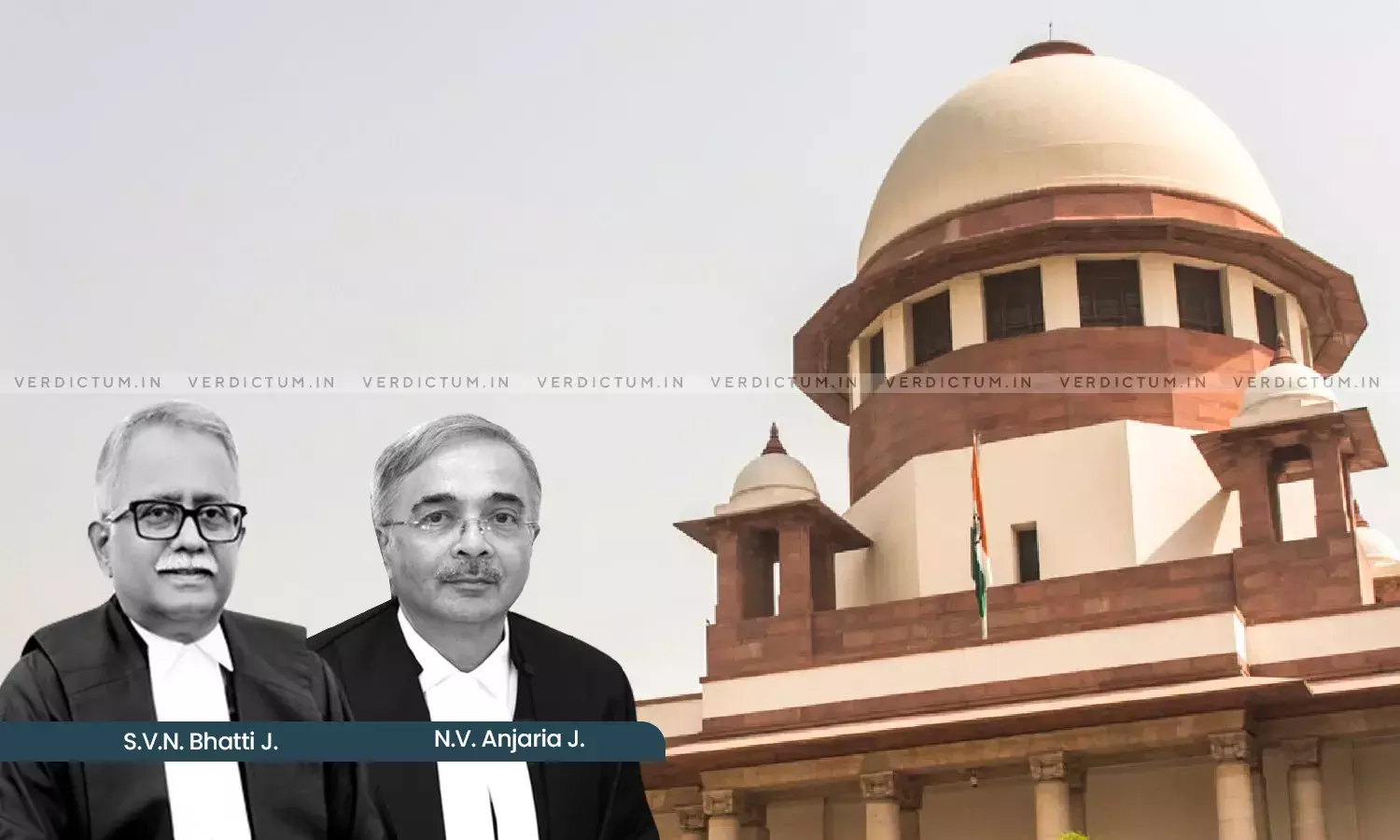
Justice S.V.N. Bhatti, Justice N.V. Anjaria, Supreme Court
The Supreme Court has held that an anti-suit injunction restraining a spouse from pursuing matrimonial proceedings before a foreign court is ordinarily unwarranted when those proceedings remain at an inchoate stage and have not culminated in a final decision.
The Court upheld the Calcutta High Court’s decision vacating an ex parte interim injunction that restrained a wife from pursuing divorce and financial proceedings before a United Kingdom Family Court.
The Court was hearing the husband’s appeal against the Calcutta High Court judgment setting aside an anti-suit injunction granted by an Alipore Civil Court under Order XXXIX Rules 1 and 2 read with Section 151 of the Code of Civil Procedure, 1908.
A Bench of Justice S.V.N. Bhatti and Justice N.V. Anjaria observed: “One of the factors, which should dissuade the court from granting anti-suit injunction is that the proceedings before the foreign court which are sought to be interjected, are yet to conclude. No legitimate ground or logical reason would generally arise to stay the proceedings before the foreign court by way of anti-suit injunction, when they are at an inchoate stage and have not culminated into a final decision. When the Alipore Trial Court granted anti-suit injunction ignoring this factual aspect that the proceedings at the UK Family Court had not concluded, it committed a patent error.”
Senior Advocates A.M. Singhvi and Meenakshi Arora appeared for the appellant. Senior Advocates Shobha Gupta and Anand Sanjay M. Nuli appeared for the respondent.
Background
The parties married according to Hindu customs in Kolkata and spent a substantial part of their matrimonial life in London. After they separated, the husband instituted divorce proceedings before an Alipore Family Court under Section 13 of the Hindu Marriage Act, 1955.
The wife subsequently initiated divorce proceedings before the UK Family Court on the ground of irretrievable breakdown of marriage and also sought interim financial relief. The UK court passed orders concerning interim maintenance and directed that the jurisdictional question be considered as a preliminary issue.
The wife’s application seeking a stay of the Indian matrimonial proceedings was rejected. The husband thereafter instituted a civil suit before the Alipore Trial Court, alleging that the UK proceedings were vexatious and without jurisdiction. He sought a permanent injunction restraining their prosecution and also applied for temporary relief.
The Alipore Trial Court granted an ex parte ad interim anti-suit injunction. It relied, among other considerations, on the ground that irretrievable breakdown of marriage was not recognised as a ground for divorce under Indian law and that a foreign decree passed on that basis might not be enforceable under Section 13 of the Code of Civil Procedure, 1908.
The Calcutta High Court set aside the injunction. It held that the jurisdictional issue was already under consideration before the UK Family Court, the enforceability of any future foreign decree was premature for determination, and judicial comity militated against restraining the pending proceedings.
Before the Supreme Court, the husband contended that the UK proceedings were oppressive, created parallel adjudicatory processes and could result in conflicting decisions. The wife submitted that possible non-recognition of a future foreign decree could not justify restraining proceedings that were still pending and that the parties’ matrimonial home had been established in the United Kingdom.
Court’s Observations
The Supreme Court explained that an anti-suit injunction operates personally against a litigant and does not directly stay proceedings before a foreign court. Since the remedy is equitable, its grant is governed by recognised principles concerning personal jurisdiction, the ends of justice and comity between courts.
Referring to Modi Entertainment Network v. W.S.G. Cricket Pte. Ltd. (2003), the Court said that where more than one forum is available, the court must consider which forum is appropriate and whether the foreign proceedings are oppressive, vexatious or pending before a forum non conveniens.
The Court underscored: “The oppressive or vexatious nature of the proceedings and irreparable harm are the twin prime considerations to be borne in mind by an Indian court while putting on hold a judicial process in the foreign jurisdiction. The anti-suit injunction has the tendency to interfere with the exercise of jurisdiction by the court in another sovereign territory to which the jurisdiction of the injunctive court does not extend.”
It also referred to Mashreq Bank PSC v. Indian Overseas Bank (2021) and Raaj Unocal Lubricants Limited v. Apple Energy Private Limited (2021) while discussing the operation of anti-suit injunctions and judicial comity.
The Court held that an anti-suit injunction cannot be granted as a matter of course or merely upon being sought. Unless pure legal or jurisdictional considerations apply, courts must be extremely slow in restraining proceedings before a foreign court.
The Bench observed: “As a matter of principle of law and the judicial discretion, the grant of anti-suit injunction is not a matter of course. The anti-suit injunction orders are not supposed to be a routine judicial exercise. The anti-suit injunction order is not the one which the court may grant on an askance. The court should be extremely slow, unless the pure legal or jurisdictional considerations are applicable, to issue the anti-suit injunction and thereby stall the proceedings in a court in the foreign country.”
The Court relied on Dinesh Singh Thakur v. Sonal Thakur (2018), where an injunction against foreign matrimonial proceedings had been declined. It said that the mere institution of foreign divorce proceedings on a ground unavailable under the Hindu Marriage Act, 1955 did not establish that the foreign court would necessarily grant the decree or exercise its jurisdiction incorrectly.
The Court found that the Alipore Trial Court had proceeded on the speculative assumption that the UK Family Court would grant divorce on the ground of irretrievable breakdown of marriage and that the resulting decree would be ineffective or unenforceable in India.
The Court remarked: “The main proceedings are pending, and all the issues are at large including the jurisdiction of that court. The ground raised by the respondent-wife for divorce was required to be established on evidence by her. On the speculative consideration that the suit would be decreed by the UK Family Court on the ground of irretrievable breakdown of marriage, anti-suit injunction would not have been granted by the Alipore Trial Court. It adverted to a pre-mature ground at pre-mature stage and thus erred in proceeding to pass the anti-suit injunction order projecting that ground.”
Accordingly, the possible application of Section 13 of the Code of Civil Procedure, 1908 to a future foreign judgment could not justify restraining proceedings that had not culminated in a final decision.
Applying the doctrine of forum non conveniens, the Supreme Court agreed with the High Court that the UK court was the convenient forum in the circumstances. It noted that the husband had resided in the United Kingdom for several years, the wife was a habitual resident there, and the parties had spent most of their matrimonial life in London.
The Court observed: “Both parties lived together as husband and wife in London, UK and had established their interests in that country showing the intentions to permanent stay there. Thus, the proceedings initiated by the respondent-wife before the English Court were founded on the substantial connecting factors. These factors included the prolonged matrimonial life, making London as habitual centre of interests, having matrimonial home and having financial arrangements also in UK.”
It clarified that the doctrine of forum non conveniens permits the court seized of proceedings to determine whether another available forum is more convenient and better suited to adjudicate the dispute.
During the pendency of the appeal, the UK court passed a conditional divorce decree, whose operation was stayed by the Supreme Court. However, the Court confined its examination to whether the Calcutta High Court had correctly vacated the earlier anti-suit injunction.
The Court clarified: “While the said development took place during the pendency of the present appeal, the substratum of challenge in this Appeal remained confined to anti-suit injunction order passed by the Alipore Trial Court on 01.11.2025, which was set aside by the High Court by the impugned judgment. This court has accordingly examined the merits of the said order dated 01.11.2025 only and adverted to the legal justification of its vacation by the High Court in the present judgment.”
It left both parties free to challenge any further or final orders passed by the UK Family Court before the competent forum and clarified that its observations would not influence such proceedings.
Conclusion
The Supreme Court upheld the Calcutta High Court judgment setting aside the Alipore Trial Court’s order and vacating the anti-suit injunction. It dismissed the husband’s appeal and disposed of all pending interlocutory applications.
The Court clarified that it had expressed no opinion on the conditional divorce decree subsequently passed by the UK court and preserved the parties’ right to challenge any further or final orders in accordance with law.
Cause Title: MPB v. VJB (Neutral Citation: 2026 INSC 1034)
Appearances
Appellant: Senior Advocates A.M. Singhvi and Meenakshi Arora; Advocates Mahesh Agarwal, S. Lakshmi Iyer, Devansh Srivastava, Anushree Kapooria and Ayush Jain; E.C. Agrawala, AOR
Respondent: Senior Advocates Shobha Gupta and Anand Sanjay M. Nuli; Advocates Anjan Datta, Ashutosh Dubey, Ranabir Ray Chowdhury, Rajshri Ashutosh Dubey, Ishita Srivastava, Jyoti P. Deborah, Sumon Pathak, Rohit Chatterjee and Rupali Panwar; Vishal Arun Mishra, AOR
