

Supreme Court Acquits Bus Driver In Death By Negligence Case; Applies Dictum Of Common Sense
In this matter before the Supreme Court, the appellant, who was serving as a driver in the Karnataka State Road Transport Corporation bus, came to be convicted.

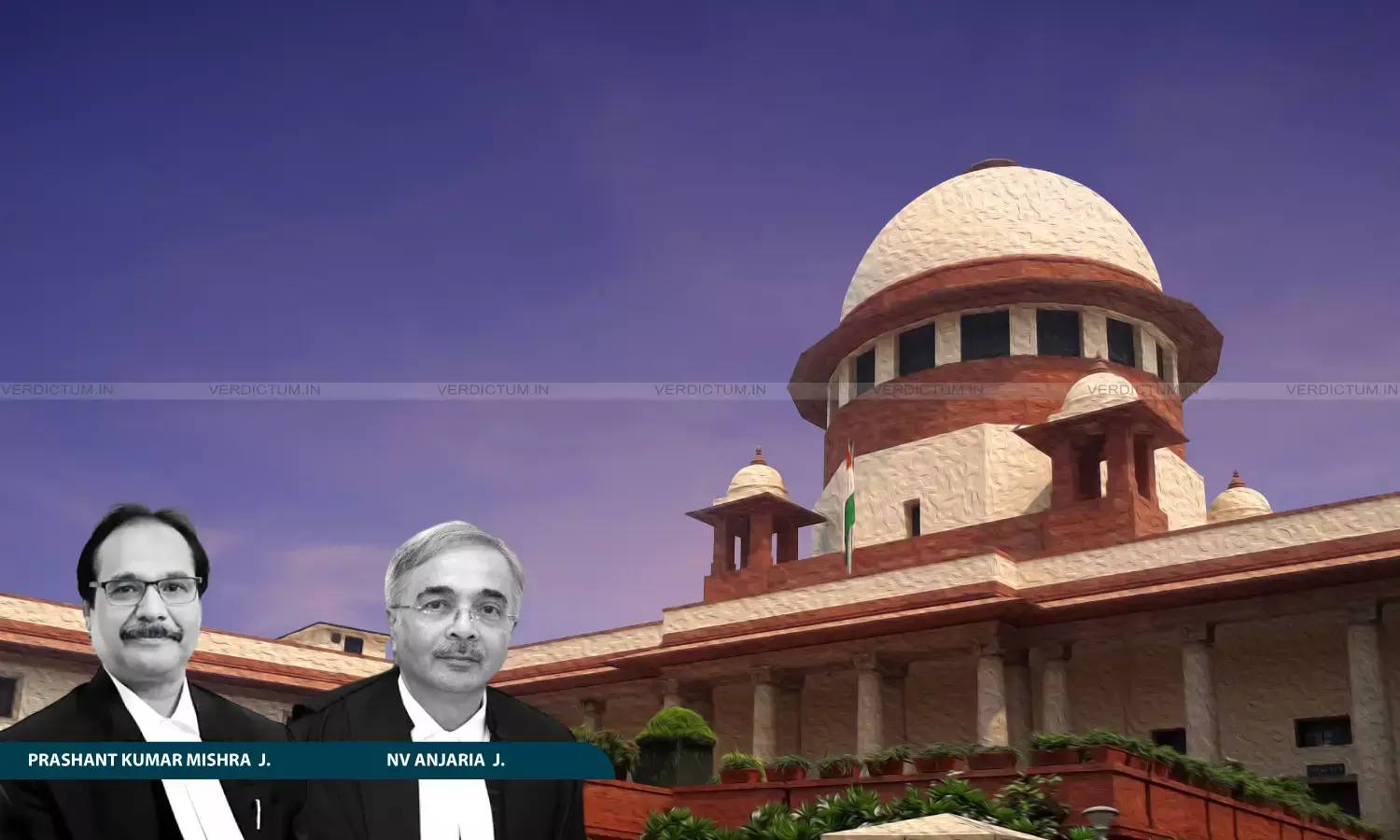
Supreme Court, Justice Prashant Kumar Mishra, Justice N.V. Anjaria
The Supreme Court has acquitted a bus driver in a case of death by negligence by observing that the driver discharged his duty to drive the bus and regulate the movement of the bus in accordance with the instructive signals from the conductor. The Bench further held that applying common sense, common wisdom and common understanding while appreciating day-to-day affairs and natural human activities in the walks of life helps one to judge the things nearer to the truth.
In this matter before the Apex Court, the appellant, who was serving as a driver in the Karnataka State Road Transport Corporation bus, came to be tried and convicted by the Court for the offences under Sections 279 and 304A of the Indian Penal Code, 1860 and under Section 134 read with Section 187 of the Motor Vehicles Act, 1988. The appellant was sentenced to undergo simple imprisonment for four months for the offence punishable under Section 279 of the IPC, and to undergo simple imprisonment for six months for the offence punishable under Section 304A, IPC.
Throwing light on the dictum of common sense, the Division Bench of Justice Prashant Kumar Mishra and Justice N.V. Anjaria explained, "The dictum of common sense often guides the process of interpretation and application of law, for, the law is also common sense when exposed to certain set of facts and circumstances. In natural exposition, the law becomes common sense. Therefore, the common sense and common wisdom can well be a canon for appreciating the evidence. This is more true when it comes to dealing with or judging human conduct. Applying common sense, common wisdom and common understanding while appreciating day-to-day affairs and natural human activities in the walks of life helps one to judge the things nearer to the truth. The truth, more often than not, emanates from common sense. Therefore, applying the yardstick of common sense and common wisdom in appreciating the evidence and the effect thereof, more particularly in criminal cases, brings home the correct picture."
"The factum obtained that the appellant-driver acted regarding stoppage and movement of the bus upon whistling of the conductor, as established from the above-highlighted evidence of PW6, guides this Court to conclude that the driver could not have been held negligent. He discharged his duty to drive the bus and regulate the movement of the bus in accordance with the instructive signals from the conductor. In the ultimate analysis, it was the conductor who was to ensure the due movement of the bus and who would be stepping inside the bus or alighting from the bus, as the case may be. The evidence does not suggest that the driver was negligent and whose negligence resulted into the fall of said passenger-Shobha from the bus while getting off the bus", it added.
AOR Deshpande Chinmay Arvind represented the Appellant, while Additional Advocate General Prateek K Chadha represented the Respondent.
Factual Background
A complaint was filed by the informant stating that he, along with his sister-in-law Shobha and her mother, took a bus driven by the appellant to travel from Athani to return home. The bus conductor whistled to stop the bus near Mallayya Temple. It was the case of the prosecution that while the informant, along with his sister-in-law and mother, were in the process of getting off the bus, the appellant-accused, driver of the said bus, moved the bus in a rash and negligent manner, which resulted in the fall of the sister-in-law from the bus.
She sustained grievous injuries to her head and was thereafter shifted to the hospital. However, later she succumbed to her injuries. Based on the complaint of the informant, a First Information Report was registered against the appellant for the offences punishable under the IPC and MV Act. The Appellate Court dismissed the appeal, confirming the judgment and order passed by the Trial Court. The High Court partly allowed the revision by maintaining the conviction of the appellant. However, it set aside the sentence in respect of the offence punishable under Section 279, IPC but the sentence for the offence punishable under Section 304A, IPC was maintained.
Reasoning
On a perusal of the testimony of the conductor of the bus, the Bench noted that the passenger had asked him to stop the bus, he gave a signal by whistling to stop the bus and the bus was therefore stopped by the appellant-accused-driver, at which juncture the passengers alighted from the bus. He stated that after passengers got off the bus, he told the driver to move the bus. At that time, he listened to the screaming of the passengers. The Bench explained that in any vehicle, particularly in a passenger bus, the conductor happens to be a person in charge, who not only issues the tickets, but also discharges the function to regulate the movement of the bus. It is at the indication of the conductor by whistling or by ringing a bell, as the case may be, that the driver of the bus is conveyed as to when the bus should be stopped to enable the passengers to alight at a particular station and when to start the bus again.
The Bench noted that when the appellant accused had followed the instructions of the conductor in stopping and moving the bus, which the appellant was duty-bound to do, it was both unreasonable and illogical to attribute any negligence on his part.
“The appellant driver was not expected to turn his head back and to see himself whether the passengers had alighted. His dependence on the signal of whistling to start the bus was a normal and natural conduct. Holding that the appellant-accused in capacity of the driver conducted himself without due care or with negligence would not be a justifiable conclusion in the facts of the case. It is therefore difficult to conclude with definitiveness that deceased Shobha had died on account of driver’s negligence”, it added.
The Bench held that it was not possible to hold that the appellant-driver acted “in a manner so rash or negligent” and he could not have been treated as guilty of some omission or doing something which might require him to be adjudged as negligent. The Bench also held that the appellant was guilty of any rash or negligent act satisfying the ingredients of Section 304A, IPC.
“The deceased might have slipped while alighting from the bus because of her own movement being less than careful at the time of getting down. The appellant-driver acted as per the conductor’s indicative instructions in moving the bus. The appellant deserves to be exonerated from the charge of acting negligently”, it stated.
Thus, holding that the courts below as well as the High Court committed a concurrent manifest error in convicting and sentencing the appellant, the Bench allowed the appeal and held the appellant not guilty while acquitting him of the offences under Section 279 as well as under Section 304A, IPC. “He shall be released forthwith if still behind the bars, provided his detention is not required for any other offence”, it ordered.
Cause Title: Mohammad Hanif Jainum Khalifa v. The State of Karnataka (Neutral Citation: 2026 INSC 565)
Appearance
Appellant: AOR Deshpande Chinmay Arvind, Advocate A V Deshpande
Respondent: AAG Prateek K Chadha, AOR Naveen Sharma, Advocates Sreekar Aechuri, Surbhi Soni, Aniket Chauhaan, Swati Bhushan Sharma, S.K. Sharma, Payal Gola