

Had Knowledge That Act Was Likely To Cause Death, But Not An Intention To Cause Death: Supreme Court Alters Conviction From Murder To Culpable Homicide
The Bench noted that the case falls within Exception IV to Section 300 IPC, sentencing appellant to period already undergone after over eleven years in custody.

The Supreme Court has held that a solitary blow struck during a sudden, unpremeditated free fight between two rival groups at a school election established only knowledge that the act was likely to cause death, and not an intention to cause death, altering the appellant's conviction from murder to culpable homicide not amounting to murder.
The Court held that the case fell within Exception IV to Section 300 IPC, given the absence of premeditation, the sudden nature of the fight, and the absence of any cruel or unusual conduct, and accordingly sentenced the appellant, who had already spent over eleven years in custody, to the period already undergone.
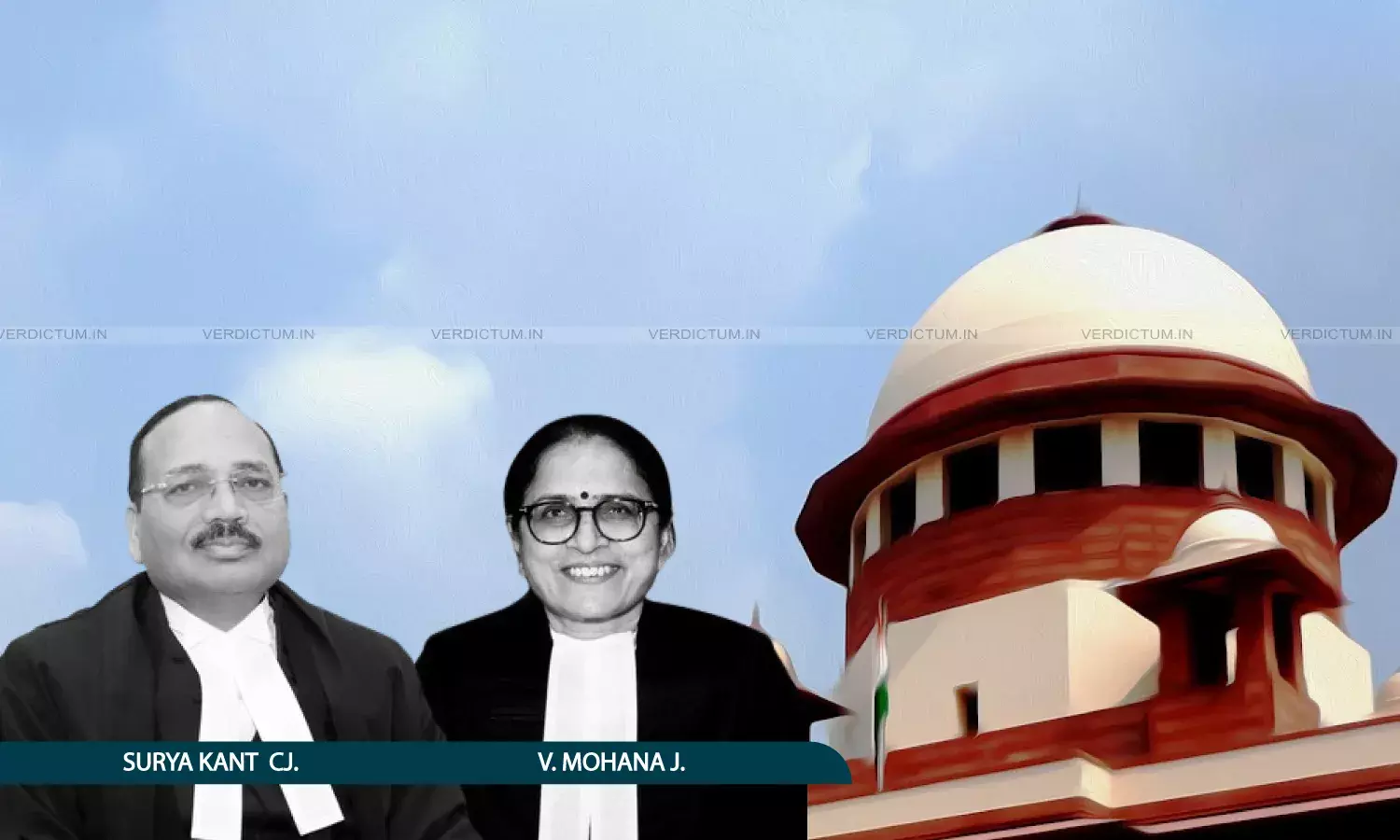
A Bench of Chief Justice of India Surya Kant and Justice V. Mohana observed, “While a single blow does not by itself reduce murder to culpable homicide, it is not relied on in isolation here. Taken together with the sudden and unpremeditated free fight, the mutual provocation, the injuries on both sides, the absence of any prior design to kill, and the absence of repetition or undue advantage, these circumstances establish knowledge that the act was likely to cause death, but not an intention to cause death or to cause an injury sufficient in the ordinary course of nature to cause death. The case therefore falls within Exception IV Page 14 of 16 to Section 300 IPC and is punishable under Section 304 Part II IPC”.
Vijay Kumar, AOR appeared for the appellant and Advocate Susheel Tomar appeared for the respondent.
The case arose from a clash on October 11, 2006 during elections to the Parent-Teacher Association of a Government High School in Rajgarh district, Madhya Pradesh, between groups led by the deceased, Aziz Khan, and the appellant, Mehmood Khan.
An attempt by the appellant's group to prevent a voter's wife from casting her vote was objected to by the deceased, leading to an exchange of abuses that escalated into a physical clash in which the appellant struck the deceased with a Gupti on the abdomen.
Two others who intervened were also injured. The deceased died fifty-four days later of septicemia and cardiac arrest traceable to the abdominal injury, upon which the case was converted to one under Section 302 IPC.
The Trial Court convicted the appellant under Sections 302 and 307 IPC, sentencing him to life imprisonment and five years' rigorous imprisonment respectively, while acquitting a co-accused for want of any specific act attributed to him.
The Madhya Pradesh High Court affirmed the conviction and sentences, holding that the fifty-four-day interval did not break the chain of causation since death resulted from infection developing out of the same injury. The Supreme Court had earlier granted leave confined to the question of sentence, and the appellant was released on bail in 2021 after more than eleven years of incarceration.
Examining the concurrent findings of both courts below, the Bench noted that the two groups had gathered at the polling booth for the election and not by prior design, that the quarrel was sudden, and that the encounter was a free fight, findings on which charges of unlawful assembly had themselves failed.
Applying the test in Virsa Singh v. State of Punjab 1958 SCR 1495, and the circumstances enumerated in Pulicherla Nagaraju v. State of A.P. (2006) 11 SCC 444, the Court found that the appellant had inflicted only a single blow, neither repeated nor followed up, without taking undue advantage or acting cruelly, and that death followed not immediately but fifty-four days later from a supervening infection. The conviction under Section 307 IPC for the separate injury to another victim was left undisturbed.
The Court accordingly partly allowed the appeal, altering the conviction under Section 302 IPC to one under Section 304 Part II IPC and sentencing the appellant to the period already undergone, while affirming the Section 307 IPC conviction with the corresponding sentence treated as already served.
Cause Title: Mehmood Khan v. The State of Madhya Pradesh (Neutral Citation: 2026 INSC 706)
Appearances:
Appellant: Vijay Kumar, AOR
Respondent: Susheel Tomar, Advocate, Sunny Choudhary, AOR.