

Personal Search Safeguard U/S.50 NDPS Act Doesn’t Apply Where Recovery Is Effected From Water Bottle: Supreme Court
The Supreme Court was considering an appeal arising out of the impugned judgment of the Madhya Pradesh High Court.

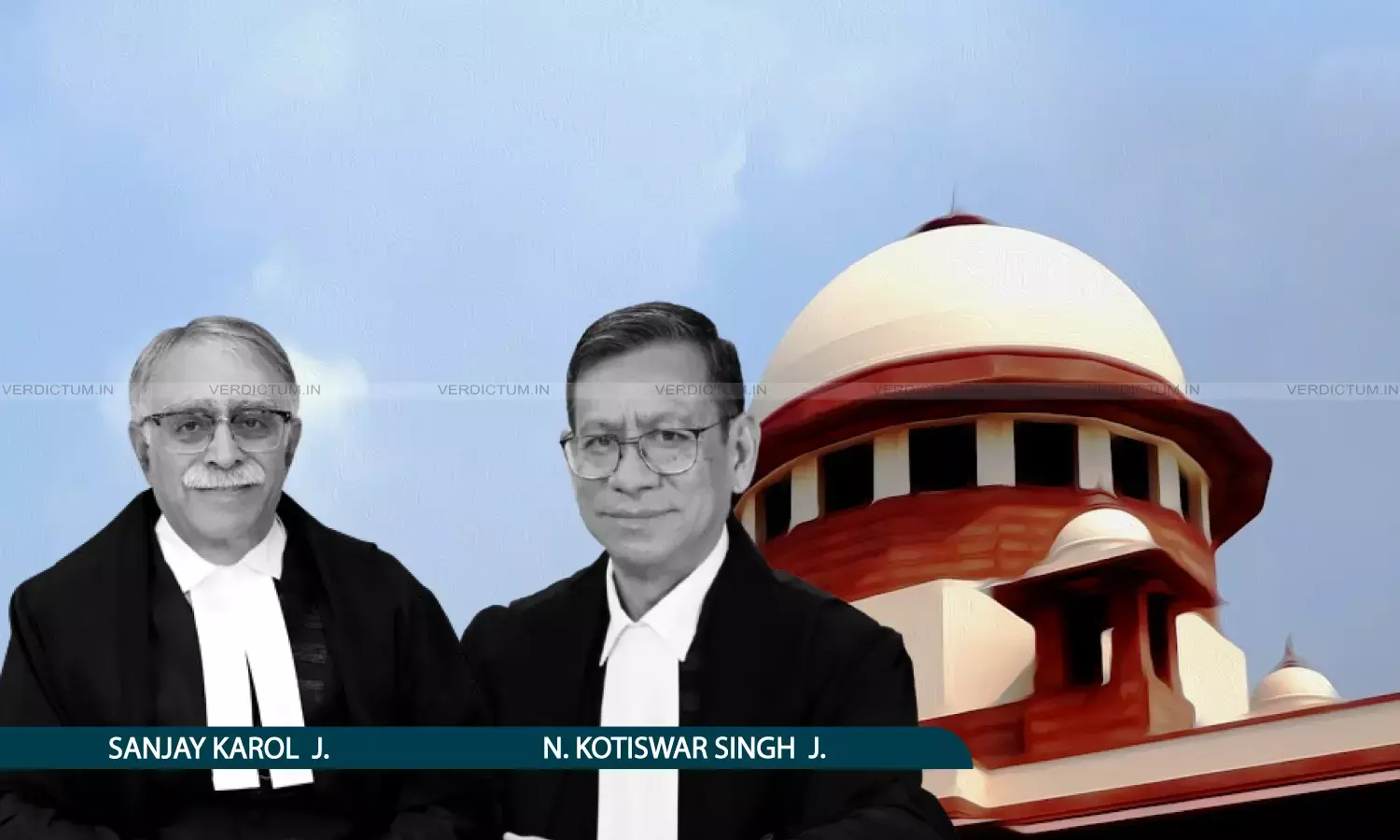
Justice Sanjay Karol, Justice N. Kotiswar Singh, Supreme Court
While explaining that Section 50 of the Narcotic Drugs and Psychotropic Substances Act, 1985 (NDPS Act) confers upon an accused a valuable right to have his personal search conducted before a Gazetted Officer or a Magistrate, the Supreme Court has held that the protection under this provision has no application where the search is of an article, such as a bag, water bottle, container, suitcase, or any other object, which the accused may be carrying.
The Apex Court was considering an appeal arising out of the impugned judgment of the Madhya Pradesh High Court in a Criminal Appeal affirming the appellant’s conviction.
The Division Bench of Justice Sanjay Karol and Justice Nongmeikapam Kotiswar Singh held, “The next contention of the appellant pertains to the alleged non-compliance of Section 50 of the NDPS Act. We find the same to be devoid of merit. Section 50 of the NDPS Act confers upon an accused a valuable right to have his personal search conducted before a Gazetted Officer or a Magistrate, if he so requires. Such right is sacrosanct and indefeasible which cannot be disregarded by the prosecution except at its own peril. [See: State of Punjab v. Baldev Singh] The protection under Section 50 is confined to cases where the recovery is sought to be effected through the personal search of the accused. It has no application where the search is of an article, such as a bag, container, suitcase or any other object, which the accused may be carrying.”
“In the instant case, given that the contraband was recovered from a water bottle which the appellant was carrying and not from his person, Section 50 of the NDPS Act has no application”, it added.
Senior Advocate Sushil Kumar Jain represented the Appellant while AOR Pashupathi Nath Razdan represented the Respondent.
Factual Background
The case dates back to the year 1996, when the police received confidential information that the appellant was carrying contraband (smack), concealed in a water bottle, and was about to board a train going towards Delhi. Acting upon the said information, the prosecution witness apprehended the appellant and allegedly recovered 100 grams of smack from the water bottle carried by him. Thereafter, the contraband was seized, and the appellant was arrested. Consequently, the FIR came to be registered against him. The Trial Court found the appellant guilty of offences punishable under Sections 8 and 21 of the NDPS Act. It held that the prosecution had proved beyond reasonable doubt that 100 grams of smack had been recovered from the water bottle found in the possession of the appellant.
The appellant was convicted under Sections 8 and 21 of the Narcotic Drugs and Psychotropic Substances Act, 1985 and sentenced to undergo rigorous imprisonment for 14 years along with a fine of Rs 1 lakh. Aggrieved thereby, the appellant preferred an appeal before the High Court, which affirmed the order of the Trial Court. Assailing such orders, the appellant approached the Apex Court.
Reasoning
The Bench, at the outset, reiterated that although the power of the Court under Article 136 of the Constitution is wide and can be exercised even in cases where the Courts below have returned concurrent findings of fact, such power should be exercised only in exceptional circumstances. “It is trite law that this Court will not readily interfere with the concurrent findings of fact unless they are shown to be perverse, erroneous or unsustainable in law”, it added.
The Bench noted that the prosecution had successfully proved its case against the appellant by examining the witnesses who are police officials. It noticed that two independent witnesses to the seizure memo turned hostile. Finding their evidence to be reliable and trustworthy, the Bench stated, “However, the testimony of the official witnesses inspires confidence. They have uniformly deposed about the search, seizure and recovery of the contraband from the appellant. Moreover, they were thoroughly cross-examined by the defence but nothing has been brought on record to discredit their version or cast any doubt on their credibility.”
Dealing with the aspect of alleged non-compliance of Section 50, the Bench explained that the protection under Section 50 has no application where the search is of an article, such as a bag, container, suitcase or any other object, which the accused may be carrying. The Bench further noted that even though Section 50 had no application, the appellant was nevertheless informed of the safeguard prescribed thereunder.
The Bench refused to accept the submission of the appellant that there was non-compliance with Section 52A, inasmuch as the representative samples were not drawn in the presence of a Magistrate. “It is well settled that mere delayed compliance or non-compliance of the procedure envisaged under Section 52A does not, by itself, entitle the accused to claim acquittal in the trial, when sufficient material is collected by the Investigating Officer to establish that the search and seizure of the contraband was conducted in accordance with the mandatory provisions of the NDPS Act”, it added.
The Bench also discarded the contention that the appellant be extended the benefit of Section 21 of the amended NDPS Act, which introduced a quantity based sentencing regime.The Bench explained that Section 41 of the Act 9 of 2001, i.e., the 2001 Amendment Act, expressly provides that the amended provisions would only apply to cases which were pending before the Trial Courts or under investigation as on October 2, 2001, the date on which the 2001 Amendment Act came into force. “The proviso thereto specifically excludes cases where the trial had concluded, and the matter was pending in appeal”, it clarified.
Considering that the unamended Section 21 prescribed a minimum sentence of 10 years and no aggravating circumstances warranted the imposition of a higher sentence, the Bench affirmed the conviction of the appellant and reduced his sentence from 14 years to 10 years of rigorous imprisonment.
Cause Title: Mehboob Shah v. State of Madhya Pradesh (Neutral Citation: 2026 INSC 729)
Appearance
Appellant: Senior Advocate Sushil Kumar Jain, Advocates Aditya Jain, Christi Jain, AOR Pratibha Jain, AOR Manjeet Kirpal, Advocates Rajesh Pathak, Kumar Ajit Singh, Harpreet Singh Sandhu
Respondent: AOR Pashupathi Nath Razdan, Advocates Abhimanyu Singh, Maitreyee Jagat Joshi