

Granting Extension To File Chargesheet Not A Mere Formality: Supreme Court Grants Bail To UAPA Accused
The Court held the grant of extension to file chargesheet is not a mere formality but must be preceded by due application of mind both by the Public Prosecutor and the Court.
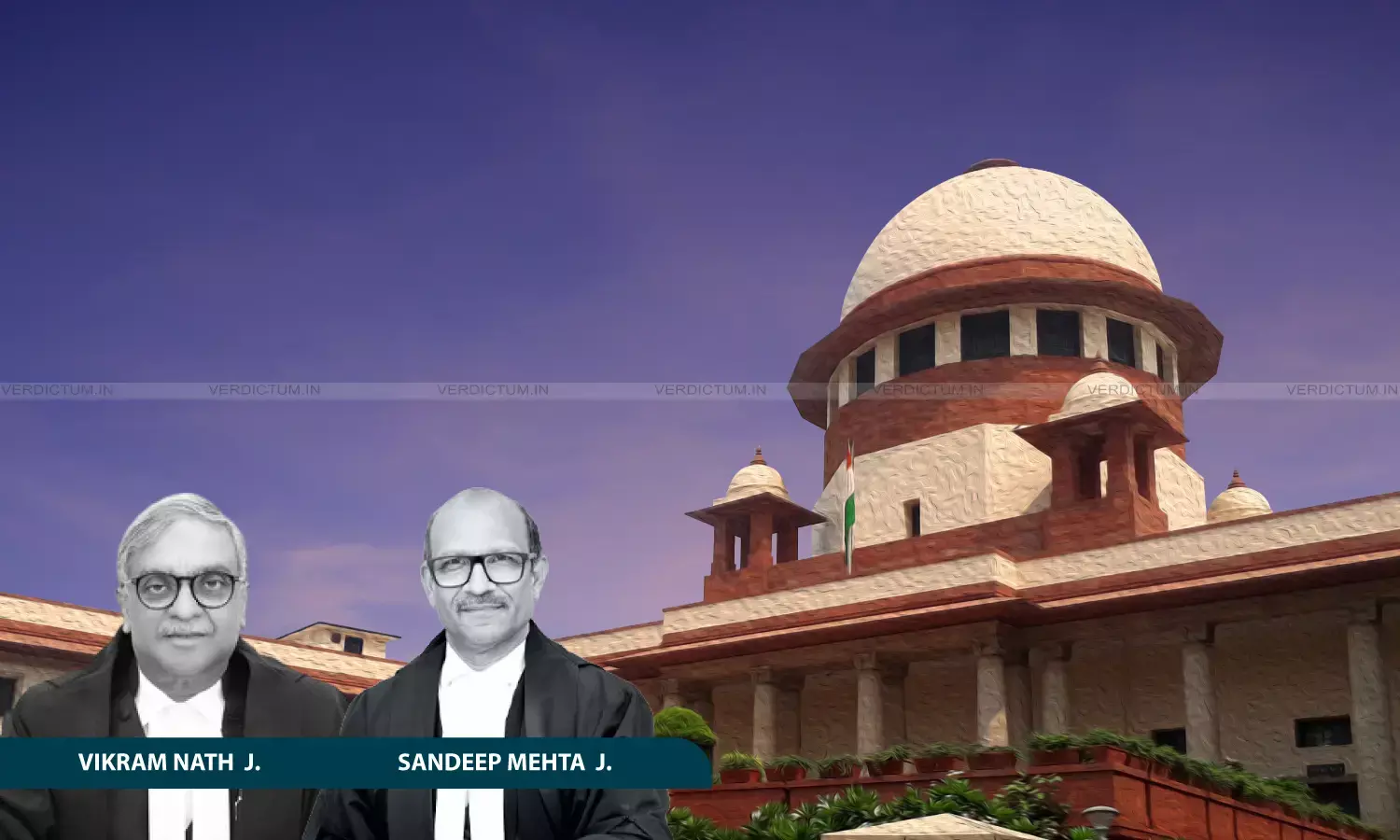
Justice Vikram Nath, Justice Sandeep Mehta, Supreme Court
The Supreme Court granted bail to an accused in UAPA case observing that the the grant of extension of time to conclude investigation is not a mere formality but must be preceded by due application of mind both by the Public Prosecutor and the Court.
The Court was hearing an appeal arising out of proceedings under the Unlawful Activities (Prevention) Act, 1967, wherein the appellant challenged orders extending the period for completion of investigation and consequential rejection of his application for default bail under Section 167(2) CrPC.
A Bench of Justice Vikram Nath and Justice Sandeep Mehta observed: “Under the provisions of Section 167(2) of the CrPC, a clear mandate exists restricting the custody of the accused for a period beyond 60 days or 90 days, as the case may be. If the investigation is not completed and the chargesheet is not filed within the aforesaid period, it would give rise to an indefeasible right in favour of the accused to seek default bail”.
Further, while taking note that “the learned Special Judge neither provided any opportunity to the appellant to oppose the prayer for extension of time to file the chargesheet nor did it apply its judicial mind while allowing the prayer for extension of time”, the Bench accordingly held that “the order extending time to conclude investigation is grossly illegal, arbitrary and violative of the fundamental right of liberty of the appellant as guaranteed under Article 21 of the Constitution of India”.
Senior Advocate Abhinav Sekhri appeared for the appellant. Standing Counsel Rajiv Shankar Dwivedi appeared for the State of Jharkhand.
Background
The appellant was arraigned as an accused in connection with proceedings registered by ATS, Ranchi, for offences under the Indian Penal Code, 1860 and the Unlawful Activities (Prevention) Act, 1967.
According to the judgment, the appellant was formally shown arrested on 7 November 2023 and was remanded to judicial custody on 8 November 2023. The statutory period of ninety days prescribed under Section 167(2) CrPC for completion of the investigation was due to expire on 5 February 2024.
Before the expiry of the statutory period, the Investigating Officer moved an application before the Special Judge seeking an extension of thirty days to complete the investigation. On the same day, the Special Judge extended the period for filing of the chargesheet by twenty-five days.
The appellant contended that the extension proceedings were conducted behind his back while he remained in judicial custody and that he was neither informed of the application nor provided any opportunity to oppose the request for extension.
Subsequently, after expiry of ninety days, the appellant moved an application seeking default bail under Section 167(2) CrPC. However, the same was rejected on the ground that extension of time had already been granted. Further extensions for the completion of the investigation were also granted thereafter.
The High Court dismissed the appellant’s challenge, holding that since the chargesheet had already been filed within the extended period, the plea for default bail no longer survived.
Court’s Observation
The Supreme Court first examined whether the appellant had been produced before the Special Judge or informed about the application seeking extension of time for investigation.
Upon perusal of the order sheets placed on record, the Court found that the appellant had neither been physically nor virtually produced before the Special Judge nor informed about the application filed by the prosecution seeking extension of time.
The Court reproduced the proceedings recorded by the Special Judge and noted that the order merely referred to submissions made by the Additional Public Prosecutor that the investigation was pending and required more time.
The Bench observed that the proceedings did not indicate that any opportunity of hearing had been afforded to the appellant before the extension of time was granted.
The Court then extensively relied upon the decision in Jigar v. State of Gujarat (2023) concerning the extension of time for investigation under special statutes. The Court reiterated that production of the accused before the Court at the stage of consideration of an application for extension is mandatory because extension of time directly impacts the accused’s indefeasible right to seek default bail.
The Court noted: “The logical and legal consequence of the grant of extension of time is the deprivation of the indefeasible right available to the accused to claim a default bail.”
The Bench further reiterated the observation that failure to produce the accused or inform him that extension proceedings are being considered is not a mere procedural irregularity but a “gross illegality” violating Article 21 of the Constitution.
The Court additionally found that the Special Judge had failed to apply the judicial mind while granting the extension.
The Bench observed that the order extending time merely recorded the bald submission of the prosecutor that the investigation was pending, without disclosing any cogent reasons justifying continued detention or explaining the progress of the investigation.
The Court held: “the order dated 2nd February, 2024, passed by the learned Special Judge does not reflect application of mind whatsoever for extending the period for completion of investigation.”
The Bench further noted that even the subsequent extension orders reproduced virtually identical reasons in a verbatim manner, thereby demonstrating a complete absence of independent judicial scrutiny.
The Court reiterated that under Section 167(2) CrPC, custody beyond sixty or ninety days, as the case may be, is strictly restricted by statute and failure to file a chargesheet within such period creates an indefeasible right in favour of the accused to seek default bail. The Bench observed: “the extensions were granted in a totally mechanical manner without assigning any justifiable reasons.”
The Court further held that the appellant had already moved an application seeking default bail before filing of the chargesheet and therefore his right to default bail stood crystallised upon expiry of the statutory period.
The Bench concluded that the continued custody of the appellant beyond ninety days became illegal once the initial extension order itself was found to be arbitrary and violative of Article 21.
Conclusion
The Supreme Court held that the orders extending time for completion of the investigation had been passed mechanically, without notice to the accused, without opportunity of hearing, and without proper judicial application of mind.
Accordingly, the Court set aside the impugned orders passed by the Special Judge and the High Court.
The Court further held that since the appellant had applied for default bail before filing of the chargesheet, his indefeasible right under Section 167(2) CrPC stood crystallised and he was entitled to be released on default bail.
The appellant was consequently directed to be released on default bail upon furnishing bail bonds and sureties to the satisfaction of the trial court, with liberty to the trial court to impose suitable conditions for securing his presence during trial.
Cause Title: Md. Ariz Hasnain @ Ariz Hasnain v. State of Jharkhand (Neutral Citation: 2026 INSC 456)
Appearances
Appellant: Senior Advocate Abhinav Sekhri; Advocates Mehaak Jaggi, Ragini Nagpal, Shailesh Poddar
Respondent: Standing Counsel Rajiv Shankar Dwivedi; Advocates Tulika Mukherjee, Beenu Sharma, Venkat Narayan
