

Consent Under Fear Or Misconception Cannot Be Loosely Inferred To Fasten Criminal Liability: Supreme Court While Quashing Rape Case
The Supreme Court was considering a matter where a consensual relationship spanning three years ended with a criminal case lodged against a man.

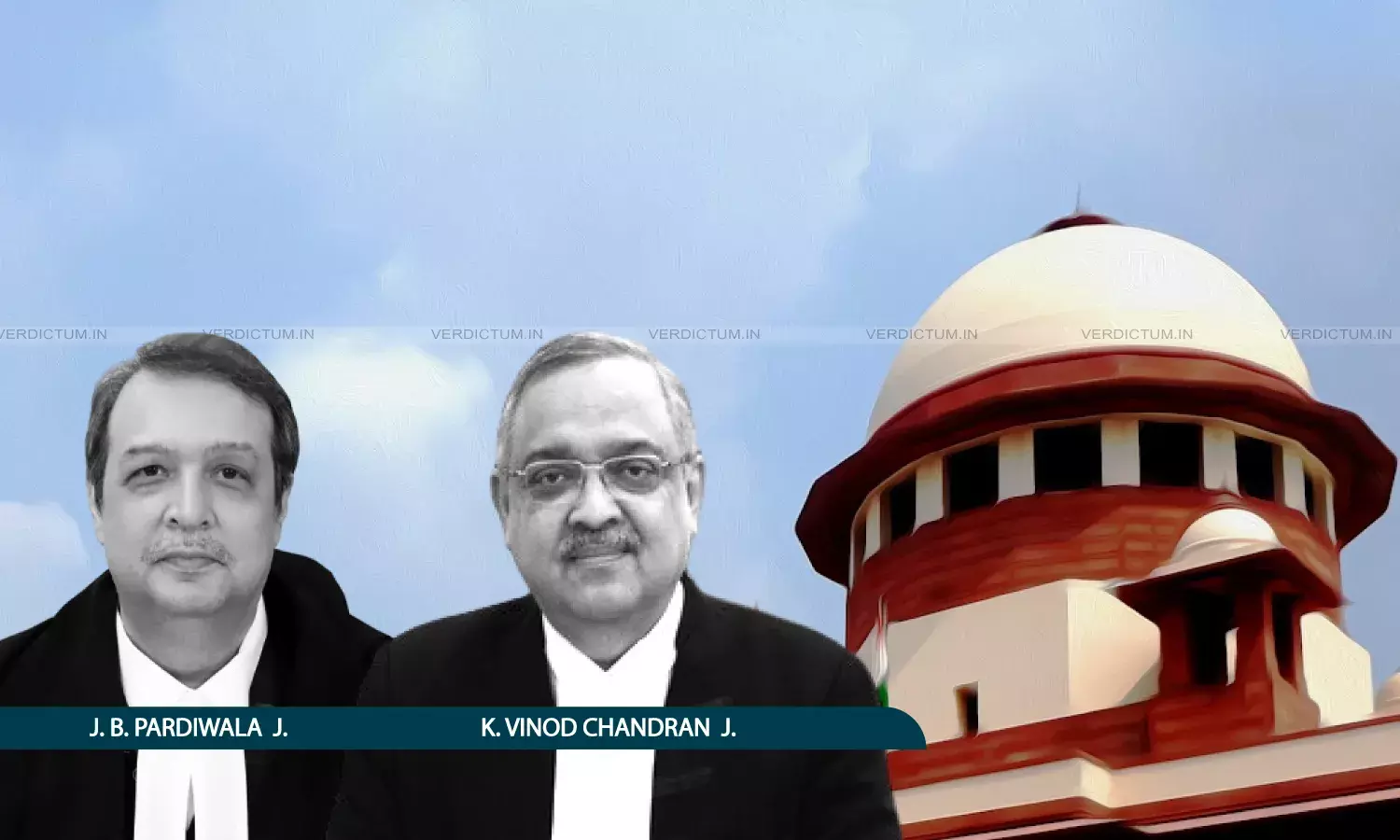
Justice J. B. Pardiwala, Justice K. Vinod Chandran, Supreme Court
While quashing a false promise to marry case, the Supreme Court has reiterated that consent under fear or misconception cannot be loosely inferred to fasten criminal liability on one of the parties when both admittedly had a consensual relationship and the other party willingly permitted a physical relationship.
The Apex Court was considering a matter where a consensual relationship spanning three years ended with a criminal case lodged against the appellant.
The Division Bench of Justice J.B. Pardiwala and Justice K. Vinod Chandran observed, “We cannot but reiterate the proposition as enumerated in the above extract that the consent under fear or misconception cannot be loosely inferred to fasten criminal liability on one of the parties when both admittedly, had a consensual relationship and the other party willingly permitted physical relationship. Even on a bare reading of the complaint, there is no clear assurance or a promise made of marriage, since the specific allegation is that they entered into a physical relationship after courtship, fully knowing the consequences, but alleged to be under the pretext of marriage; clearly an afterthought.”
Senior Advocate Rajesh Pandey represented the Appellant while Standing Counsel Vinayak Sharma represented the Respondent.
Factual Background
The second respondent, an engineering graduate, had been studying for competitive examinations when she met the appellant at an academy, wherein both were enrolled. They fell in love, and their family members also talked to each other. On the understanding that they would be married, the appellant used to visit the house of the second respondent, who lived with her mother and brother. When nobody was at home, they entered into a physical relationship, which continued thereafter for about three years.
An FIR was registered based on the First Information Statement (FIS) of the woman (second respondent) on the allegation of refusal to marry, after exploiting her sexually on the pretext of marriage.
Reasoning
The woman alleged that when her mother was not present, the appellant used to frequently come to her house and they had a physical relationship. On this aspect, the Bench stated, “Obviously, the information that the mother has left, was passed on by the 2nd respondent herself, since we cannot presume that the appellant had mounted a constant surveillance of the 2 nd respondent’s house for this purpose.”
The Bench took note of the fact that the physical relationship continued for three years unabated and later they separated. The marriage proposal mooted by both the families also fell through, upon which the present complaint was raised. The Bench found that the appellant had agreed to marry the second respondent before the Mahila Thana Counselling Centre, Bilaspur, which was not complied with.
“Immediately, we have to observe that the undertaking would have been on the threat of criminal prosecution; which even otherwise is unenforceable. The undertaking also cannot be alleged to be a promise to marry, since by then admittedly there was a courtship of three years, when the 2nd respondent admittedly had permitted physical relationship. The consent obviously was not on coercion or misrepresentation”, it stated.
Considering that the complainant was a well-educated woman, who entered into a consensual relationship and carried it on for three years, allegedly on the pretext of marriage, which never fructified, the Bench held, “She categorically states that she would drop the charge, if he marries her. A criminal prosecution cannot be reduced to a strong-arm tactic.”
Thus, finding no criminal culpability on the appellant who entered into a consensual relationship with the second respondent, the Bench allowed the appeal, quashed the charge-sheet and closed all further proceedings.
Cause Title: Martanda Singh v. State of Chhattisgarh (Neutral Citation: 2026 INSC 1081)
Appearance
Appellant: Senior Advocate Rajesh Pandey, Advocates Ayushi Pandey, Niranjan Marde, AOR Aswathi M.K.
Respondent: Standing Counsel Vinayak Sharma, Advocates Yashvardhan Shah, Aman Shekhar, Kavyayani N. Singh, AOR Ravinder Kumar Yadav