

Bar U/S 25 Hindu Succession Act On Inheritance Rights Of Murder Accused Applies To Both Intestate & Testamentary Succession: Supreme Court
The Bench further clarified that a formal criminal conviction is not a condition precedent for the bar to operate in civil proceedings.

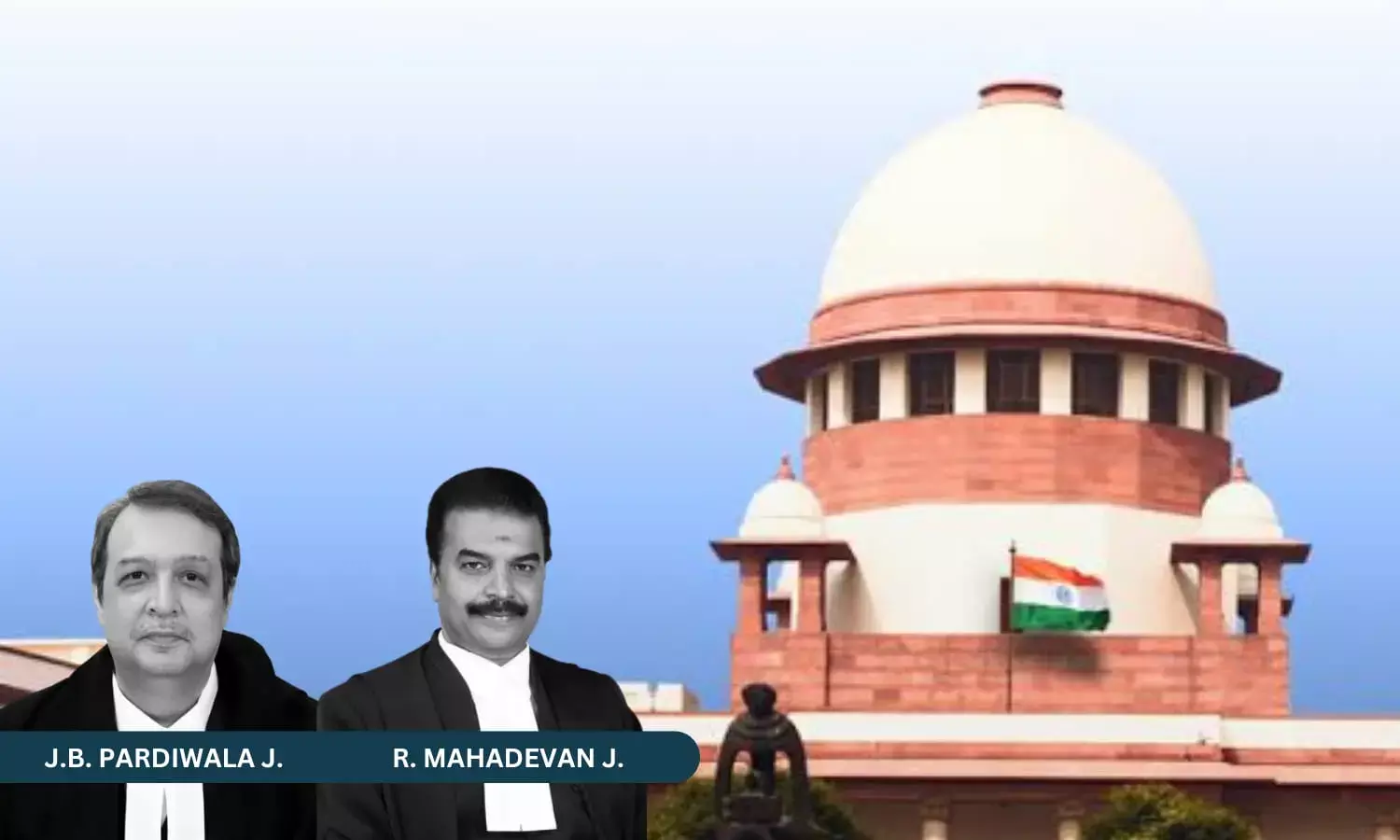
Justice J.B. Pardiwala, Justice R. Mahadevan, Supreme Court
The Supreme Court following its observations on the mandatory duty of courts to reject suits based on 'clever drafting', has further delineated the rigors of statutory disqualification under Section 25 of the Hindu Succession Act, 1956. It has observed that a person accused of murdering someone from whom they claim inheritance is legally barred from asserting any rights to that person's estate. Crucially, the Court held that this disqualification is not limited to cases where a person dies without a will (intestate) but extends to testamentary succession (where there is a Will) as well.
The Bench further clarified that a formal criminal conviction is not a condition precedent for the bar to operate in civil proceedings. Since the disqualification under Section 25 results in a civil consequence, the issue can be examined based on the preponderance of probabilities rather than the stricter standard of beyond reasonable doubt required for a criminal conviction.
Justice J.B. Pardiwala and Justice R. Mahadevan observed, “The bar under Section 25 of the Hindu Succession Act, 1956 applies to both intestate and testamentary succession. A person accused of the murder of one from whom inheritance is claimed, is disentitled from asserting rights, not only under Section 25 but also on the principles of justice, fair play and equity. Strict proof is not indispensable in civil proceedings if the preponderance of probabilities points to commission of the offence”.
“…Section 25 does not envisage a situation where the person claiming inheritance must necessarily stand convicted in a criminal case. The disqualification operates against a person who commits murder or abets the commission of murder. The provision does not make conviction a condition precedent…”, it further noted.
Senior Advocate Gagan Gupta appeared for the appellant and Mahesh Thakur, AOR appeared for the respondent.
In the matter, the respondent (plaintiff) sought to declare himself the owner of properties based on a Will allegedly executed by K. Raghunath, who died on May 04, 2019.
The appellants (the deceased's family) argued that the respondent was the principal accused in the murder of Raghunath and was therefore disqualified from inheriting under Section 25.
However, the respondent countered that a Will does not constitute a transfer of property and that Section 25 only applies to intestate succession.
Now, the Court considering the applicability of the relevant provision, noted,
“Section 25 of the Hindu Succession Act provides that a person who commits murder or abets the commission of murder shall be disqualified from inheriting the property of the person murdered, or any other property in furtherance of the succession to which such person committed or abetted the commission of murder. Section 27 further declares that where a person is so disqualified, the property shall devolve as if such person had predeceased the intestate. Section 30 recognises testamentary succession and enables any Hindu to dispose of property by Will or other testamentary disposition in accordance with the Indian Succession Act, 1925 or any other applicable law. Thus, the Hindu Succession Act contemplates both intestate and testamentary succession. Consequently, the bar under Section 25 applies equally to a person who seeks to inherit the estate of the deceased through testamentary succession”.
“The principle underlying Section 25 is founded upon public policy, justice, equity and good conscience, namely, that no person can be permitted to profit from his own wrong. The statutory provision merely incorporates a long settled equitable doctrine. The bar against a murder inheriting the estate of the deceased existed even prior to the coming into force of the Hindu Succession Act, 1956. A person must not be permitted to profit from or take advantage of his own wrong. This principle is reflected in the maxim ex turpi causa non oritur actio and the rule that no man may benefit from his own wrong”, it further noted.
Accordingly, the Bench held that the respondent's suit, being founded on a claim for properties of a person he was accused of murdering, was legally untenable. It held that such a claim is barred not only by the letter of Section 25 of the Act but by the broader reservoir of equity that guards against the instrumentalization of legal rights as vehicles of injustice.
Cause Title: Manjula and Others v. D.A. Srinivas (Neutral Citation: 2026 INSC 465)
Appearances:
Appellants: Mahesh Thakur, AOR,. Anuparna Bordoloi, Narveer Yadav, Dhanush M, Siddhartha Sati, Ajay Pal Singh, Ruchi Kumari, Akshay Kumar, Sai Tanishka K, Advocates.
Respondents: Gagan Gupta, Sr. Adv., T.M. Shivakumar, Deepak Goel, AOR, Sanjana, Advocates.
Click here to read/download the Judgment