

Failure To Implead Company As Accused On Whose Account Cheque Was Drawn Amounts To Fatal Defect In Complaint Filed U/S.138 Of NI Act: Supreme Court
The Supreme Court was considering an appeal challenging the dismissal of a petition filed under Section 482 of the CrPC by the Himachal Pradesh High Court.

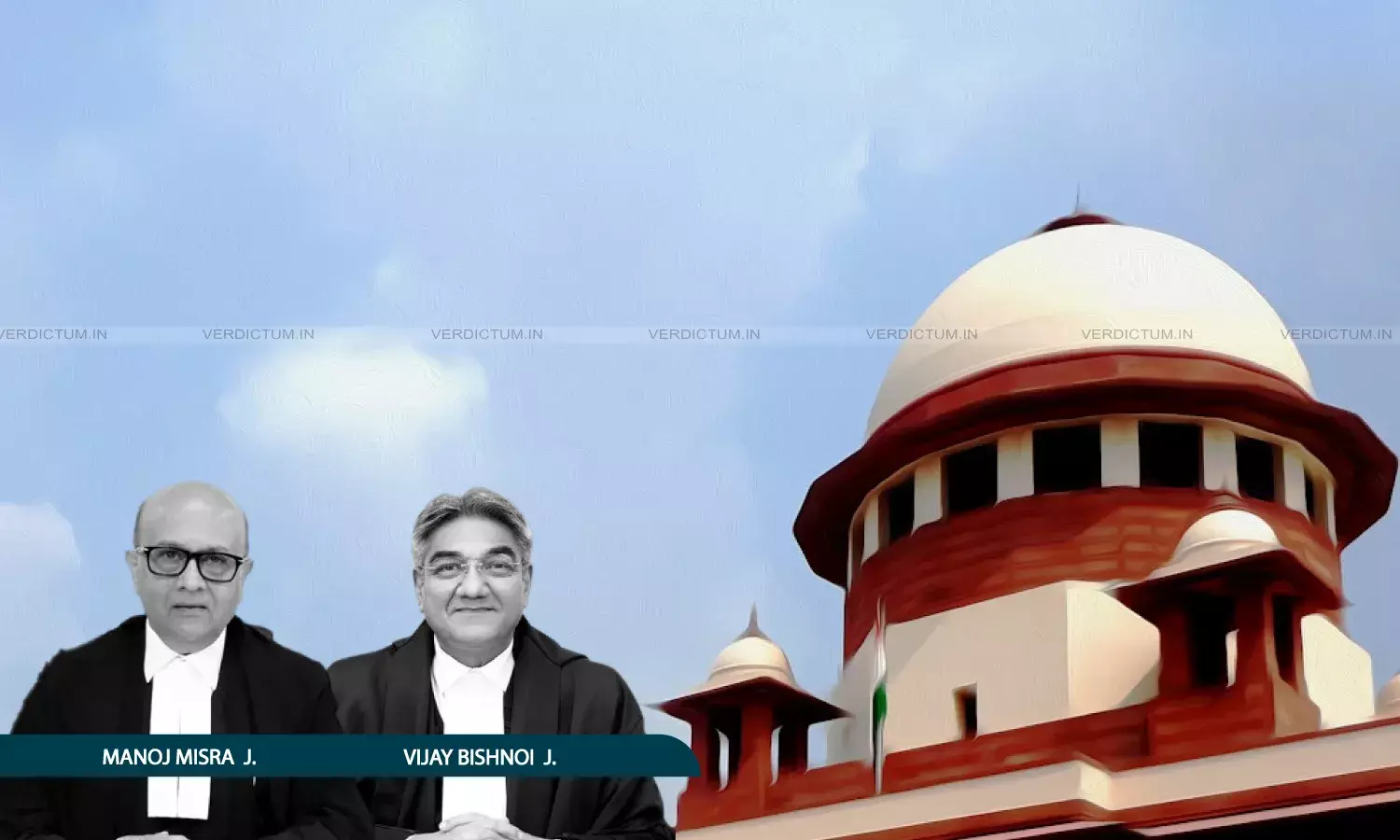
Justice Manoj Misra, Justice Vijay Bishnoi, Supreme Court
While quashing a complaint registered under Section 138 of the Negotiable Instruments Act, 1881, the Supreme Court has held that the failure to implead the Company as an accused on whose account the cheque was drawn would amount to a fatal defect in the complaint.
The Apex Court was considering an appeal challenging the dismissal of a petition filed under Section 482 of the Code of Criminal Procedure, 1973, read with Article 227 of the Constitution, by the Himachal Pradesh High Court in a case registered under Section 138 of the Negotiable Instruments Act, 1881. The High Court had directed the Trial Court to suo motu issue notice to M/s Cine Prime Entertainment under Section 319 of the CrPC and, after impleading it as the second accused, commence trial de novo against the Company, as per provisions of sub-section (4) of Section 319 of CrPC, and bring it to its logical conclusion expeditiously.
The Division Bench of Justice Manoj Misra and Justice Vijay Bishnoi held, “Here, the complaint suffered from a fatal defect for its failure to implead the Company as an accused on whose account the cheque was drawn. In such circumstances, no cognizance on that complaint could have been taken in view of the decision in Aneeta Hada (supra). Hence, all further proceedings on the complaint were bad in law.”
AOR Ashwani Kumar Dubey represented the Appellant while Additional Advocate General Vaibhav Srivastava represented the Respondent.
Factual Background
The second Respondent, Pankaj Sharma, had filed a complaint under Section 138 of the NI Act against the accused-appellant alleging that the Company owed Rs. 5 lakh to the complainant in lieu of services rendered by him and the accused-appellant was one of the directors and authorised signatory of the Company. In discharge of the liability of the Company, a cheque of Rs 5 lakh duly signed by the accused-appellant, as authorised signatory of the Company, was issued to the complainant, which was returned unpaid with the remark ‘payment stopped by drawer’. Thereafter, the complainant served a notice of demand on the accused-appellant. However, despite service of the notice, the accused-appellant failed to make the requisite payment.
The Judicial Magistrate took cognisance of the complaint and summoned the appellant under Section 138. The High Court took the view that, since from the evidence led in the course of trial it appeared that the offence was committed by the Company, the Trial Court could have taken recourse to the powers under Section 319 of CrPC to arraign the Company as an accused. Aggrieved by the order of the High Court, the appeal came to be filed before the Apex Court.
Reasoning
The Bench explained that the Court empowered to take cognisance has the power, under the proviso to sub-section (1) of Section 142 of the NI Act, to take cognisance of a complaint made after the prescribed period upon being satisfied that the complainant had sufficient cause for not making the complaint within such period. “But this power must not be used to circumvent the provisions of the Act and allow the complainant to remove fatal defects in the course of the proceedings when the complaint itself deserved dismissal at the threshold”, it added.
In interpreting the provisions of Sections 138 and 141 of the NI Act, the Bench referred to the judgment in Aneeta Hada v. Godfather Travels & Tours (P) Ltd. (2012), wherein it was held that for maintaining prosecution of any director of the company arraigning a company as an accused is mandatory. It was further held that commission of offence by the company is a condition precedent to attract the vicarious liability of others.
The Bench was of the view that the High Court exceeded its jurisdiction by directing the Magistrate/ Trial Court to suo moto arraign the company as an accused. “In consequence, and having regard to the finding that the complaint suffered from a fatal defect, we have no hesitation in holding that the complaint and all consequential proceedings arising there from are liable to be quashed and are hereby quashed”, it held.
Thus, allowing the appeal and setting aside the impugned order of the High Court, the Bench quashed the complaint and all consequential proceedings under Section 138 of the NI Act.
Cause Title: Manjula Kapoor v. The State of Himachal Pradesh (Neutral Citation: 2026 INSC 789)
Appearance
Appellant: AOR Ashwani Kumar Dubey, Advocates Devinder Singh Khatana, Garima Sharma
Respondent: Additional Advocate General Vaibhav Srivastava, AOR Sugandha Anand, Advocate Chetan Anand Mohapatra, AOR E. R. Sumathy, Advocate Harsh