

Arbitral Tribunal Can Rule On Its Own Jurisdiction U/S 16 A&C Act; Remedy Against Rejection Lies U/S 34 After Final Award: Supreme Court
The Bench held that the doctrine of kompetenz-kompetenz empowers arbitral tribunals to decide their own jurisdiction, including joinder of non-signatories, without premature Article 227 interference.

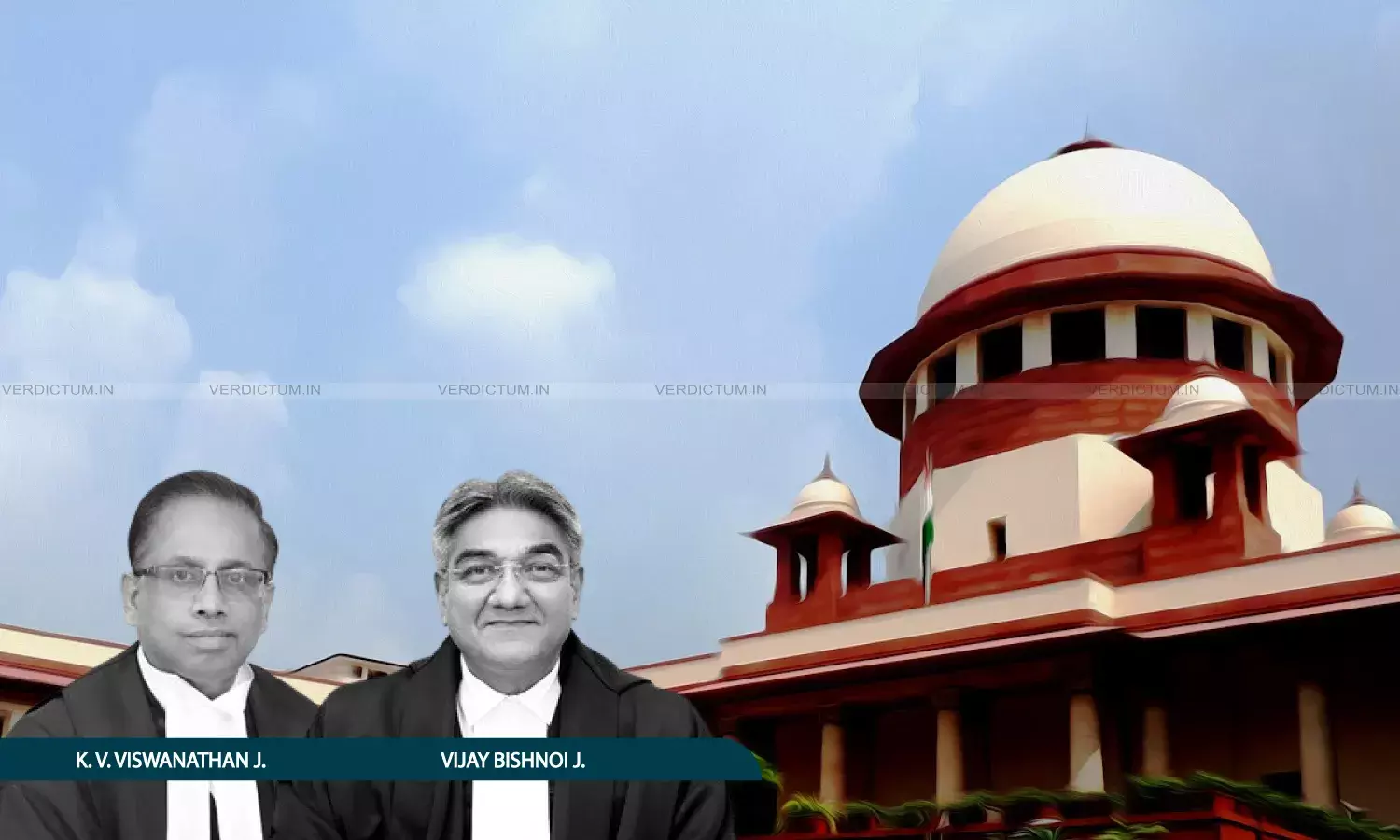
Justice K. V. Viswanathan, Justice Vijay Bishnoi, Supreme Court
The Supreme Court has held that any grievance or challenge regarding an arbitral tribunal’s rejection of a jurisdictional application under Section 16 of the Arbitration and Conciliation Act, 1996, cannot be ventilated mid-proceedings through writ or supervisory jurisdiction. The Court clarified that the statutory architecture of the Act mandates minimal judicial intervention, requiring aggrieved parties to await the final arbitral award before seeking statutory recourse under Section 34 of the Act.
On the doctrine of kompetenz-kompetenz, the court noted that the tribunal possesses the exclusive jurisdiction to rule on its own competence, rendering interlocutory challenges before the High Court unwarranted. It said that the High Courts must exercise extreme circumspection and refrain from routinely entertaining revision petitions under Article 227 Constitution of India unless a patent lack of inherent jurisdiction is visibly manifest and explicitly recorded.
A Division Bench comprising Justice K.V. Viswanathan and Justice Vijay Bishnoi observed, “…The remedy against the rejection of a Section 16 of the Act application strictly lies under Section 34 of the Act after the pronouncement of the final award. Hence, we deem it appropriate to set aside both the impugned orders of the High Court and dismiss the revision petition before the High Court”.
“…the Arbitral Tribunal possessed the absolute competence to decide the question as to whether Respondent Nos. 1 to 3 were veritable parties to the arbitration agreement, notwithstanding their non-signatory status and hence 29 the order of the Tribunal in the present case ought not have been challenged by filing an Article 227 Petition before the High Court”, the Bench further noted.
Advocate Abir Phukan appeared for the appellant and Senior Advocate Madhavi Diwan appeared for the respondent.
In the matter, the High Court had stayed notices issued to non-signatory corporate respondents and subsequently rejected a preliminary objection regarding the maintainability of their civil revision petition against the tribunal's jurisdictional ruling.
The dispute in the present case, originated from a partnership firm, M/s Boloma Tea Company, constituted in 1948. Following subsequent family demises, firm reconstitutions, and the incorporation of related corporate entities including M/s Bokahola Tea Company Private Limited, the appellant filed a civil suit in 2012 seeking rendition of accounts and damages for alleged financial irregularities against multiple defendants, some of whom were non-signatories to the partnership deed containing the arbitration clause.
An initial application under Section 8 of the Act to refer the suit to arbitration was rejected by the Trial Court and affirmed by the High Court on the ground that the suit could not be split up against non-signatory parties.
However, in a subsequent appeal, the Supreme Court, with the consent of the appearing parties, referred the disputes to a sole arbitrator. When the non-signatory corporate respondents subsequently moved the tribunal seeking deletion of their names, the tribunal treated it as a Section 16 jurisdictional challenge and rejected the application based on the apex court's referral order, prompting the respondents to approach the High Court under Article 227.
Reversing the High Court’s decision, the Court observed that the Arbitration Act is a self-contained code wherein Section 5 explicitly curtails judicial interference to honor the legislative intent of prompt dispute resolution. The bench noted that the determination of whether a non-signatory is a veritable party involves a complex inquiry that belongs entirely to the tribunal under Section 16.
“…In cases involving the joinder of non-signatory parties, the referral court is only required to prima facie rule on the existence of the arbitration agreement, leaving the intricate determination of whether the non-signatory is indeed bound by the agreement to the Arbitral Tribunal. This interpretation gives true effect to the doctrine of kompetenz-kompetenz enshrined under Section 16 of the Act, which empowers the Arbitral Tribunal to rule on its own jurisdiction…”, the Bench said.
“…Respondent Nos. 1 to 3 cannot now come before us with a dispute which they could have been raised at an earlier occasion. This practice unnecessarily resulted in another round of litigation, which could have been avoided. These types of practices must be avoided by parties to an arbitration proceedings, as these multiple judicial interventions create unnecessary delay in proceedings, which ultimately destroys the object with which the Act was introduced”, the Bench further noted.
The Court found that the High Court erred by failing to record any specific finding of patent perversity or inherent jurisdictional defect before staying the arbitral proceedings.
Accordingly, it set aside both impugned orders of the High Court and dismissed the civil revision petition. However, noting that the arbitral tribunal had already framed specific issues concerning the maintainability of the proceedings against the non-signatory respondents, the bench directed the sole arbitrator to independently determine their status uninfluenced by the observations of the court, ensuring an expeditious conclusion to the proceedings.
Cause Title: Manash Kamal Bezboruah v. M/s Bokahola Tea Company Private Limited & Ors. (Neutral Citation: 2026 INSC 701)
Appearances:
Appellant: Abir Phukan, Advocate.
Respondent: Madhavi Diwan, Senior Advocate.