

Order U/S.299 CrPC Has To Be Passed When Accused Is Found Absconding & Not When He Is Subsequently Apprehended: Supreme Court
The Supreme Court rendered such findings while acquitting a murder accused who went absconding.

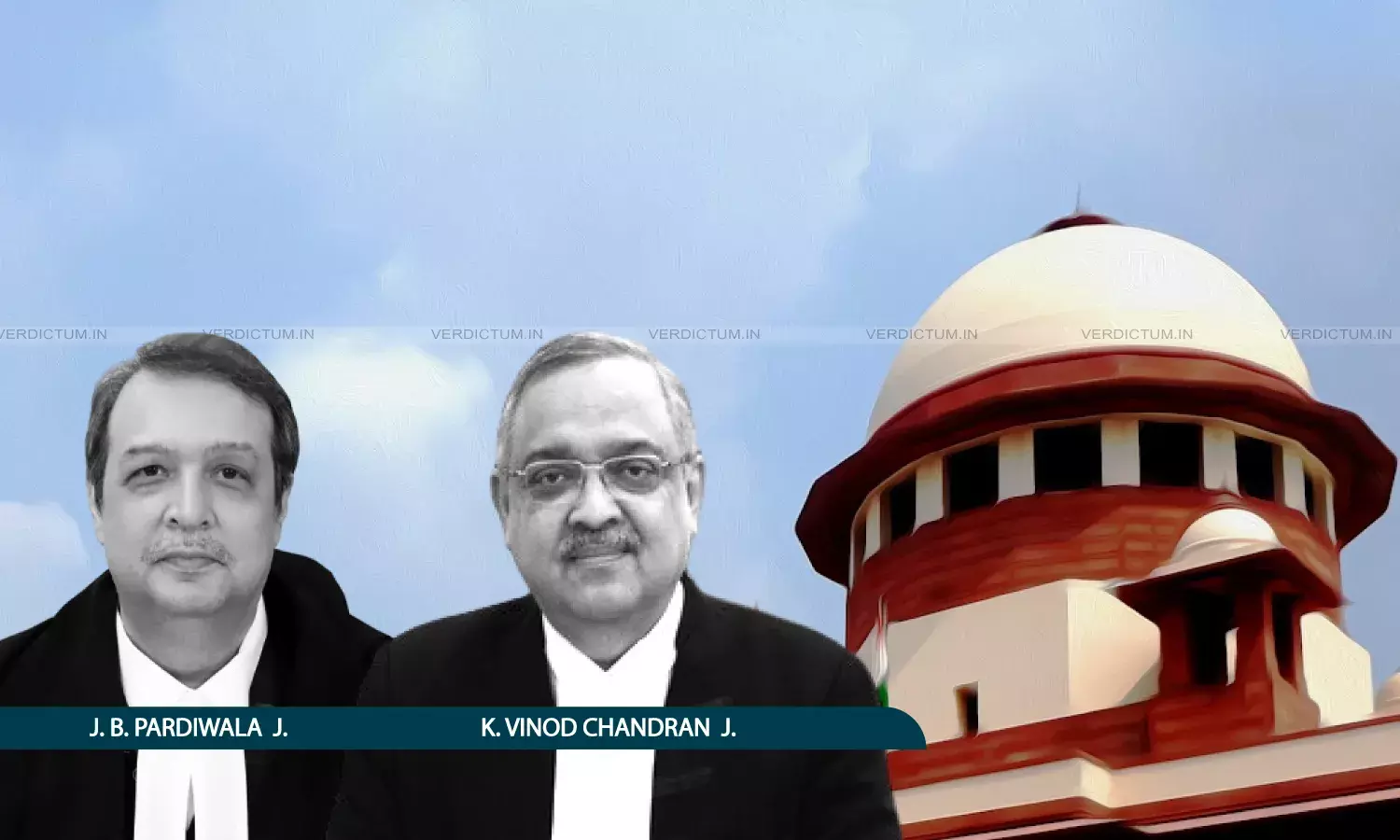
Justice J. B. Pardiwala, Justice K. Vinod Chandran, Supreme Court
The Supreme Court has held that an order under Section 299 of the Code Of Criminal Procedure has to conclusively find proof of the jurisdictional facts and has to be passed at the committal stage or at the trial stage, when the accused is found absconding and not when he is subsequently apprehended.
The Apex Court rendered such findings while acquitting a murder accused who went absconding after noting that no order was passed under Section 299 when the matter was brought before Court, either at the time of committal or at the time of commencement of trial.
The Division Bench of Justice J. B. Pardiwala and Justice K. Vinod Chandran held, “The order under Section 299 has to conclusively find proof of both the jurisdictional facts for invocation of Section 299, which has to be passed at the first stage; at the committal stage or at the trial stage, when the accused is found absconding and not when he is subsequently apprehended. If there is only one accused, there is no question of committing the case for trial if he is absconding and then the evidence could be taken by the Magistrate himself. On the other hand, if after committal, the accused absconds, again the same procedure has to be followed by the Sessions Court which would go into the two jurisdictional aspects and on finding the same, proceed to examine the witnesses.”
AOR Jayesh K. Unnikrishnan represented the Appellant while Advocate Abhishek Pandey represented the Respondent.
Factual Background
Two accused were arrayed, charging them for the offence of murder of a person in the year 1999. The prosecution case was that some of the prosecution witnesses were coming after a fair, when they witnessed an incident where the appellant was assaulting a person, sitting on his chest and strangulating him. The other accused was found exhorting the assault and he threatened the passersby. Frightened by the threats hurled, the witnesses left the scene. The appellant who was alleged with the overt act absconded, and the other was tried, but acquitted. The appellant was arrested in 2017 and was tried for the murder of the victim.
At the trial stage, after more than a decade and a half, the crucial witness PW1 was not available, having expired. There were other eyewitnesses who turned hostile. PW2 was one eyewitness who, though he spoke of having seen the assault, did not identify the accused, who was not produced from judicial custody.
Reasoning
Considering that the matter revolved around the interpretation of Section 299 of the Code Of Criminal Procedure, the Bench noted that the invocation of Section 299 is possible only when two jurisdictional facts are established which leads to two, consequences, one in praesenti and the other in futuro. “The proof of jurisdictional facts required for invocation of Section 299 are on two aspects, one that the accused is absconding and the other that there is no immediate prospect of arresting him”, it added.
The Bench also explained that the evidence of the witnesses are recorded in the absence of the accused and the consequence, in futuro is that such testimony can be used at a trial after the apprehension of the absconding accused, which again can only be done, if the court is satisfied that the presence of that witness cannot be procured, because he is dead, incapable of giving evidence or cannot be found or his presence cannot be procured without an amount of delay, expense or inconvenience, which in the circumstances of the case, would be unreasonable.
“When there are more than one accused and one of them absconds, then, after finding proof of the jurisdictional facts; of the flight and the impossibility of immediate arrest, the trial could be proceeded against the accused brought before the Court and concluded. Then, the testimony of such witness can be relied on in the fresh trial, after arrest of accused, without giving the accused an opportunity of cross examination if the Court concludes that the said witness cannot be found or their presence cannot be procured”, it stated.
Dealing with the facts of the case, the Bench noted that the cross examination of the witness PW2 indicated that there were two persons by the name Mahendra Singh in the village, the locality in which the crime occurred. According to the Bench, the identification or the absence of it became critical and the eyewitness’s testimony could not inculpate the accused. The Bench further noticed that the reliance by the Trial Court and the High Court was on the testimony of PW1 at the earlier instance where he narrated about the first accused having committed the murder. However, there was no order passed under Section 299 in the year 1999 when the matter was brought before Court, either at the time of committal or at the time of commencement of trial.
The Bench thus held, “The flight of the accused, the appellant herein, and the impossibility of apprehending him immediately had to be urged before that Court and it has to be proved to the satisfaction of that Court. Only an order passed, finding proof of both the jurisdictional facts would enable testimony of the witness recorded at that stage to be relied on at a later stage; when the presence of that witness cannot be procured."
Holding that no order was passed finding proof of both the jurisdictional facts, the Bench held that the prosecution against the first accused (appellant) would fail. Thus, ordering the acquittal of the appellant, the Bench allowed the appeal.
Cause Title: Mahendra Singh v. The State of Chhattisgarh (Neutral Citation: 2026 INSC 775)
Appearance
Appellant: AOR Jayesh K. Unnikrishnan, Advocates Sasmita Tripathy, Ashish Kumar Rai, Ayush Baliarsingh, Somesh Sankhala
Respondent: Advocate Abhishek Pandey, AOR Siddhartha Sinha