

Developer Cannot Casually Turn Around & Challenge Occupant's Claim: Supreme Court Restores MHADA's Redevelopment Orders, Directs Developer To Handover Flats Within 2 Months
The Bench set aside restraint on MHADA; developer's civil suit challenging PAAA held misconceived and mala fide.

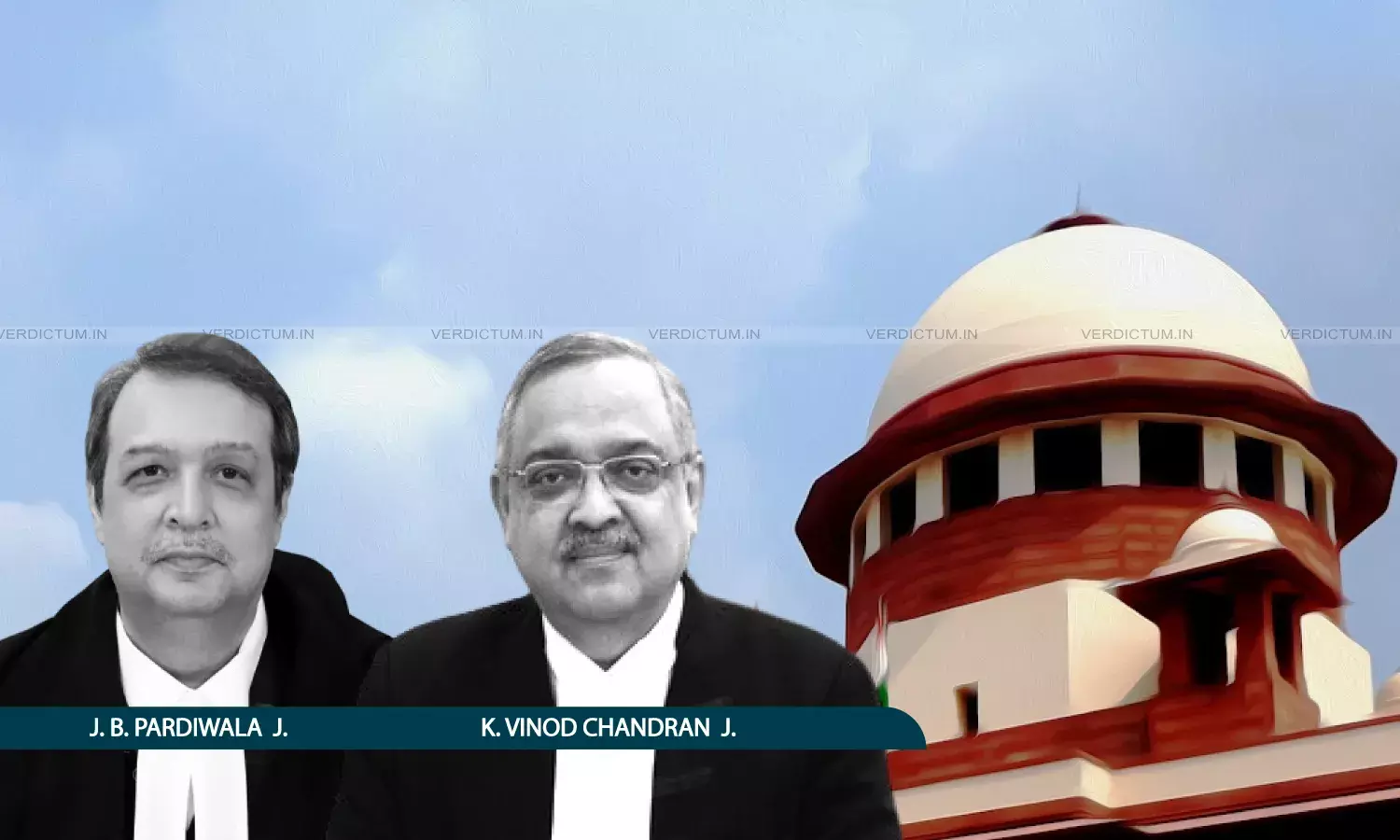
Justice J. B. Pardiwala, Justice K. Vinod Chandran, Supreme Court
The Supreme Court has held that a developer cannot, after obtaining consent, vacation of premises and possession for redevelopment on the promise of allotment as specified in a Permanent Alternate Accommodation Agreement (PAAA), casually turn around years later and challenge the very claim of the occupant on whose strength the redevelopment proceeded, restoring the orders of the Maharashtra Housing and Area Development Authority (MHADA) directing execution of the PAAA and handover of premises.
The Court further held that the developer's civil suit, filed after undertaking before the High Court to concede possession of two flats to the occupant, was itself misconceived and mala fide, setting aside the Bombay High Court's judgment that had restrained MHADA from taking coercive steps against the developer.
The Bench allowed a civil appeal arising out of proceedings before the Bombay High Court concerning redevelopment of a cessed building under the Maharashtra Housing and Area Development Act, 1976.
A Division Bench comprising Justice J.B. Pardiwala and Justice K. Vinod Chandran observed, “…The developer cannot casually after all these years having obtained a consent, leading to vacation of premises and possession being handed over for the purpose of redevelopment, on the promise of allotment of premises as specified in the PAAA, turn around and challenge the very claim raised by the 1st appellant as an occupant. The probate if at all is by way of abundant caution since the developer had defaulted to handover the premises even after its completion”.
“…We are of the opinion that the Civil Suit itself is misconceived and mala fide in the context of the undertaking given before the High Court which is sought to be resiled from, which more than reflects the conduct of the developer/landlord”, the Bench further noted.
Senior Advocate Shyam Divan appeared for the appellants and Senior Advocate Vinay Navare appeared for the respondent.
The appellants, joint occupants of Room No. 5 on the third floor of a cessed building at Grand Road, Mumbai, sought enforcement of a PAAA dated October 17, 2019 executed by the respondent-developer, following redevelopment of the building under an NOC issued by MHADA.
The original tenant, with whom the first appellant was recorded as joint occupant since 2010, died in 2012, and the appellants succeeded to her estate as legal heirs under a certificate of probate dated January 30, 2024. MHADA passed orders on May 28, 2025 and June 27, 2025 directing the developer to execute the PAAA and hand over possession, followed by a show cause notice on July 10, 2025 for non-compliance, threatening action under Section 91A of the MHAD Act.
The developer challenged these orders before the Bombay High Court, contending that the PAAA was a private arrangement not amenable to writ jurisdiction and that the fungible FSI had not been utilised since construction was confined to 30 floors instead of the originally proposed 34, entitling the appellants to a lesser area.
A Division Bench of the High Court found non-application of mind by MHADA, injuncted it from further coercive action, and left the parties to a civil suit, despite no such suit being pending at the time. The developer filed a civil suit only on February 06, 2026, after the High Court's judgment, seeking to invalidate the PAAA in its entirety, contrary to its own undertaking before the High Court.
The Supreme Court held that an occupant's entitlement under the MHAD Act and Regulation 33(7) is not confined to statutory tenants, relying on contemporaneous records that consistently recognized the first appellant as a joint occupant. It found the developer's challenge to the Permanent Alternate Accommodation Agreement (PAAA), raised only after a change in management, to be a belated afterthought and in breach of its undertaking before the High Court.
Accordingly, the Court directed the respondents to execute the PAAA and hand over possession of the three apartments within two months, failing which the appellants would be entitled to damages at monthly rental value, besides damages for delay already caused.
The Court further directed that the pending civil suit not be proceeded with, and awarded costs of Rs. 50,000 each before the High Court and the Supreme Court, payable by the respondents to the appellants.
Cause Title: Mahabanoo Contractor and Anr. v. M/s. Kalikund Developers and Ors. (Neutral Citation: 2026 INSC 737)
Appearances:
Appellants: Shyam Divan, Senior Advocate.
Respondents: Vinay Navare, Senior Advocate, Chirag M. Shroff, Advocate