

Initiation Of Winding Up Proceeding Won’t Impact Limitation For Separate Remedy Of Suit For Money Recovery: Supreme Court
The appeal before the Supreme Court challenged the judgment of the First Appellate Court on the ground that the suit claim was barred by limitation.

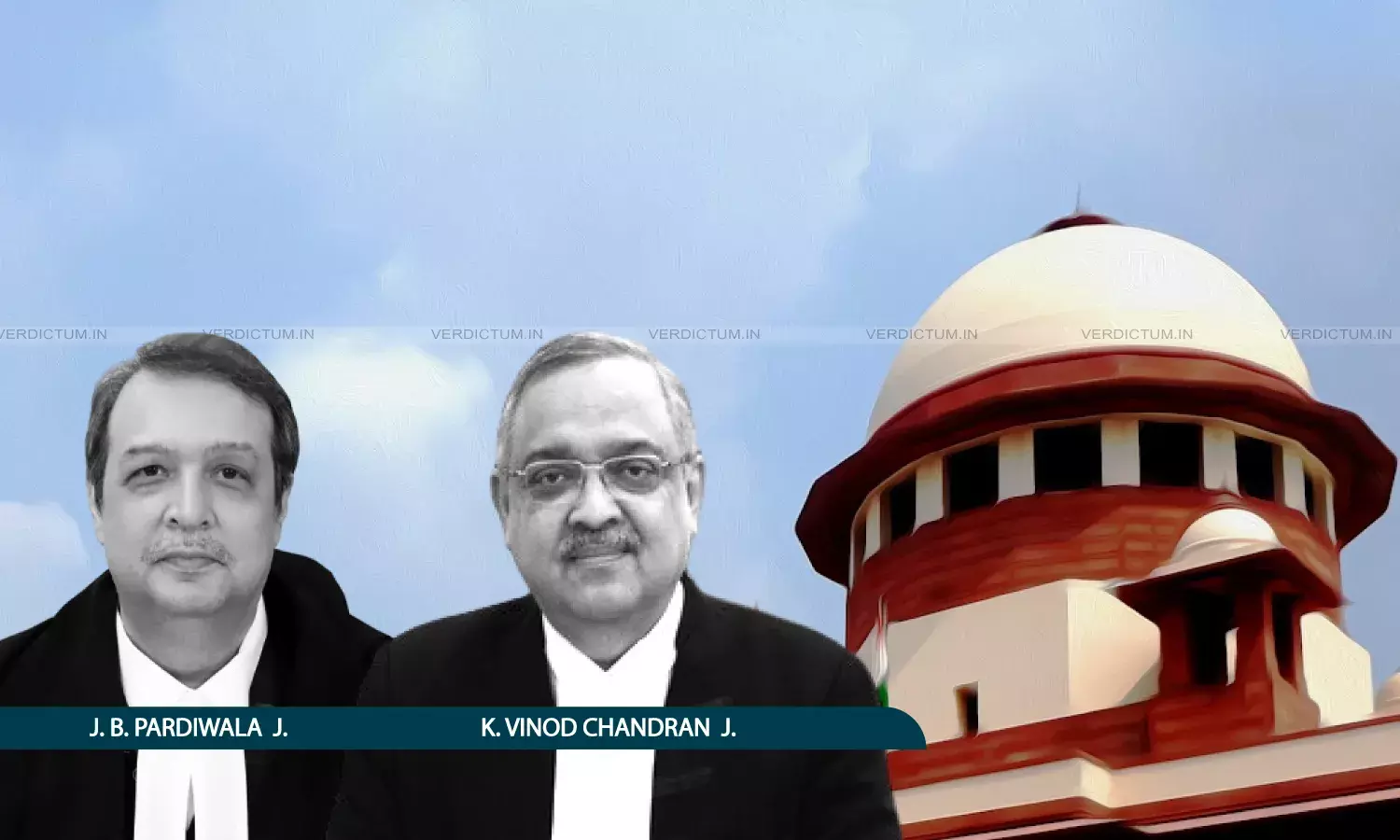
Justice J. B. Pardiwala, Justice K. Vinod Chandran, Supreme Court
While highlighting the distinction between a winding up proceeding and a suit for recovery of money simpliciter, the Supreme Court has held that the initiation of a winding up proceeding, which may or may not enable recovery, will not impact the limitation for the separate remedy of suit for recovery of money.
The appeal before the Apex Court was filed challenging the judgment passed by the First Appellate Court, primarily on the contention that the suit claim was barred by limitation.
The Division Bench of Justice J. B. Pardiwala and Justice K. Vinod Chandran held, “In Jignesh Shah and Anr. v. Union of India and Anr. a converse situation was considered. The filing of a civil suit was projected as a ground for the delayed winding up petition filed before the High Court, which was sought to be transferred to the NCLT. It was categorically held that the filing of a suit for recovery based upon a cause of action, that is within limitation cannot in any manner impact the separate and independent remedy of a winding up proceeding. The converse position applies squarely to this case that the initiation of a winding up proceeding, which may or may not enable recovery, will not impact the limitation for the separate remedy of suit for recovery of money.
AOR Dhananjay Baijal represented the Petitioner while Senior Advocate Manish Goswami represented the Respondent.
Factual Background
A suit filed by the respondent was dismissed, finding that the plaintiff’s status as a registered partnership firm was not proved before the Trial Court and the suit was hit by Section 69(2) of the Indian Partnership Act, 1932. An appeal was filed contending that the Trial Court ignored the legal effect of a Memorandum of Registration exhibited by the plaintiff, conclusively proving the registration of the firm. The First Appellate Court accepted the same, and after considering the merits of the matter, decreed the suit, directing the defendant to pay the appellant a sum of Rs 24,36,105 along with interest from the date of filing of the suit till realisation of the amount.
The appellant, who was the defendant, was challenging the judgment and decree passed by the First Appellate Court, primarily on the contention that the suit claim was barred by limitation and also on valid proof having not been produced with respect to the registration of the plaintiff-firm.
Reasoning
On a perusal of the facts of the case, the Bench noted that there was sufficient evidence to find the registration of the respondent-firm. The memorandum issued by the Registrar of Firms, West Bengal, acknowledged the receipt of documents, and it was also an intimation that the documents had been filed/recorded/registered pursuant to the Indian Partnership Act, 1932.
The Bench further noticed that the document produced under Order XLI Rule 27(1) was a certified copy of Form-VIII of the Registrar of Firms, duly certified by the Registrar of Firms whereby the Registration number of the plaintiff-firm and the date of registration were reiterated. The Bench found no reason to uphold the order of the Trial Court rejecting the suit, finding the plaintiff to be not a partnership firm.
Coming to the issue of limitation, the Bench noted that the suit was for recovery of money which was sought on the strength of the bills raised, with respect to the supplies made by the respondent to the appellant totalling Rs 23,41,693.
It was noticed that the respondent claimed that the cause of action arose on June 3, 2008, when there was an admission of debt and part payment. The ground of limitation was resisted on the strength of the admission made on September 2, 2008, when part payment was made, also with reference to Annexure P-18 dated August 1, 2008, the communication addressed by the appellant in response to the demand raised by the respondent.
The Bench referred to the judgments in Yeswant Deorao Deshmukh v. Walchand Ramchand Kothari (1950) & Jignesh Shah and Anr. v. Union of India and Anr. (2019). Coming to the facts of the case, the Bench noted that the Company Petition filed was not entertained since it was found that, though slightly delayed, the appellant issued a reply alleging that the substantial part of the claim made by the respondent, was apparently ‘at the behest and with the connivance of the erstwhile associates of our company.’
It was further noticed that there was no extension of limitation by the Company Court, which in any event, the Court was not competent so to do. The Bench noted that there was a clear finding was that there was no scope of winding up of the appellant, the demand having been disputed by the appellant. “The decisions of this Court with respect to finding a clear distinction between a winding up proceeding and a suit for recovery of money simpliciter, applies squarely”, it added.
The Bench found that Annexure P-18 did not acknowledge the debt as sought to be recovered by the respondent, evidenced by the bills. The Bench found the suit to be filed on the strength of the invoices raised and not on the basis of a running account. “The mere deduction shown with respect to the payment of the admitted bills, in the schedule to the plaint, will not make it a running account. The notice of demand, the reply issued or the payment made on admission of two bills, with disputes raised with respect to the other bills, demolishes the case set up by the respondent-plaintiff on cause of action as emanating from the plaint”, it held.
Thus, allowing the appeal, the Bench held that the claim for recovery was hit by limitation and dismissed the suit.
Cause Title: Mageba Bridge Products Private Limited v. M/s. Trade Centre (Neutral Citation: 2026 INSC 839)
Appearance
Appellant: AOR Dhananjay Baijal
Respondent: Senior Advocate Manish Goswami, Advocates Kaushik Chatterjee, Reena Pandey, AOR Anurag Pandey