

Supreme Court Disapproves Routine Practice Of Granting Stay Of Trial While Issuing Notice In Challenges To Interlocutory Orders
The Court expressing “deep anguish”, noted that the High Court appeared to have overlooked the fundamental principles governing consideration of an application under Order VII Rule 11 CPC.

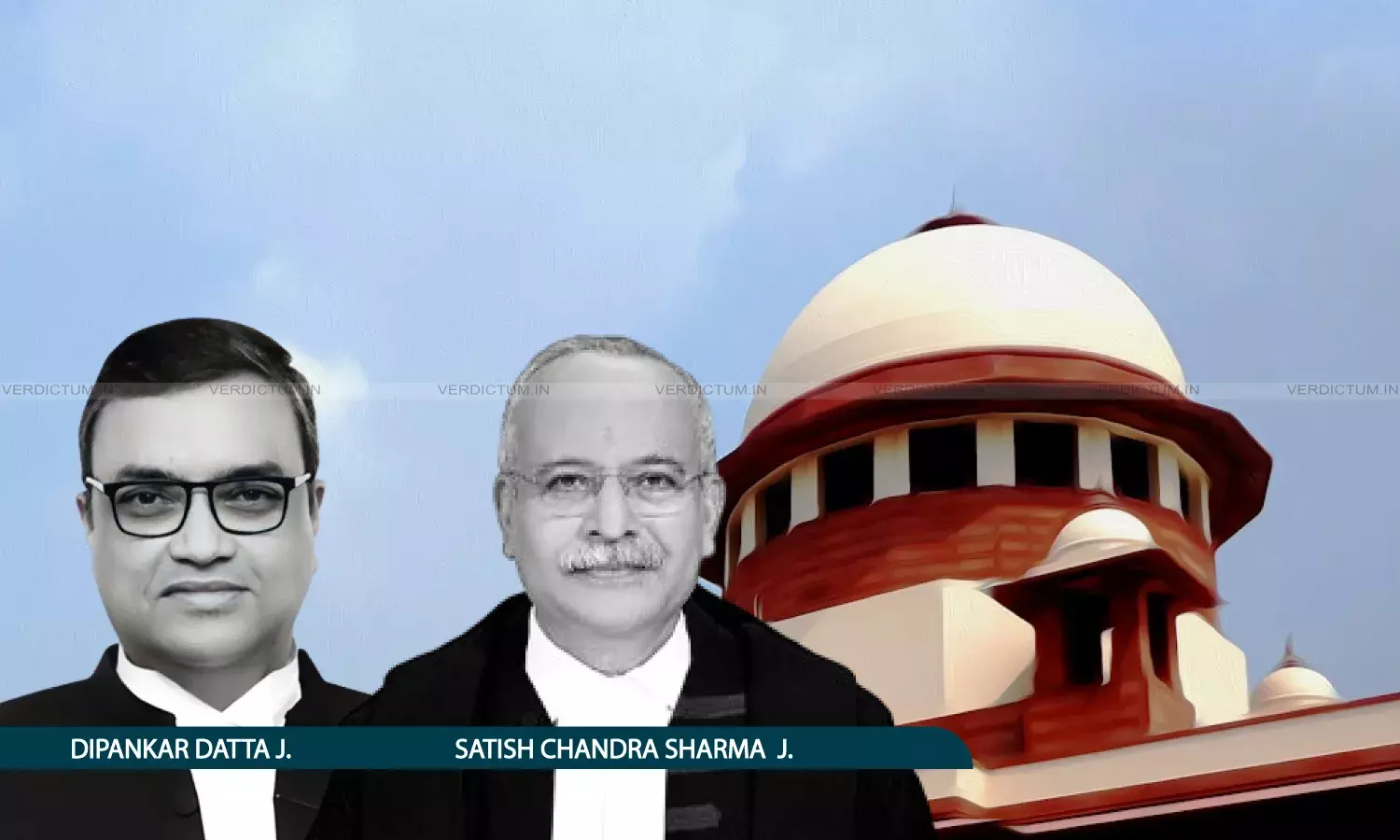
Justice Dipankar Datta, Justice Satish Chandra Sharma, Supreme Court
The Supreme Court has held that the routine practice adopted by High Courts of granting stays of trial court proceedings while issuing notice in challenges to interlocutory orders must be disapproved and eschewed. Consequentially, it set aside a judgment of the Bombay High Court which had allowed revision applications and directed rejection of a plaint under Order VII Rule 11 of the CPC holding that the High Court had “donned the hat of the trial court” while exercising its limited revisional jurisdiction under Section 115 CPC.
Expressing “deep anguish”, the Bench said that the High Court appeared to have overlooked the fundamental principles governing consideration of an application under Order VII Rule 11 CPC.
A Division Bench comprising Justice Dipankar Datta and Justice Satish Chandra Sharma observed, “…the routine practice of the high courts of granting a stay of trial while issuing notice in challenges to interlocutory orders has to be disapproved. Unless the high courts, on an examination deeper than prima facie, arrive at a finding that continuation of the trial would seriously and irreparably prejudice the outcome of the revision or adversely affect the parties, stay of the trial ought to be eschewed”.
Senior Advocates Dr. Abhishek Manu Singhvi, Pravin Samdani appeared for the appellant and Senior Advocates Ranjit Kumar, Jaydeep Gupta appeared for the respondents.
In the matter, International Asset Reconstruction Company Private Limited and Madhav Vidarbha Estate Private Limited had instituted a special civil suit before the 18th Joint Civil Judge, Senior Division, Nagpur, seeking, among other reliefs, declarations that certain sale deeds executed in favour of Praharsh Corporation Private Limited and Sawan Nandkumar Bhatewara were null and void, along with possession and damages. The plaintiffs claimed the cause of action arose in 2016 when Praharsh allegedly obtained possession of the suit property fraudulently.
Praharsh and Sawan filed applications under Order VII Rule 11 CPC seeking rejection of the plaint, contending absence of cause of action and bar under Sections 11 and 47 CPC. The Trial Court dismissed both applications, holding that the issues of res judicata and limitation required trial, and that only the plaint and its accompanying documents could be examined at that stage.
Aggrieved by the order, the defendants preferred revision applications under Section 115 CPC, which the High Court allowed by a common judgment running to 117 pages, thereby rejecting the plaint against Praharsh and Sawan.
The Supreme Court noted that the impugned judgment, despite its length, contained no finding on how or where the Trial Court had erred, a deficiency counsel for the contesting respondents did not dispute when queried.
“…apart from the lack of finding with respect to error, if any, committed by the Trial Court, we also find that the High Court while considering the revision applications before it, donned the hat of the trial court. If the identity of the court were undisclosed, bare reading of the judgment would unmistakably and inevitably lead a reader to the conclusion that it is a judgment of the original court rejecting a plaint. The High Court, unfortunately, erred here too. It also erred by marching farther than the limited scope of inquiry necessitated at the stage of consideration of an application under Order VII Rule 11, CPC. Observations were made based on facts and documents, which did not form part of the plaint. Without entering the thickets of the matter, we notice material observations having been made by the High Court concerning the validity of documents for which the stage had yet to ripen…”, it noted.
“…Trite it is, at the stage of considering an application under Order VII Rule 11, CPC, only the averments made in the plaint and documents annexed thereto must be considered. With a deep sense of anguish, we cannot but observe that the very fundamentals of consideration of an application under Order VII Rule 11, CPC seem not to have been present in the mind of the High Court in the present case”, the Bench further noted.
Reiterating settled principles on revisional jurisdiction and the observations of the First Law Commission's 14th Report of 1958, the Court held that interference under Section 115 CPC is permissible only where a subordinate court has exercised jurisdiction not vested in it by law, failed to exercise jurisdiction so vested, or exercised jurisdiction illegally or with material irregularity, and not merely because the revisional court would have arrived at a different conclusion on facts or documents.
Accordingly, the impugned judgment and order dated May 8, 2024 was set aside, and the special civil suit was revived on the file of the Trial Court. The Trial Court was directed to proceed uninfluenced by observations made either by the High Court or the Supreme Court, leaving all issues of fact and law open.
Cause Title: Madhav Vidarbha Estate Pvt. Ltd. v. Praharsh Corporation Pvt. Ltd. & Ors. (Neutral Citation: 2026 INSC 925)
Appearances:
Appellant: Dr. Abhishek Manu Singhvi, Pravin Samdani, Senior Advocates.
Respondents: Jaydeep Gupta, Ranjit Kumar, Senior Advocates.