

Functional Disability Affecting Earning Capacity May Be Assessed At Higher Percentage Including 100%: Supreme Court Enhances Mason’s Motor Accident Compensation
The Appeal before the Supreme Court arose out of the judgment passed by the Madras High Court partly allowing the appeal preferred by the appellant-claimant.

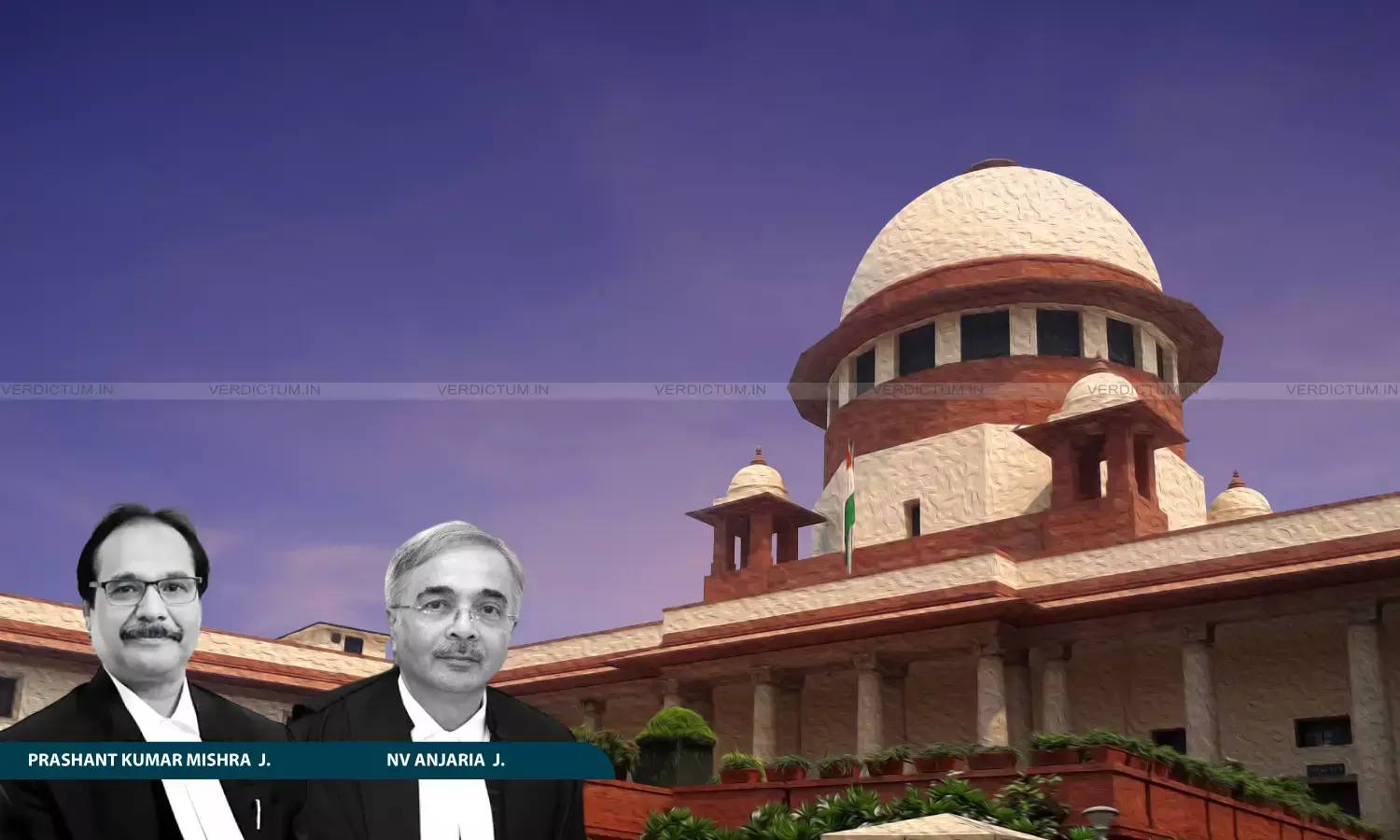
Supreme Court, Justice Prashant Kumar Mishra, Justice N.V. Anjaria
While awarding enhanced motor accident compensation to a mason whose right leg came to be amputated, the Supreme Court has held that the physical disability may be assessed at a particular percentage, but the functional disability affecting earning capacity may, depending upon the nature of the avocation carried on by the injured, be assessed at a higher percentage, including 100%.
The Appeal before the Apex Court arose out of the judgment passed by the Madras High Court partly allowing the appeal preferred by the appellant-claimant and enhancing the compensation awarded by the Motor Accident Claims Tribunal/Sub Court from Rs 10,84,330 to Rs 23,86,320 together with interest.
Referring to the judgment in Raj Kumar vs. Ajay Kumar and Another (2011) wherein it has been held that for the purposes of determining compensation, the effect of the permanent disability on the earning capacity of the injured is the relevant consideration, the Division Bench of Justice Prashant Kumar Mishra and Justice N.V. Anjaria stated, “From the above observations in Raj Kumar (supra), it becomes crystal clear that though the physical disability may be assessed at a particular percentage, the functional disability affecting earning capacity may, depending upon the nature of avocation carried on by the injured, be assessed at a higher percentage including 100%. The assessment of compensation in cases of permanent disability cannot be undertaken by mechanically applying the percentage of physical disability as the percentage of economic loss.”
AOR R. Shase represented the Appellant, while Advocate Abhishek Kumar Gola represented the Respondent.
Factual Background
The incident dates back to the year 2017 when the appellant, proceeding on his bicycle, got hit by a lorry coming from behind. As a result of the accident, the appellant sustained grievous injuries, including injuries to his head, jaw, eye and right leg. Owing to the severity of the injuries suffered, his right leg subsequently came to be amputated above the knee. Pursuant to the accident, the FIR came to be registered at Rasipuram Police Station under Sections 279 and 338 of the Indian Penal Code, 1860, against the driver of the offending vehicle. The Tribunal held the driver of the offending lorry negligent and consequently fastened liability upon the owner and insurer of the vehicle.
The appellant instituted claim proceedings under Section 166 of the Motor Vehicles Act, 1988, before the MACT, claiming compensation of Rs 25,00,000 for the injuries and permanent disability suffered by him in the aforesaid accident. It was the case of the appellant that at the time of the accident, he was aged about 30 years and was working as a mason earning approximately Rs. 20,000 per month. The appellant further asserted that on account of the amputation of his right leg and the permanent disability suffered by him, he had lost his earning capacity. The disability certificate issued by the competent authority assessed his permanent disability at 70%. The High Court, by the impugned judgment, partly allowed the appeal and enhanced the monthly income of the appellant from Rs 6,000 to Rs 12,000 and further granted an addition of 40% towards future prospects. Still dissatisfied with the quantum of compensation so determined by the High Court, the appellant-claimant approached the Apex Court seeking further enhancement of compensation.
Reasoning
On a perusal of the impugned judgment, the Bench noted that while the High Court enhanced the monthly income of the appellant from Rs. 6,000 to Rs. 12,000, it awarded a sum of Rs 3,42,720 towards future prospects by applying an addition of 40%. It was further noticed that the said amount of Rs 3,42,720 was arrived at by applying 40% future prospects on the amount of loss of income as calculated by the Tribunal, namely Rs. 8,56,800.
“Once the High Court itself enhanced the monthly income of the appellant to Rs. 12,000/- and consequently recalculated the loss of earning capacity at Rs. 17,13,600/- (12,000 × 12 × 17 × 70/100), the addition towards future prospects ought to have been computed on the said recalculated amount. In such circumstances, the correct amount towards future prospects would work out to Rs. 6,85,440/- being 40% of Rs. 17,13,600/-. The High Court appears to have inadvertently computed the addition towards future prospects on the basis of the income assessed by the Tribunal instead of the recalculated income determined by the High Court itself”, it added.
Considering that the disability certificate issued by the competent authority assessed the permanent disability suffered by the appellant at 70%, the Bench held that the Tribunal as well as the High Court proceeded on the basis of the said physical disability and accordingly assessed the loss of earning capacity at 70%. As per the Bench, both the Courts failed to examine the aspect of functional disability suffered by the appellant in the peculiar facts of the present case.
Taking note of the fact that the appellant underwent amputation of his right leg above the knee, the Bench held that by virtue of the aforesaid amputation, the appellant effectively lost his capacity to continue the work of a mason, which was admittedly the sole avocation being pursued by him for earning his livelihood. “The amputation of the right leg above the knee has not merely caused physical disability to the appellant but has rendered him incapable of effectively carrying on the manual and physical work which constituted his only source of livelihood. In such circumstances, restricting the loss of earning capacity to 70% merely on the basis of physical disability would not be justified”, it stated.
The Bench thus held that the functional disability suffered by the appellant was required to be assessed at 100% and not at 70% as assessed by the Tribunal and affirmed by the High Court. The Bench thus recalculated the compensation payable towards loss of earning capacity by holding the monthly income of the appellant at Rs 12,000 with the addition of 40% towards future prospects and applying the multiplier of ‘17’. Thus, partly allowing the appeal, the Bench enhanced the compensation to Rs 40,29,730. “The respondent no. 2-Insurance Company is directed to deposit the enhanced amount before the Tribunal within a period of six weeks from today”, it ordered.
Cause Title: M Paramesh v. VRL Logistics Ltd. (Neutral Citation: 2026 INSC 655)
Appearance
Appellant: AOR R. Shase, Advocates R Kanishca, Senthil Kumar, Kamalesh C
Respondent: Advocate Abhishek Kumar Gola, AOR Sudhir Naagar, Advocates Arun Kumar Nagar, Anshul Mehral, Sidharth Khatana, Kunal Chaudhary, Mahin Khan, Seerat Nissar Bhat