Deceased’s Substance-Abuse History Made Accident Theory Probable: Supreme Court Acquits Man Of Murder
The Court noted that the deceased was found in an open field beside his motorcycle and that the autopsy surgeon had not ruled out the possibility of the injuries being caused by a fall from a moving motorcycle.
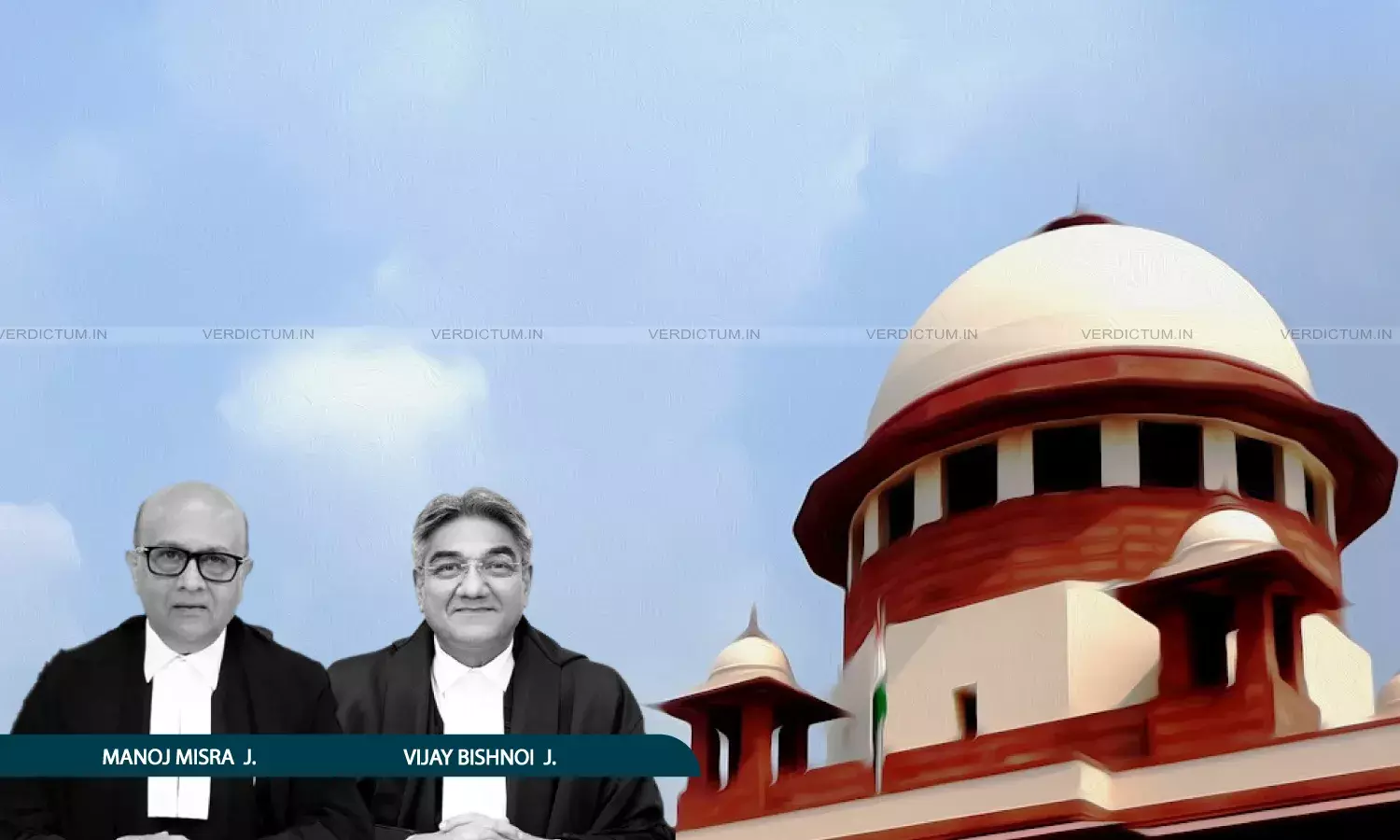
Justice Manoj Misra, Justice Vijay Bishnoi, Supreme Court
The Supreme Court acquitted a man convicted of murder after holding that the deceased’s substance-abuse history made the defence theory of a motorcycle accident probable and created doubt about the prosecution’s case.
The Court found that the prosecution had failed to establish a complete chain of circumstances connecting the appellant to the death. It set aside his conviction under Sections 302 and 201 of the Indian Penal Code, 1860 and directed his immediate release unless required in another case.
The Court was hearing an appeal challenging a Chhattisgarh High Court judgment affirming the Trial Court’s conviction of the appellant for murder and causing disappearance of evidence. The prosecution case rested entirely on circumstantial evidence, including WhatsApp messages, alleged recoveries and unexplained injuries on the appellant.
A Bench of Justice Manoj Misra and Justice Vijay Bishnoi observed: “Another important feature of the case is that the deceased was a person habituated to substance abuse. Such a person is prone to accident. Therefore, the accident theory set up in defence is probable and creates a doubt about the prosecution case.”
Advocate Yasharth Kant appeared for the appellant, while Advocate Ankita Sharma appeared for the State.
Background
The judgment noted that the deceased was found lying in an open field with his motorcycle and a yellow rope beside him. The matter was initially reported to the police as an accidental death, but an FIR against unknown persons was subsequently registered after the autopsy raised suspicion of homicide.
The prosecution alleged that the appellant had fought with and killed the deceased before moving his body to the field. It relied upon WhatsApp messages allegedly exchanged between two witnesses, a disclosure statement, and the purported recovery of an iron rod, screwdriver, bloodstained soil and a shirt.
The Trial Court convicted the appellant under Sections 302 and 201 IPC. The High Court affirmed the conviction after holding that the prosecution had established homicidal death, a quarrel, last-seen evidence, recovery of the alleged weapons and unexplained injuries on the appellant.
Before the Supreme Court, the appellant contended that no witness had placed the deceased with him on the relevant night, the WhatsApp messages were unsupported, and the recovered articles were not forensically connected to the deceased. The State relied upon the messages, the alleged bloodstains and the appellant’s unexplained injuries.
Court’s Observations
Circumstantial Chain Was Not Established
The Court reiterated that every circumstance relied upon in a case based entirely on circumstantial evidence must be fully established and must unerringly point towards the accused’s guilt.
Referring to Sharad Birdhichand Sarda v. State of Maharashtra (1984), the Bench held: “The circumstances taken cumulatively should form a chain so far complete that there is no escape from the conclusion that within all human probability the crime was committed by the accused; the circumstances should be consistent only with the hypothesis regarding the guilt of the accused; and they must exclude every possible hypothesis except the one to be proved. Further, the circumstances from which the conclusion of guilt is to be drawn should be fully established, meaning thereby that they ‘must’ or ‘should’ and not ‘may be’ established.”
The Court also referred to Shivaji Sahabrao Bobade v. State of Maharashtra (1973) and reiterated that an accused must be, and not merely may be, guilty before a conviction can follow.
The Bench found no evidence that the deceased was last seen alive with the appellant. It noted that the witnesses relied upon by the prosecution to establish the deceased’s presence in the appellant’s house had not supported that case.
WhatsApp Messages Created Only Suspicion
The Court considered whether the WhatsApp communication could be treated as relevant under Sections 6, 7 or 8 of the Indian Evidence Act, 1872. It held that the time of death had not been fixed through substantive evidence, making it difficult to establish that the messages formed part of the same transaction under Section 6.
The Bench further observed that both witnesses connected with the messages denied witnessing the incident, while the alleged sender also denied sending them.
The Court held: “Whether that information was based on PW-5’s personal knowledge or on hearsay, or assumptions, would depend on his deposition in Court. PW-5 and PW-6 both made a statement that they have not witnessed the incident. PW-5 goes to the extent of saying that he has not sent the message. In such circumstances, who was the author of that message; whether that message was sent on the basis of personal knowledge of the person who sent the message or it was based on hearsay information received by its author, are all questions of which there is no answer.”
The Bench consequently held that the messages did not establish that the deceased was present in the appellant’s house or that the appellant assaulted him. At most, they created suspicion, which could not sustain a conviction.
Recoveries Were Not Connected To The Deceased
The Court found doubt concerning whether bloodstained soil had been recovered from the appellant’s house or only from the field where the body was discovered. It noted material differences between the testimony of the seizure witnesses.
The Bench observed: “Whether the blood-stained soil was recovered from the house/ room of the accused or was recovered from the open field is an aspect on which one of the witnesses of the seizure memo has created a doubt. Additionally, the blood-stains could not be connected to the deceased and, admittedly, there is no DNA profile of the blood so recovered to match it with the DNA profile of the deceased. Same is the case with the iron rod and the screwdriver.”
The Court therefore held that the alleged recoveries did not complete the chain of circumstances against the appellant.
Accident Theory Created Reasonable Doubt
The Court noted that the deceased’s body was found in an open field beside his motorcycle. Although the autopsy surgeon described the death as homicidal, he admitted that the injuries could also have resulted from falling from a moving motorcycle.
The Bench held that this medical possibility, considered with the deceased’s substance-abuse history, rendered the accident theory probable and raised doubt about the prosecution’s version.
The Court further rejected the reliance placed on the appellant’s failure to explain his injuries. It held that this circumstance might have carried weight had the prosecution first established that the appellant and the deceased were seen fighting shortly before the body was found.
The Bench stated: “The absence of explanation of his injuries by the accused found during medical examination conducted on 11.02.2019, in no circumstance could lead to an inference that he is guilty. This circumstance may have been of value if the prosecution had been successful in establishing that the accused and the deceased were seen fighting soon before the body of the deceased was found. Notably, none of the prosecution witness has deposed that the accused and the deceased were fighting on the fateful night.”
Conclusion
The Supreme Court held that there was hardly any evidentiary basis upon which the appellant’s conviction could be sustained.
It allowed the appeal, set aside the judgments of the Trial Court and the Chhattisgarh High Court, and acquitted the appellant of all charges. The Court directed his immediate release unless he was required in another case and disposed of the pending applications.
Cause Title: Kusumlal Sao v. State of Chhattisgarh (Neutral Citation: 2026 INSC 1148)
Appearances
Appellant: Advocates Yasharth Kant (AOR), Tanvi Saran, Sonal Kushwah and Abhinav Sharma
Respondents: Advocates Ankita Sharma (AOR), Arjun D. Singh, Akanksha Kumari and Gargi Vishwakarma