

Registration Certificate Not Conclusive Of Entitlement To Interim Possession Of Seized Vehicles: Supreme Court
The Supreme Court was considering an appeal challenging the judgment passed by the Andhra Pradesh High Court.

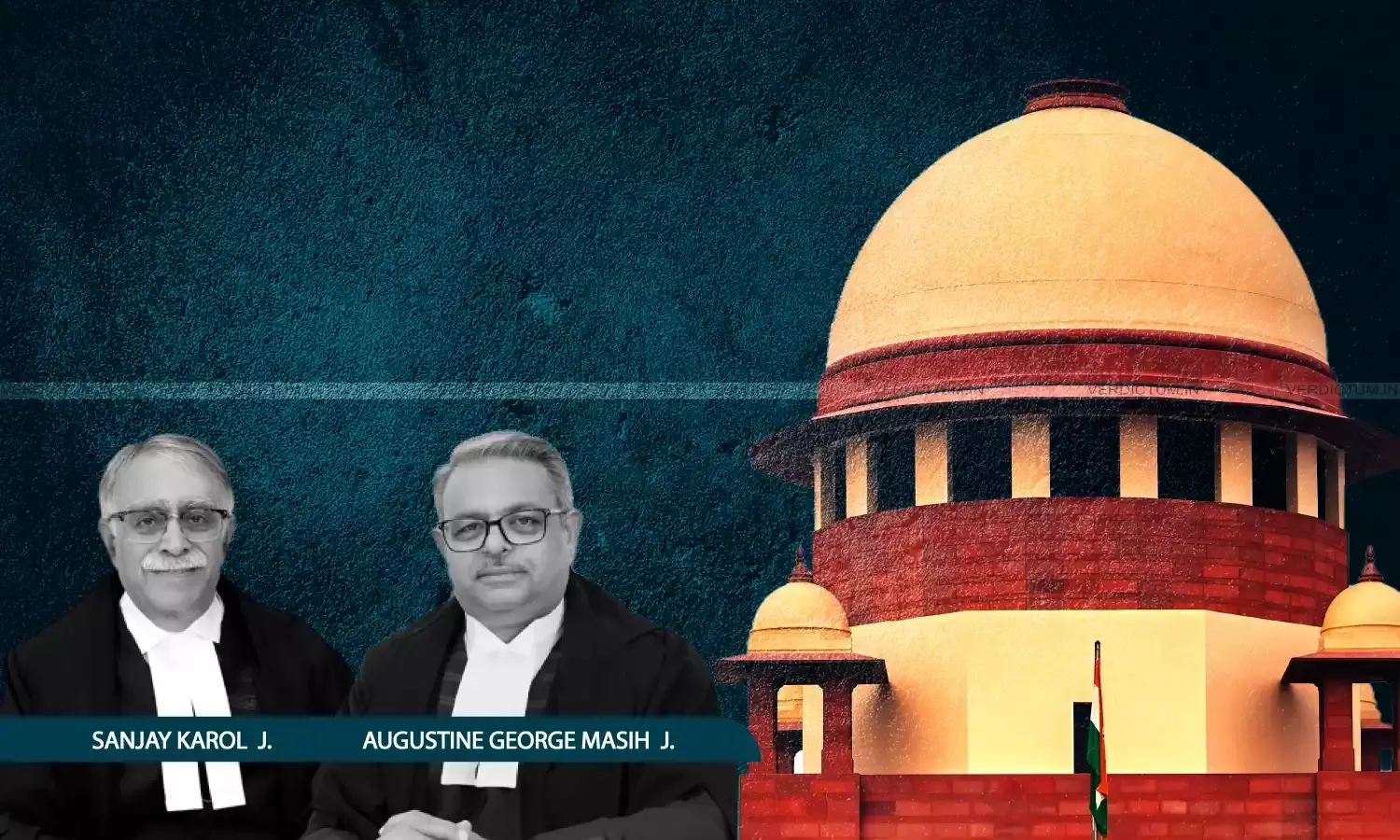
While observing that a registration certificate is a relevant factor but not conclusive of entitlement to interim possession of seized vehicles, the Supreme Court has upheld an order granting interim possession of seized vehicles to a Company.
The Apex Court was considering an appeal challenging the judgment passed by the Andhra Pradesh High Court wherein the Petition filed by the appellant was dismissed, and the petition filed by M/s Earth Stein Private Limited (respondent company) was allowed. By the said order, the interim custody of the subject vehicles, namely one Bolero City Pick-up, 3 Excavators and one Ashok Leyland Tipper was granted to the respondent company, pending the resolution of the criminal cases between them.
The Division Bench of Justice Sanjay Karol and Justice Augustine George Masih held, “Applying the above stated principles to the facts at hand, we may now consider the circumstances relied upon by the parties. The appellant's case rests almost entirely on the registration certificates standing in the name of his company. We are unable to accept that this circumstance, by itself, is determinative. Registration is a relevant factor, but it is evidentiary and not conclusive of entitlement to interim possession.”
Senior Advocate S. Nagamuthu represented the Appellant while AOR Guntur Pramod Kumar represented the Respondent.
Factual Background
The Appellant is the director of one M/s Pure Minerals involved in the quarrying of granite. He was also a director of the respondent company with an 80% shareholding. The subject vehicles were purchased in the name of the company M/s Pure Minerals between 2014 and 2022. It was the case of the appellant that he visited the house of the owner of M/s Parakrish Mineral Enterprises Pvt. Ltd, a company from which certain amounts were due to the appellant towards the supply of granite. On this occasion, the respondents S.R Kumar, T. Arivudainambi and G. Thirgunanam intimidated him and got his signatures on blank papers, which were used to forge his resignation from the respondent company. The Respondents committed criminal trespass into the granite factory of M/s Pure Minerals and forcefully took away the subject vehicles. An FIR was registered in this regard based on the complaint filed by the appellant.
The Respondent alleged that the appellant had misappropriated ₹1,73,11,894 from the respondent company and utilised the amounts to purchase the subject vehicles in the name of his company M/s Pure Minerals, with himself as the authorised owner. Following the seizure of the vehicles, the appellant filed a Criminal Miscellaneous Petition before the Trial Court seeking interim custody. This was dismissed by an order noting that a Writ Petition filed by the Respondents was pending before the High Court regarding the legality of the re-investigation and the seizure, which would be rendered infructuous if the petition was to be decided at that stage. Aggrieved, the petitioner approached the High Court seeking quashing of this order. Similarly, the Respondent company also preferred a Petition before the Trial Court for return of properties which came to be dismissed. Against this, a Petition was filed before the High Court. The petition of the respondent company was allowed, and the subject vehicles were ordered to be released in its favour subject to an undertaking affidavit. Aggrieved by the impugned order, the appellant filed the appeals.
Reasoning
Referring to Section 451 and 457 of the CrPC, the Bench explained that as per the language used in these provisions, the Court is vested with the power to grant custody to whomsoever it deems fit i.e. the Court has the discretion to determine who is best entitled to possession of the property. “The use of the words ‘possession’ and ‘custody’ emphasize that the Court does not adjudicate title but merely undertakes the exercise of granting interim possession, with the object of preventing decay and diminution in the value of the subject property”, it added.
The Bench noted that the registration certificate stood considerably weakened given that criminal proceedings remained pending against the appellant alleging misappropriation of funds from the accounts of the respondent company for the very purpose of acquiring the subject vehicles in the name of his own company. Another circumstance weighing in favour of the respondent company was the fact that the hypothecation instalments payable to Shriram Finance Ltd. towards the loan availed for the subject vehicles had admittedly been discharged from the account of the respondent company, and not by the appellant in his individual capacity. It was also undisputed that the vehicles were seized from the operational site of the respondent company, where they had remained in continued use pursuant to a written undertaking executed by the appellant himself.
“In view of the above, we agree with the findings of the High Court. Based on a cumulative assessment, we find that the circumstances favouring the respondent company, namely, the continued possession, the undisputed factum of the payment of the EMI instalments, and the undertaking on record, outweigh the circumstances in favour of the appellant, namely the registration certificates”, it held.
Thus, holding that the respondent company M/s Earth Stein Private Limited had been rightly granted the interim possession, the Bench dismissed the appeals.
Cause Title: Krishnan Narayana v. State of Andhra Pradesh (Neutral Citation: 2026 INSC 748)
Appearance
Appellant: Senior Advocate S. Nagamuthu, AOR M.P. Parthiban, Advocates Priyaranjani Nagamuthu, Bilal Mansoor, Shreyas Kaushal, S. Geyolin Selvam, Alagiri K, Shivansh Sharma, Abhishek S
Respondent: AOR Guntur Pramod Kumar, Advocates Prerna Singh, Vanshika Singh, AOR Aniruddha Purushotham, Honey Singh, Advocates Pratyaksh Kumar, Laxman Tapashi, Virendra Mohan