

Comparing Coal & Iron Ore Is Like Apples & Oranges: Supreme Court Upholds Rule Barring Deduction Of Royalty, DMF, NMET Payments
Explanation preventing "royalty on royalty" deduction held constitutional as legitimate anti-evasion measure after Union demonstrates manipulation of average sale price by miners in Odisha & Karnataka.

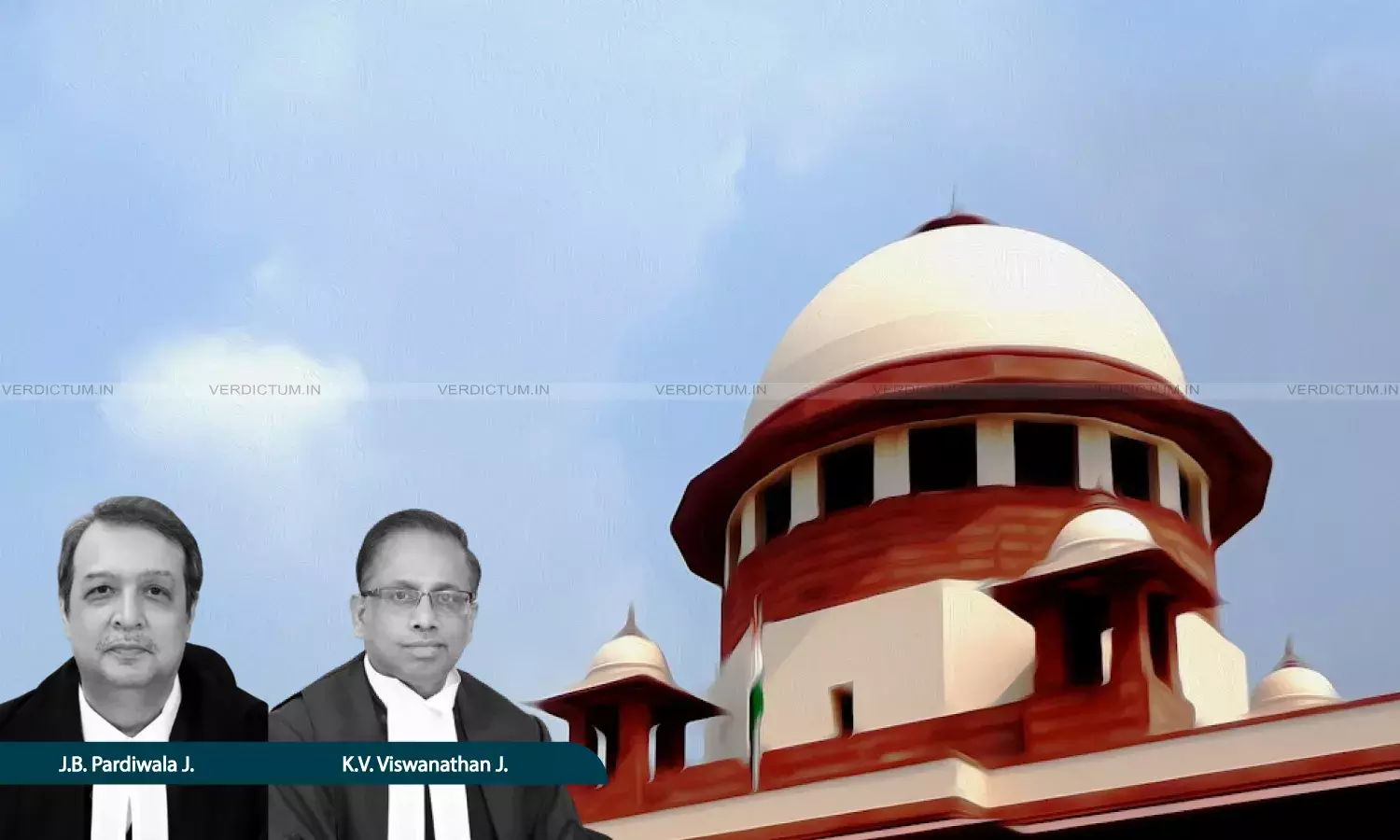
Justice J.B. Pardiwala, Justice K.V. Viswanathan, Supreme Court
The Supreme Court has upheld the constitutional validity of the Explanations appended to Rule 38 of the Minerals (Other than Atomic and Hydro Carbons Energy Minerals) Concession Rules, 2016 and Rule 45(8)(a) of the Mineral Conservation and Development Rules, 2017. It mandates that no deduction shall be made from the gross sale amount in respect of payments made towards Royalty, District Mineral Foundation (DMF) and National Mineral Exploration Trust (NMET) while computing sale value for iron ore, holding that the measure of tax is not a true test of the nature of tax.
It held that individual hardship cannot invalidate a levy aimed at preventing tax evasion, especially where evidence shows deliberate price manipulation to reduce royalty and premium payments.
The Court rejected the comparison with coal as akin to comparing apples and oranges, noting coal pricing relies on the National Coal Index derived from PSU notified/auction prices and import prices, whereas iron ore's ASP is entirely dependent on data self-reported by miners, making it far more susceptible to manipulation.
A Bench comprising Justice J.B. Pardiwala and Justice K.V. Viswanathan observed, “…we hold that the Explanations to Rule 38 of the 2016 Rules and Rule 45(8)(a) of the 2017 Rules, insofar as they provide for inclusion of royalty and payments made towards DMF and NMET in the sale value for computing the average sale price for determination of royalty, is constitutional and valid. We hold that the impugned Rules are not violative of Article 14 and Article 19(1)(g) of the Constitution. We further hold that the impugned provisions are not ultra vires Section 9 of the MMDR Act”.
“We find nothing manifestly arbitrary in the process adopted. There is nothing capricious or irrational about the measure and it cannot be said that it has been adopted without any determining principle nor do we find the measure excessive or disproportionate for it to be characterized as manifestly arbitrary”, it noted further.
Senior Advocates Dr. Abhishek Manu Singhvi and Balbir Singh appeared for the petitioner and R. Venkataramani, Attorney General for India appeared for the respondent.
Kirloskar Ferrous Industries, holding a mining lease for iron ore in Karnataka secured through auction, challenged the Explanations to Rule 38 of the 2016 Rules and Rule 45(8)(a) of the 2017 Rules, which prevented deduction of Royalty, DMF and NMET payments from the sale value used to compute the Average Sale Price (ASP), the base figure on which 15% royalty on iron ore is levied under Section 9 of the MMDR Act.
The petitioners contended this created a "cascading" or "royalty on royalty" effect, inflating the effective levy well beyond the statutory rate, and pointed out that an identical anomaly for coal had been rectified by a 2020 amendment excluding such payments from "actual price."
The petitioners had earlier challenged the same provisions in an earlier writ petition, disposed of on May 19, 2025, wherein the Court noted the Union's own acknowledgment of the anomaly via a Committee constituted under Praveen Kumar and granted the Union two months to conclude a public consultation process on amending the Rules.
When the Union ultimately decided not to amend the Rules, citing revenue concerns, the Court granted the petitioners liberty to challenge that decision afresh "on all grounds available to them in law," leading to the present writ petition.
The Court drew on a long line of precedent, including Sardar Baldev Singh v. CIT, Delhi & Ajmer 1960 SCC OnLine SC 147, Balaji v. ITO 1961 (43) ITR 393, Navnit Lal C. Javeri v. K.K. Sen, Appellate Assistant Commissioner of Income Tax, Bombay [1965] 1 SCR 909, and Union of India v. A. Sanyasi Rao (1996) 3 SCC 465, to hold that legislative competence to levy a tax or contractual consideration inherently includes competence to enact measures preventing its evasion, even through statutory fictions, and that such measures are not rendered unconstitutional merely because they may cause hardship in individual cases.
The Union placed before the Court detailed month-wise data from Odisha and Karnataka for August 2022 to January 2023, demonstrating that mines reporting the highest ex-mine prices in one month would report negligible despatches, while mines reporting the lowest ex-mine prices would report disproportionately high despatches in the same period, a pattern the Court found indicative of deliberate manipulation to depress the weighted-average ASP.
“We also do not find any violation of Article 14 of the Constitution from the angle of discrimination. The comparison with coal is completely unjustified as there is no concept of ASP in coal and that too based on data given by the miners. Hence, comparing coal and iron ore, in this context, is akin to comparing apples and oranges which we are not prepared to do. According to the petitioners, ad valorem cannot include in the value the levy of royalty, payments made towards DMF and NMET. We are not able to countenance that submission. As a means to check evasion, a measure has been prescribed under which ad valorem will be arrived at to check manipulation and to strike at evasion, certain factors have been loaded on to the sale value and we find nothing illegal in the same”, the Bench said.
“…In the challenge to the Constitutionality of the Rules as to demonstrate how the levy is illegal, the petitioners have not been able to establish unconstitutionality. On the contrary, the Union has offered proper justification for the measure of levy adopted and it passes constitutional muster”, the Bench noted further.
Accordingly, the writ petition was dismissed, and it held the impugned Explanations to be constitutional, not violative of Articles 14 and 19(1)(g) of the Constitution of India, and not ultra vires Section 9 of the MMDR Act. No order as to costs.
Cause Title: Kirloskar Ferrous Industries Ltd. and Anr. v. Union of India & Anr. (Neutral Citation: 2026 INSC 679)
Appearances:
Petitioners: Dr. Abhishek Manu Singhvi and Balbir Singh, Senior Advocates, with Ninad Laud, Advocate.
Respondents: R. Venkataramani, Attorney General for India.