Weapon Recovery Alone Cannot Sustain Conviction Without Link To Crime: Supreme Court Restores Trial Court Acquittal In 1988 Murder Case
The Apex Court held that recovery of a blood-stained weapon under Section 27 of the Evidence Act, without a proved connection to the crime and without trustworthy ocular or circumstantial evidence, could not justify a conviction
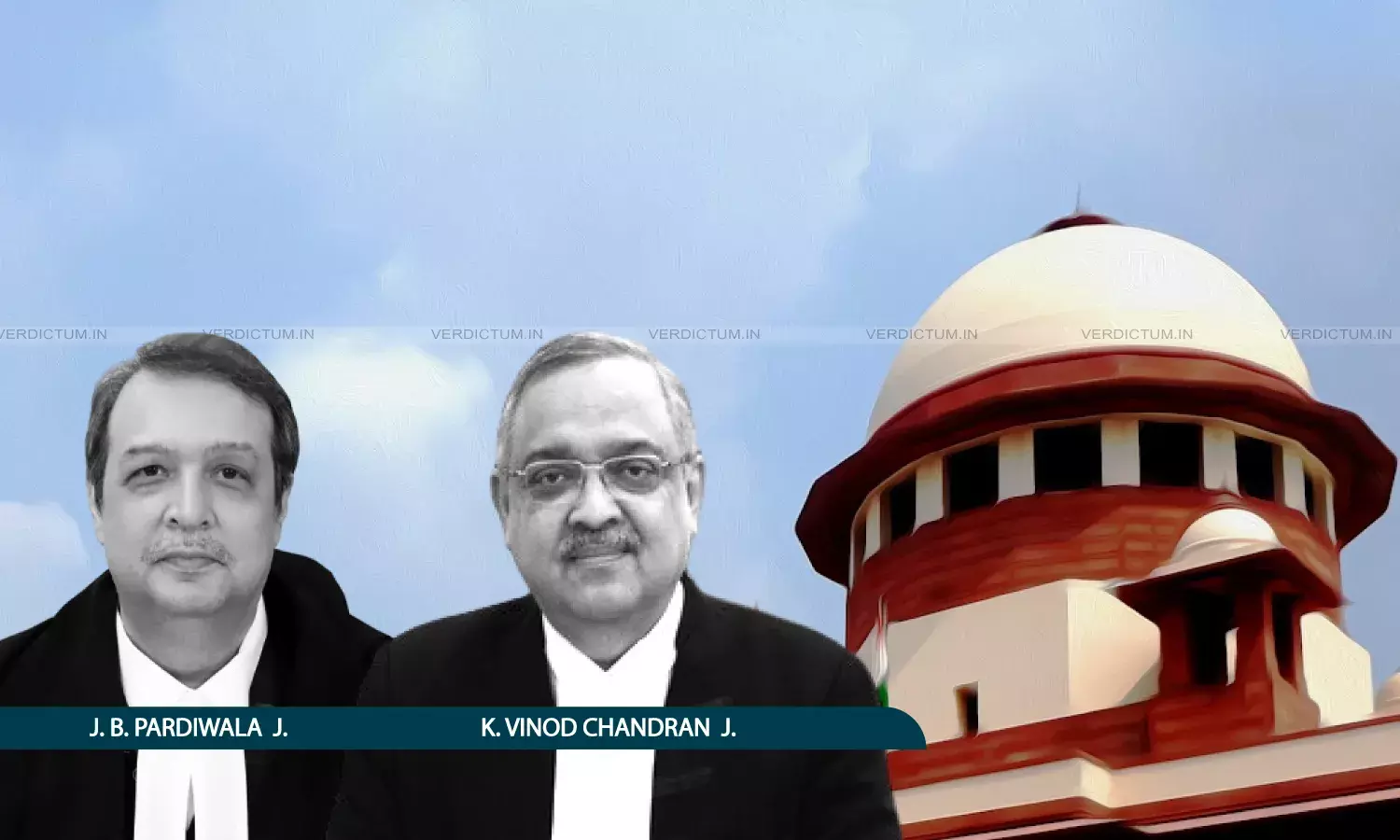
Justice J. B. Pardiwala, Justice K. Vinod Chandran, Supreme Court
The Supreme Court has held that recovery of a weapon under Section 27 of the Indian Evidence Act, 1872, even if proved and even if human blood is found on it, cannot by itself lead to conviction unless the prosecution establishes a clear link between the recovered weapon, the crime and the accused.
The Supreme Court accordingly restored the Trial Court’s order of acquittal in a 1988 murder case, holding that the eyewitness testimonies were suspect, the alleged dying declaration was not credible, the scene of occurrence was doubtful, and the prosecution's evidence did not satisfy the standard required to overturn an acquittal.
The Court was hearing an appeal against a Bombay High Court order which had remitted the matter to the Sessions Court for reconsideration of eyewitness testimony, Section 27 recoveries and the chemical analysis report, after the Trial Court had acquitted the accused.
A Bench of Justice J.B. Pardiwala and Justice K. Vinod Chandran observed: “Section 27 recovery of the weapon has been proved, and blood stains were found on it, which on chemical analysis was found to be human blood. The prosecution did not confront the eyewitness with the weapon, which the Trial Court was described in a manner, which was not in consonance with the physical appearance of the weapon produced before the Court. Section 27 recovery alone cannot lead to a conviction and here it fails to implicate A4 since there is no connection to the crime proved, but for the human blood found, not indicated to be that of the accused.”
The Bench further added: “The only evidence is the blood stains found on the weapon recovered under Section 27 of the Evidence Act which by itself cannot lead to a finding of guilt without other circumstances which provide a complete chain leading to the hypothesis of guilt being the only one possible, excluding any hypothesis of innocence.”
Advocate Amol Nirmalkumar Suryawanshi appeared for the appellants, while Advocate Nitin Lonkar appeared for the respondents.
Background
The case arose from the alleged murder of a man in 1988. The Trial Court had examined the evidence and acquitted the accused. The deceased’s brother approached the High Court in revision against the acquittal.
The High Court had once set aside the acquittal without hearing the accused, but the matter was remitted by the Supreme Court since Section 401(2) CrPC restricts the exercise of revisional power to the prejudice of an accused without affording an opportunity of hearing.
On remand, the High Court again remitted the matter to the Sessions Court to reconsider the eyewitnesses’ testimony along with the recoveries under Section 27 of the Evidence Act and the chemical analysis report. The High Court, however, upheld the Trial Court’s refusal to rely on the alleged dying declarations.
Court’s Observations
The Court first considered the procedural issue arising from the fact that the case had reached the High Court in revision. It noted that when the revision was filed in 1990, there was no statutory right of appeal for a victim against acquittal, though such a right was later introduced through the proviso to Section 372 CrPC.
The Court referred to Mallikarjun Kodagali v. State of Karnataka (2019) and Joseph Stephen v. Santhanasamy (2022) on the victim’s appellate remedy after the 2009 amendment.
The Court noted: “As on the date of filing of the criminal revision application, there was no provision for appeal by the victim from an order of acquittal and Section 378 of the Cr.P.C only provided for an appeal in case of acquittal, by the State, that too after obtaining leave of the High Court.”
Considering that the incident was from 1988 and the accused had faced legal proceedings for decades, the Court decided to reappreciate the evidence itself.
The prosecution relied on eyewitnesses who claimed to have seen the assault. The Court noted that one witness consistently spoke of another person being present with him during both the earlier altercation and the later assault, but that person was not examined.
The Court observed that the other eyewitnesses did not speak of each other’s presence. It also noted that the alleged eyewitnesses, despite claiming close acquaintance with the deceased, neither took him to the hospital nor informed the police, even though the police station was nearby.
The Court stated: “Chance witnesses in a public place, as found by the High Court cannot be disbelieved for that reason alone. However, their testimony, especially of the incident, does not inspire confidence and hence their presence at the scene of occurrence had to be established since all of them had close acquaintance with the injured and did not take him to the hospital or inform the police.”
The Court found serious inconsistencies regarding the alleged dying declaration. One witness claimed that the deceased made a dying declaration in the auto-rickshaw, while another claimed it was made in the hospital.
The Court also noted contradictions between the doctors on whether the injured was conscious. The doctor who first attended to the injured stated that he was brought unconscious and did not regain consciousness, while another doctor later said he was conscious enough to make a dying declaration.
The Court observed: “The dying declaration hence, is on a very sketchy premise, was the finding of the Trial Court, especially when there was no clarity as to the conscious state of the injured at the hospital which is also presumably from the very grievous injuries suffered by the deceased, as disclosed from the postmortem report which also speaks of internal injuries in the lung and the heart making it highly improbable that the injured was conscious and was able to speak clearly of the assault made by the five named persons.”
The Court also found that the scene of occurrence was not free from doubt. It noted that despite the alleged brutal assault, the Investigating Officer had only prepared a scene mahazar and had not seized any material from the spot.
The Court observed: “Definitely the blood of the accused would have been spilled at the scene, since he sustained numerous cut injuries and would have been profusely bleeding at the spot from which he was alleged to have been transported to the hospital.”
This, the Court held, added to the suspicion about the prosecution version.
The Court accepted that recovery of the weapon under Section 27 had been proved and that human blood was detected on it. However, it held that this circumstance did not establish guilt.
The Court noted that the eyewitnesses were not confronted with the weapon, that the Trial Court had found inconsistency between the description of the weapon and its physical appearance, and that the blood was not shown to be connected with the deceased.
The Court emphasised that once a Trial Court records acquittal, the presumption of innocence in favour of the accused stands fortified.
The Court observed: “The principle not to overturn an acquittal if the view taken in the order of acquittal is plausible; even if another view is possible, is not one of mere caution but is a tenet of criminal jurisprudence which ensures no prejudice being caused to the accused and ensures the benefit of any reasonable doubt arising, being conferred on the accused.”
The Court acknowledged the anguish of the deceased’s brother but held that conviction could not rest on assumptions.
The Bench remarked: “A brutal murder definitely, and we understand the anguish of the brother who was the revision petitioner. The murder went unavenged, but it is not for the courts to convict the accused on mere assumptions when the evidence led by the prosecution fails to satisfy the judicial mind, of the guilt of the accused.”
Conclusion
Allowing the appeal, the Supreme Court set aside the High Court’s order and restored the Trial Court’s acquittal.
Cause Title: Khalil Pasha & Ors. v. Abdul Rasheed & Anr. (Neutral Citation: 2026 INSC 754)
Appearances
Appellants: Advocate Amol Nirmalkumar Suryawanshi with Advocates Damini Vishwakarma, Srishty Pandey and B. Dhananjay
Respondents: Advocates Nitin Lonkar, Siddharth Dharmadhikari, Aaditya Aniruddha Pande and Shrirang B. Varma; M/s PBA Legal, AOR