

Registration of FIR And Onward Dispatch Do Not Replace Duty To Record & Transmit Secret Information U/S 42 NDPS Act: Supreme Court
The Bench noted that substantive compliance proved as contraband interception in public transit exigency justified contemporaneous ruqa and telephonic notice to superior officer.

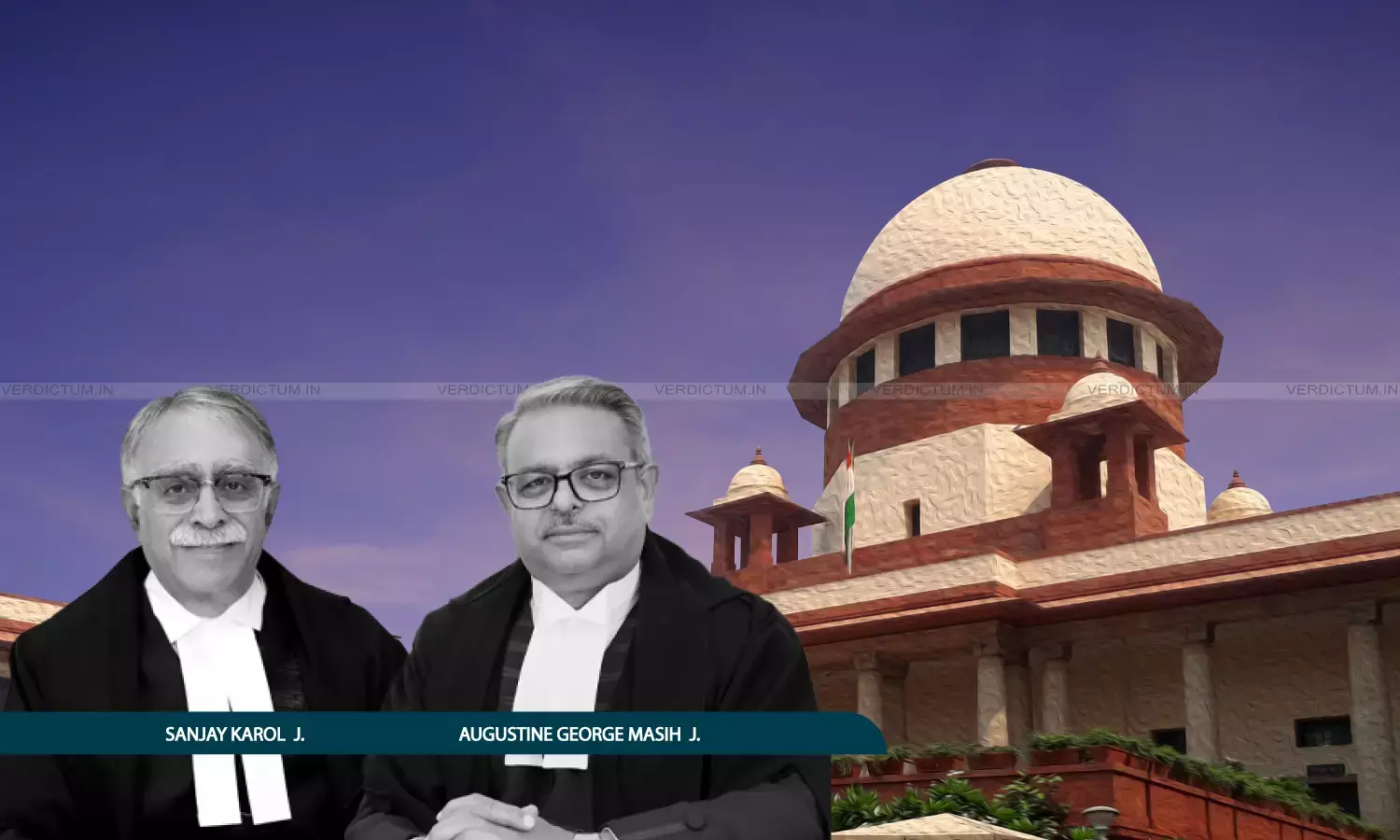
The Supreme Court has held that the procedural registration of a First Information Report (FIR) under the Code of Criminal Procedure, 1973, along with its routine transmission to superior authorities, cannot serve as a substitute for the statutory obligations mandated under Section 42 of the Narcotic Drugs and Psychotropic Substances Act, 1985.
The Court held that while total non-compliance with the requirement to reduce secret information into writing and transmit it to a superior officer is fatal to the prosecution, substantial compliance can be established if the information is received on the move in an emergent situation, provided a contemporaneous writing like a ruqa is dispatched prior to the search and the superior officer is promptly notified.
The Bench noted that Section 50 of the NDPS Act applies strictly to the personal search of an individual and does not extend to the search of a vehicle or container. Consequently, any procedural irregularity regarding personal search or the rank of an officiating officer does not vitiate a recovery made separately from a vehicle. Furthermore, the Court emphasized that delay in sending samples to the Chemical Examiner constitutes a mere procedural irregularity if judicial orders and laboratory reports independently verify that the seals remained intact and untampered throughout the intervening period.
The Bench comprising Justice Sanjay Karol and Justice Augustine George Masih observed, “…The registration of an FIR and its onward transmission through the ordinary channels of the Code of Criminal Procedure are no substitute for the distinct obligation which Section 42 casts, and compliance with the latter is not to be assumed from the former. It is nevertheless necessary to notice the precise vice at which that proposition is directed. It is directed against an assumption, and against the practice of treating the registration of an FIR, without more, as discharging an obligation which the statute casts separately and independently. It does not enact a rule of exclusion, whereby the circumstance that an FIR came to be registered upon a writing emanating from the empowered officer himself is to be shut out from consideration altogether when the Court comes to determine, upon the totality of the material, whether the statutory purpose has in fact been served. The distinction is one between assuming compliance from a single circumstance and weighing that circumstance along with others, and it is a distinction which the Courts below did not overlook”.
The brief facts of the case center on an interception conducted on May 4, 2014, near the Canal Bridge, Village Tehang, Punjab, where police officials acting on secret information stopped a Tata Safari vehicle occupied by Dharam Pal @ Bobby and the appellant, Kashmir Ram @ Pappi. A search of the vehicle yielded ten plastic bags containing 200 kilograms of poppy husk hidden under a tarpaulin, and a subsequent search based on disclosure statements led to the recovery of eight additional bags weighing 160 kilograms from their residence.
The Special Court, Jalandhar, convicted both accused under Section 15(c) NDPS Act for commercial quantity, sentencing them to ten years of rigorous imprisonment and a fine of INR 1,00,000. While the trial court discarded the house recovery for non-compliance with Section 100(4) CrPC, it upheld the vehicle recovery. The Punjab and Haryana High Court dismissed the joint appeal on October 30, 2019, affirming the conviction. Kashmir Ram subsequently assailed the High Court's decision before the Supreme Court.
The Court held that the recovery from the vehicle was executed in an emergent transit situation, where reducing secret information to writing beforehand was not feasible, and that dispatching a ruqa alongside telephonically summoning the Gazetted Officer constituted valid substantial compliance under Section 42. The Court further reasoned that Section 50 safeguards do not govern vehicle searches, that sample dispatch delays do not invalidate the trial when judicial endorsement confirms unbroken seal integrity, and that unproven oral discrepancies do not rebut the statutory presumption of conscious possession under Section 54.
Accordingly, the Court dismissed the appeal and upheld the appellant's conviction under Section 15(c) of the NDPS Act, sustaining the sentence of ten years' rigorous imprisonment along with the fine of INR 1,00,000, with default imprisonment of one year.
Cause Title: Kashmir Ram @ Pappi v. State of Punjab (Neutral Citation: 2026 INSC 854)
Appearances:
Appellant: Gautam Das, AOR, Gautam Das, Ashish Ranjan, Abanikanta Sahu, Smita Samantaray, Santosh Bebarta, Khushi Chopra, Shivek Rai Kapoor, Mayank Arunkumar Joshi, Vandana Miglani, Dhirendra Kumar Jha, Advocates.
Respondent: Karan Sharma, AOR, Rajat Jain, Mohit Siwach, Chetan Manchanda, Advocates.