Each Circumstance Not Proved Beyond Reasonable Doubt: Supreme Court Acquits Four Accused In 25 Year Old Murder Case
The Apex Court held that proof that the death was homicidal did not establish the appellants’ involvement when the identification evidence and links in the circumstantial case remained unreliable.
The Supreme Court reiterated that a conviction based on circumstantial evidence requires each circumstance to be established beyond doubt and the circumstances, taken together, to point to the accused’s guilt.
Finding substantial gaps in the prosecution’s case, it set aside the murder convictions of four appellants in an Odisha case and granted them the benefit of doubt.
The Court was hearing criminal appeals against an Orissa High Court judgment affirming the trial court’s convictions for murder with the aid of unlawful-assembly liability, rioting and criminal intimidation under the Indian Penal Code, 1860. Although six people had been convicted, the appeals concerning two of them had abated following their deaths, leaving four appellants before the Supreme Court.
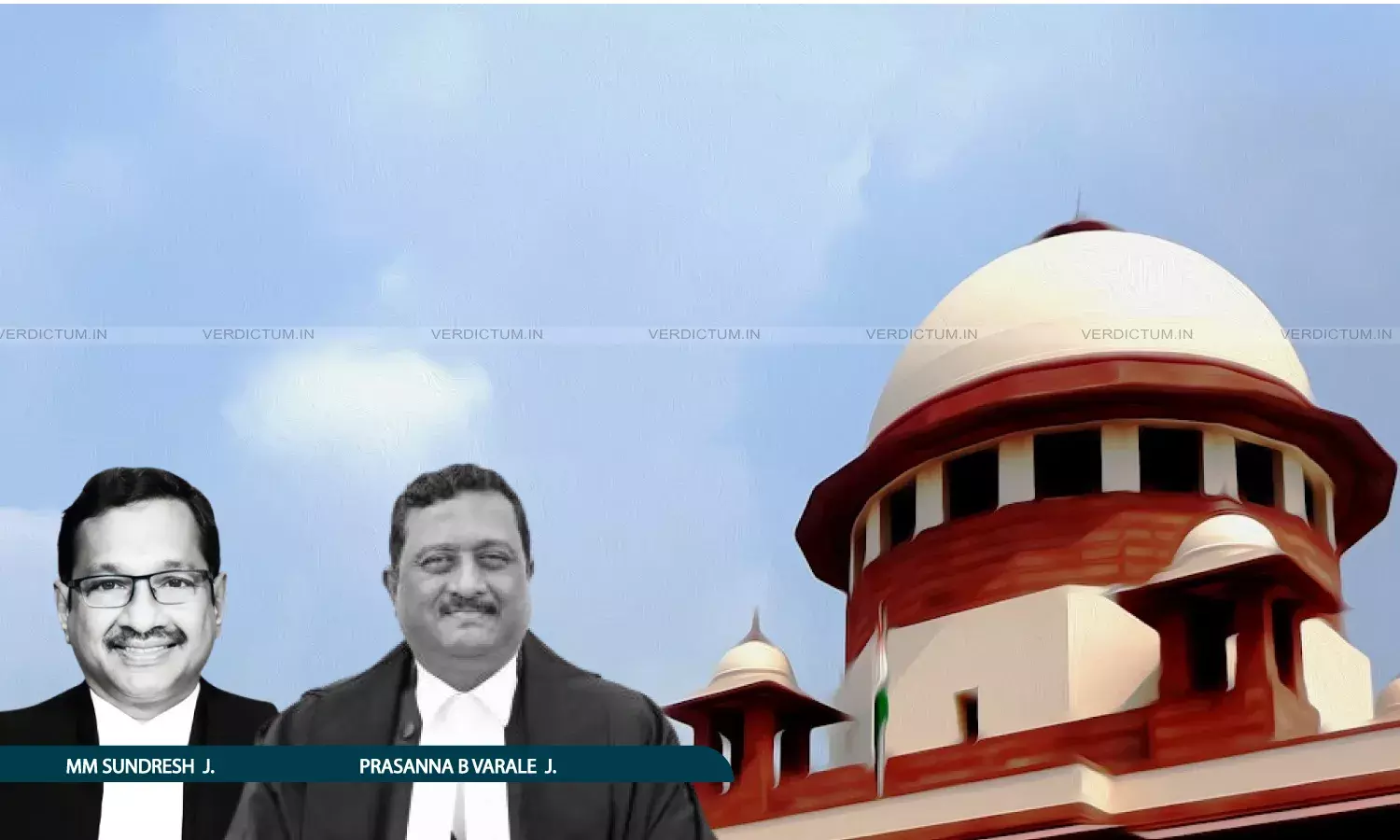
A Bench of Justice M.M. Sundresh and Justice Prasanna B. Varale observed that "to convict the accused on the basis of circumstantial evidence each circumstance must be established beyond doubt and collectively point towards the guilt of the accused.”
Senior Advocates Rajdipa Behura and Jana Kalyan Das appeared for the appellants, while Advocate Vishnu Kant appeared for the State of Odisha.
Background
According to the prosecution, an accused person threatened the deceased, after which an armed group searched for him, intercepted him while he was travelling on a motorcycle and assaulted him. Medical evidence established that the death was homicidal. The investigation resulted in a trial of 14 accused persons.
The trial court convicted six persons and acquitted eight others. On appeal, the Orissa High Court rejected the purported eyewitness identification, finding that the witnesses could not have identified the assailants in the darkness merely from the sounds of the assault. It nevertheless upheld the six convictions on circumstantial evidence.
Before the Supreme Court, the appellants challenged the reliability of the related witnesses and the completeness of the alleged chain of circumstances. The State maintained that the threats, search for the deceased, assault and physical evidence established their guilt.
Court’s Observations
The Court distinguished proof of homicidal death from proof that the appellants had caused it. It found a material inconsistency between the informant’s account and another witness’s claim about who had witnessed the attack.
The Court observed: “The testimony of PW-3 reveals that he was not present at the spot when the incident occurred. Significantly, in the First Information Report lodged by him, he stated that only PW-17 and PW-26 had witnessed the occurrence. However, the testimony of PW-4 presents a materially different version. According to PW-4, he, along with PW-3, PW-10, PW-11, PW-17, and PW-26, was observing the accused persons at the time of the incident. Thus, while PW-3's version indicates that he was not an eye-witness to the occurrence, PW-4's testimony seeks to portray PW-3, along with the other prosecution witnesses, as being present and witnessing the incident, giving rise to a significant inconsistency in the prosecution case.”
The Court also questioned the informant’s account of his conduct after the attack: although he claimed to have witnessed it, he could not say which accused carried which weapon and had not immediately informed others of the incident.
The Court considered the difficulty of identifying the attackers on a pitch-dark night from a distance. Referring to State of U.P. v. Ashok Kumar (1979) and Tamilselvan v. State (2008), it noted that the alleged source of light was a torch carried by the accused themselves to identify the deceased. The High Court had already found that the witnesses could not have seen the attack or identified the assailants by its sounds.
The Court remarked: “Insofar as the circumstance relating to the identification of the appellants is concerned, the reliance placed upon it by the High Court appears to be misconceived. We have also discarded the testimony of the prosecution witnesses on this aspect, as it is not possible to safely conclude that they had either witnessed the occurrence on a pitch-dark night or identified the assailants merely on the basis of the sounds of the assault. Once such evidence is found to be unreliable, the circumstance of identification cannot be said to have been proved.”
With the eyewitness account discarded, the Court assessed whether the remaining circumstances independently proved guilt. It referred to the tests stated in Sharad Birdhichand Sarda v. State of Maharashtra (1984), Kamal v. State (NCT of Delhi) (2023) and Abdul Nassar v. State of Kerala (2025): every incriminating circumstance must be proved, and the combined chain must exclude a reasonable conclusion consistent with innocence.
The Court found that the alleged threats and search for the deceased substantially depended on the same inconsistent witnesses. It also rejected the prosecution’s account that a 53 kg laterite stone had been used in the assault. The Court observed: “We also find no merit in the theory of the prosecution that the deceased died due to hit of a 53 kg laterite stone as there is absolutely no material to show that how this heavy stone weighing 53 kg was brought and who brought it and also the prosecution was unable to recover this so-called 53 kg laterite stone which was used for commission of offence.”
Assessing the evidence as a whole, the Court held: “Viewed cumulatively, the prosecution has failed to establish a complete and consistent chain of circumstances excluding every hypothesis other than the guilt of the appellants. The evidence on record leaves substantial gaps which create a reasonable doubt as to their involvement. In criminal jurisprudence, where two views are reasonably possible, the one favourable to the accused must prevail.”
Conclusion
The Supreme Court allowed the appeals and set aside the High Court’s judgment and the trial court’s conviction and sentence orders. The four remaining appellants were given the benefit of doubt. Pending applications, if any, were disposed of.
Cause Title: Kartika @ Kirtan @ Kirtan Charan Jena & Anr. Etc. v. State of Odisha (Neutral Citation: 2026 INSC 1015)
Appearances
Appellants: Senior Advocates Rajdipa Behura and Jana Kalyan Das; Advocates-on-Record A. Venayagam Balan and Parmanand Gaur; Advocates Philomon Kani, Neha Dobriyal, Santhanalakshmi, Sandeep Das, Mehak Khurana and Lokesh Kumar
Respondent: Advocate-on-Record Vishnu Kant