

He Was Its Front Face Authorized To Sign All Negotiable Instruments & To Make Payments: Supreme Court Upholds Conviction Of NGO Treasurer U/S 138 NI Act
The appeal before the Supreme Court was filed by the appellant, who was convicted of committing an offence under Section 138 of the Negotiable Instruments Act.

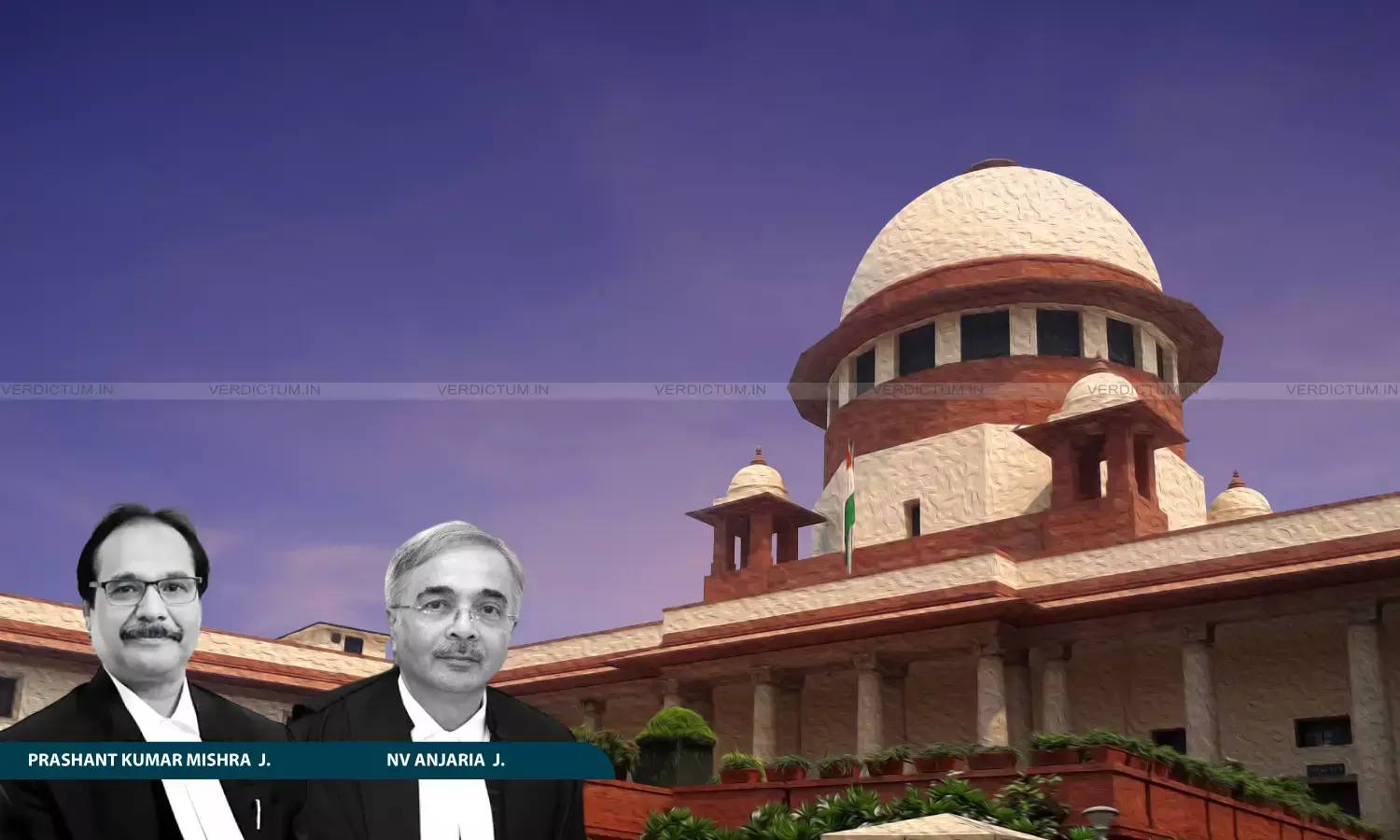
Supreme Court, Justice Prashant Kumar Mishra, Justice N.V. Anjaria
While ordering the Treasurer of an NGO to pay a fine imposed under Section 138 of the Negotiable Instruments Act, 1881 (NI Act), the Supreme Court has held that the relationship between the parties emanated from one Memorandum of Understanding (MOU) and the accused was responsible for all the rights and liabilities arising for or against the Company by virtue of the MOU.
The appeal before the Apex Court was filed by the appellant, who was convicted by the High Court for committing an offence under Section 138 of the Negotiable Instruments Act, 1881 (NI Act) and was sentenced to undergo rigorous imprisonment for one year. A fine of Rs 1,50,00,000 was also imposed.
The Division Bench of Justice Prashant Kumar Mishra and Justice N.V. Anjaria held, “It is thus apparent that it is the appellant alone who was responsible for all the rights and liabilities arising for or against TIMES by virtue of the MOU. Although appellant is only the Treasurer of TIMES but not the owner or Chairman of the society but the fact remains that the MOU entered between the parties nowhere cast any liability on the Chairman of the NGO. If the NGO i.e. TIMES has made the appellant as its front face by authorizing him to sign all the negotiable instruments and to make payment of the account to APCPDCL (Presently Telangana CPDCL) through cheque/RTGS online transaction, it is only the appellant who shall be responsible for all the consequences thereof.”
Senior Advocate Santosh Kumar represented the Appellant, while Senior Advocate Ravi Shankar Jandhyala represented the Respondent.
Arguments
It was the case of the appellant that he not being the drawer of the cheque, could not be convicted for the reason that an authorized signatory is merely authorized to sign on behalf of the company and does not become the drawer.
On the contrary, the respondent claimed that the appellant having signed the cheque as Treasurer of TIMES NGO, with whom the private Respondent had entered into an MOU for outsourcing the work of collection of electricity bills of domestic consumers, the appellant was liable to incur the statutory mandate of any penal consequence under the NI Act.
Reasoning
The Bench noted that the relationship between the parties emanated from one Memorandum of Understanding (MOU) for the collection of electricity bill and payments of APCPDCL through M/s. TIMES. It was further noticed that the appellant had signed on this MOU as Treasurer of TIMES.
The Bench noticed that the appellant alone was responsible for all the rights and liabilities arising for or against TIMES by virtue of the MOU, as the MOU entered into between the parties nowhere cast any liability on the Chairman of the NGO. Considering the MOU, the Bench held that the appellant became the drawer of the cheque on behalf of the TIMES as the document did not recognize any other entity that would be responsible for any action in its transactions with APCPDCL (Telangana CPDCL).
Considering that the appellant was only the Treasurer of the society, the Bench allowed the appeal in part by modifying the sentence and directing the appellant to pay a fine amount of Rs.1.5 crore to the second Respondent (now Telangana CPDCL or Southern Power Distribution Company of Telangana Limited (TSSPDCL)) and, in default, to undergo Rigorous Imprisonment of one year.
“The fine shall be paid within a period of two months from today. If the amount is not paid within two months from today, the appellant shall immediately surrender or taken into custody to undergo the default sentence of rigorous imprisonment of one year”, it ordered.
Cause Title: K Ranganayakulu v. State of Telangana & Ors. (Neutral Citation: 2026 INSC 555)
Appearance
Appellant: Senior Advocate Santosh Kumar, AOR Shekhar Kumar, Advocates Vijay Kumar, Vemula Raghuraman, Pradeepkumar R, B Shenbegam, Vipin Poria, Vishal Tiwari, Dhruv Singh
Respondent: Senior Advocate Ravi Shankar Jandhyala, AOR Devina Sehgal, Advocates Yatharth Kansal, Srikanth Varma Mudunuru, AOR Sravan Kumar Karanam, Advocates Kumar Abhishek, P. Venkatraju, Srilekha Pujari, M. Harshini, G. Sushmita