

State Cannot Unilaterally Usurp Property Of Religious & Charitable Institutions: Supreme Court
An acceptance of a gift of temple land by a Revenue functionary, however laudable the public purpose it is intended to serve, offends the object of the 1959 Act, the Bench noted.

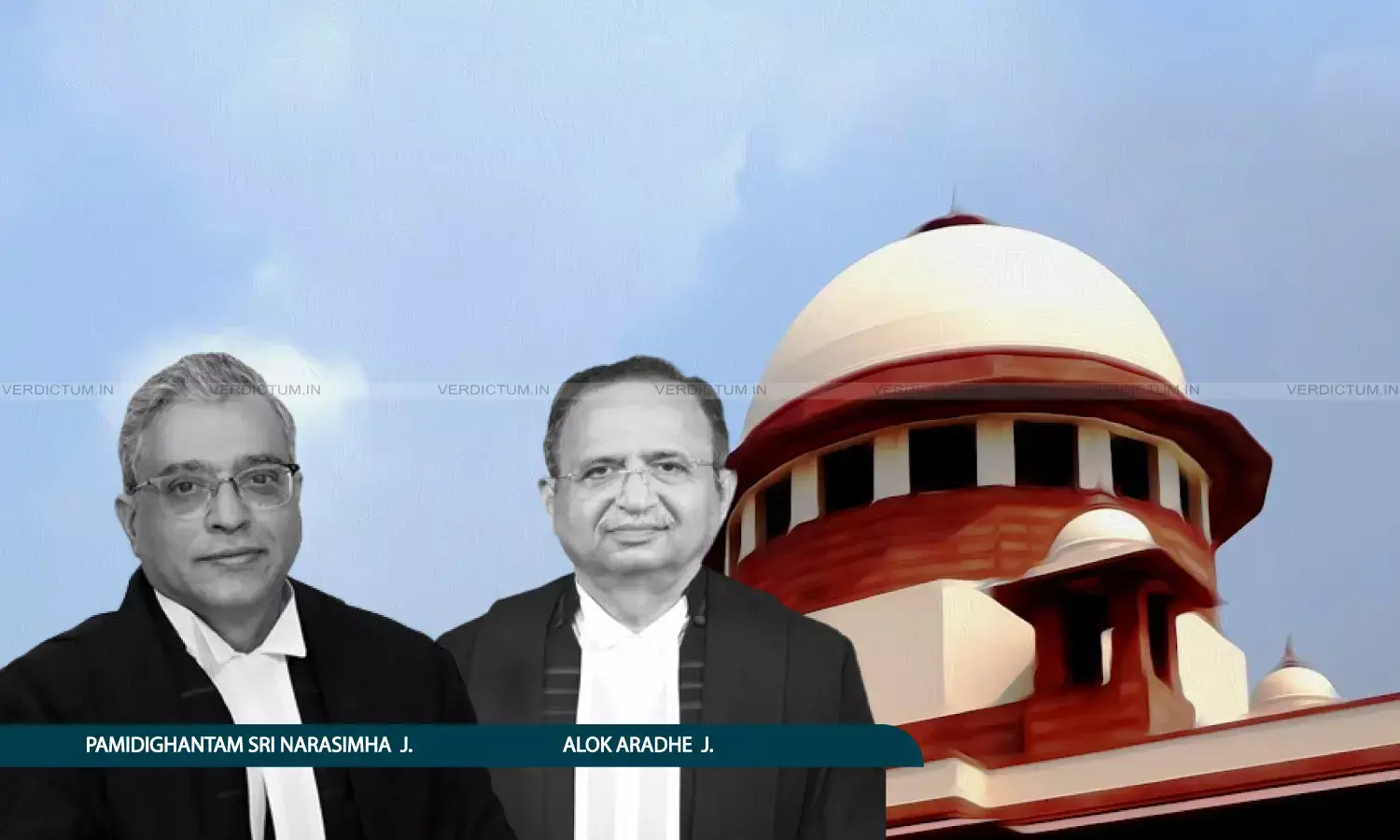
Justice Pamidighantam Sri Narasimha and Justice Alok Aradhe, Supreme Court
The Supreme Court has held that the State, which the law makes custodian of religious and charitable properties, cannot take such property for itself or allow its officers to do so. A transaction offending this principle, whatever its label or public purpose, is liable to be struck down.
The Court declared void a gift of temple inam land made by a temporary trustee to the Tamil Nadu Government. Under the Tamil Nadu Hindu Religious and Charitable Endowments Act, 1959, a gift of inam property cannot be validated by any sanction. The Court did not undo the Taluk Office built on the land, but directed that the Temple receive enhanced rent and costs.
A Bench of Justice Pamidighantam Sri Narasimha and Justice Alok Aradhe observed, “The State, as custodian, cannot unilaterally usurp, nor permit any of its officers to usurp, the property of the religious/charitable institutions it is charged to protect; a transaction that offends this principle, whatever its label or ostensible public purpose, is liable to be struck down”.
“The State, acting through the Commissioner and other functionaries under the 1959 Act, is a custodian and regulator of temple properties, not their owner. An acceptance of a gift of temple land by a Revenue functionary, however laudable the public purpose it is intended to serve, offends the object of the 1959 Act. A temple property is held for the deity and not for gratuitous disposal by whoever happens to hold the office of trustee, however well-intentioned”, it noted further.
Advocate S. Ravi Shankar appeared for the appellants while Haripriya Padmanabhan, Additional Advocate General, Senior Advocate M. Sathyanarayanan appeared for the respondent.
Noting Sections 23, 27, 28, 34, 34-A and 41 of the 1959 Act, the Bench noted, “The object of the said provisions is to shield temple property from dissipation, whether at the hands of an improvident trustee or, as the facts of this case illustrate, an overreaching arm of the State itself; a custodian does not cease to be bound by the terms of its custodianship merely because it is also the sovereign”.
The subject land, about one acre in Kodumudi Village, Erode District, belonged to the Nagapalayam Mariamman-Ponnachiamman Temple. In August 2017, a temporary trustee gifted it to the Government for a Taluk Office, and the Tehsildar accepted the gift. A writ petition by villagers was withdrawn. The hereditary trustee then challenged the gift, but the Madras High Court dismissed his petition on March 19, 2019.
It held that Section 34 of the 1959 Act does not mention gifts and that title was a disputed question of fact. Devotees were later permitted to approach the Supreme Court. In 2022, the State told the Court on affidavit that the land was inam land and that its gift was prohibited.
The Court held that Section 34(5) excludes inams from Section 34, so Section 41 governs. Section 41(1) declares a gift of inam property null and void and, unlike other transactions, permits no government sanction for a gift. The gift was therefore void ab initio. Its registration was also barred by Section 22-A of the Registration Act, 1908, as applicable in Tamil Nadu, and registration could not cure the defect. Even under Section 34, the gift would fail for want of sanction.
A gift, being gratuitous, cannot be an act of ordinary prudence by a trustee under Sections 27 and 28. The State is custodian and regulator of temple property, not its owner. The Court also criticised the State for defending the gift for years until questioned by this Court.
The Court set aside the High Court’s order and declared the land inam property vested in the Temple. It declared the gift deed void and its registration of no legal effect. The lease to the Government was kept in place, with rent enhanced to Rs. 31,000 per month from March 8, 2019, to be refixed every three years. Arrears are payable within three months, and the lease terms are to be set by the trust with the Temple’s benefit paramount. The State must pay Rs. 1,00,000 in costs within eight weeks and strictly follow Sections 34, 34-A and 41.
Cause Title: K. Ramalingam and Others v. Government of Tamil Nadu Rep. by its Secretary and Others (Neutral Citation: 2026 INSC 1144)
Appearances:
Appellants: S. Ravi Shankar, Advocate.
Respondents: K.L. Janjani, Haripriya Padmanabhan, Additional Advocate General, M. Sathyanarayanan, Senior Counsel, Shailesh Madiyal, amicus curiae.