Demolition After 17 Years Would Be Contrary To Public Interest: Supreme Court Directs Regularisation Of Commercial Complex
The Court held that where an irregular allotment had culminated into a fully operational commercial complex involving ₹450 crores of investment, 8,000 livelihoods and substantial annual tax revenue, demolition would cause disproportionate and irreparable public harm and that public interest would be better served through a rigorously supervised regularisation coupled with full financial restitution.
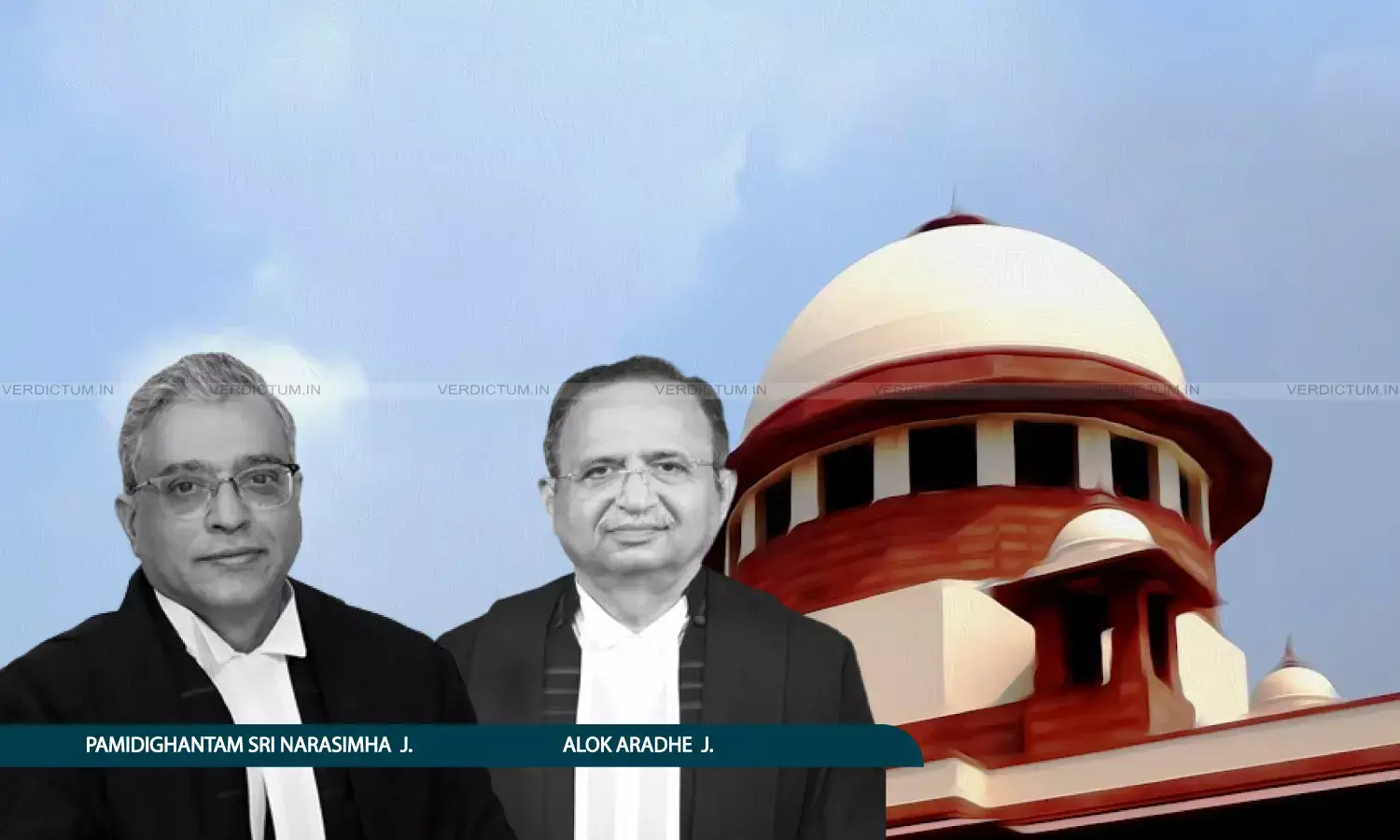
Justice Pamidighantam Sri Narasimha and Justice Alok Aradhe, Supreme Court
The Supreme Court has held that demolition of a shopping mall and hotel complex functioning for over seventeen years in the IT Park Sector at Vashi, Navi Mumbai would be contrary to public interest, observing that the economic and social harm caused by demolition would far outweigh the public benefit sought to be achieved.
The Court accordingly directed regularisation of the allotment subject to payment of the market value of the land along with interest and additional amounts determined by the Court.
The Court was hearing appeals filed by K. Raheja Corp. Private Limited, employees of the shopping mall and hotel, and the Retailers Association of India, challenging a Bombay High Court judgment directing restoration of the allotted plot at Vashi, Navi Mumbai, to its original condition and delivery of vacant possession to CIDCO on the ground that the original allotment was illegal and arbitrary.
A Division Bench of Justice Pamidighantam Sri Narasimha and Justice Alok Aradhe observed: “Demolition of a fully operational commercial complex after seventeen years, Rs. 450 crores of investment, 8,000 livelihoods, and Rs. 100 crores of annual tax revenue would not vindicate the public interest. The financial prejudice caused to CIDCO by the irregularity of the original allotment is entirely capable of being remedied through a rigorous financial recovery mechanism.”
The Bench further observed: “Public law must be sensitive to the distinction between remedies that restore public welfare and remedies that merely punish, when punishment comes at the cost of the very public the law seeks to protect.”
Senior Advocates Mukul Rohatgi, Niranjan Reddy and Amar Dave appeared for the Developer. Senior Advocates Sanjay Kharde, Balbir Singh, Shekhar Naphade and Aniruddha Joshi appeared for the respondents.
Background
The dispute related to allotment of plots in Sector 30A, Vashi, Navi Mumbai, which had originally been earmarked for Information Technology industries as part of the International Infotech Park project developed by CIDCO. Following a downturn in the global IT sector, CIDCO’s Board approved conversion of a portion of the area for residential, commercial and office use.
In September 2003, CIDCO approved allotment of plots measuring approximately 29,000 sq. metres, including the subject plot, in favour of the Developer with a Floor Space Index of 3.0 at the rate of ₹10,250 per sq. metre. The allotment was made on an individual application basis in anticipation of formal Government approval and subject to the development of a Japanese garden on an adjoining plot.
The allotment was challenged before the Bombay High Court through Public Interest Litigations. Meanwhile, the Developer proceeded with construction and eventually completed a shopping mall and hotel complex spread over approximately 10,50,000 sq. feet at an investment exceeding ₹450 crores. An occupancy certificate was granted in 2008, and the complex had remained operational since 2009.
During the pendency of proceedings, the Sankaran Committee constituted by the State Government examined CIDCO allotments and found that the subject plot ought to have been disposed of through a competitive tender. The Committee estimated that CIDCO suffered a loss of approximately ₹50 crores owing to allotment at a concessional rate and recommended cancellation of the allotment.
The Bombay High Court ultimately held the allotment to be illegal and arbitrary in violation of Article 14 of the Constitution and directed the Developer to restore the subject plot to its original condition and hand over vacant possession to CIDCO. However, the High Court simultaneously granted liberty to seek regularisation.
Aggrieved thereby, the Developer, employees and retailers approached the Supreme Court.
Court’s Observation
The Supreme Court observed at the outset that although the original allotment suffered from serious irregularities relating to pricing and absence of a transparent competitive process, the High Court had conspicuously refrained from quashing the allotment itself and had expressly kept open the issue of regularisation. The Court noted that neither the liberty granted by the High Court nor CIDCO’s regularisation policy had been challenged before the Supreme Court.
The Court further observed that Regulation 4 of the New Bombay Disposal of Lands Regulations, 1975 permitted the disposal of plots not merely through auction or tender but also by considering individual applications. According to the Court, the infirmity in the present case lay not in the mode of allotment itself but in the pricing mechanism and lack of transparency.
The Bench thereafter examined whether demolition of the commercial complex constituted an appropriate remedy. Applying the doctrine of proportionality, the Court observed that remedial measures in public law must bear a rational relationship with the nature of the wrong sought to be corrected and should not themselves inflict disproportionate harm upon society.
The Court observed: “A remedy that causes public harm disproportionate to the public benefit it achieves is not a remedy that law ought to countenance.”
The Supreme Court emphasised that the passage of time and crystallisation of irreversible third-party rights had fundamentally altered the equities of the case. The Court noted that the shopping mall and hotel had remained operational for over seventeen years, approximately 150 retailers were functioning within the complex, and nearly 8,000 persons derived their livelihood from the establishment.
The Court relied significantly upon the findings of the Banthia Committee constituted by the State Government to examine the feasibility of regularisation. The Committee had recognised that although the original allotment was irregular, the public interest no longer lay in demolition but in ensuring full financial restitution to CIDCO while preserving the substantial economic and social infrastructure already created.
The Supreme Court observed: “The need to enforce the rule of law and penalise unlawful conduct must be balanced against the imperative of avoiding disproportionate and destructive economic consequences.”
The Court held that public law remedies cannot operate in a vacuum, divorced from subsequent economic realities and that the objective of judicial intervention must be restoration of public welfare rather than punishment for its own sake. The Bench observed that demolition would neither restore public funds nor benefit the public at large but would instead destroy existing economic infrastructure and livelihoods.
The Court therefore concluded that regularisation upon payment of full market value together with interest represented the most equitable and proportionate solution, balancing public accountability with economic realities.
While determining the quantum payable, the Court rejected the methodology adopted by the Sankaran Committee, which had quantified loss on the basis of market conditions prevailing in 2005. The Court observed that regularisation could not be granted based on historical concessional valuations because such an approach would permit the Developer to benefit from artificially frozen land prices despite substantial appreciation in value over the years.
Accepting the reasoning of the Banthia Committee, the Court held that regularisation had to be treated as a fresh conferment of legal legitimacy and therefore the Developer was required to pay the prevailing market value as on the date of the High Court judgment in 2014.
The Court observed: “Regularisation is not a continuation of the original transaction; it is a fresh grant of legal legitimacy, prospective in nature, for which the Developer must pay what the land was actually worth at the time of the court's judgment.”
Using ready reckoner rates applicable to Sector 30A, Vashi, Navi Mumbai, for the year 2014, the Court calculated the market value of the subject plot at ₹166.36 crores and, after adding interest at 8% from 01.12.2014 till 30.04.2026, quantified the total payable amount at ₹318.31 crores. Since the Developer had already paid substantial consideration towards the original allotment, the Court directed payment of an additional amount of ₹55.44 crores in public interest.
Conclusion
The Supreme Court held that although the original allotment of the subject plot by CIDCO was irregular and violative of principles of transparency under Article 14 of the Constitution, demolition of the fully operational commercial complex after seventeen years would be grossly disproportionate and contrary to public interest.
The Court held that public interest would be better served by a rigorously supervised regularisation coupled with full financial restitution to CIDCO. Accordingly, the Court quashed the direction issued by the Bombay High Court requiring restoration of the plot to its original condition and directed regularisation of the allotment subject to payment of ₹318.31 crores along with an additional ₹1 crore towards the unfulfilled obligation of developing a garden.
The Court directed that upon payment of the aforesaid amount within four months, the allotment in favour of the Developer would stand regularised.
Cause Title: K. Raheja Corp. Private Limited v. State of Maharashtra & Ors. (Neutral Citation: 2026 INSC 551)
Appearances
Appellants: Senior Advocates Mukul Rohatgi, Niranjan Reddy and Amar Dave; Advocates Mahesh Agarwal, Hemlata Jain, Ankur Saigal, Bindi Dave, Pranaya Goyal, Victor Das, Dharav Shah, Aayush Maheshwari, Rajshree Jaiswal, Nidhi Sri and Sana Jain; Advocate-on-Record E.C. Agrawala. Senior Advocate Amar Dave; Advocates Ruby Singh Ahuja, Megha Dugar, Jappanpreet Hora and Shagun Parashar; M/s Karanjawala & Co., Advocate-on-Record.
Respondents: Senior Advocate Sanjay Kharde; Advocate Siddharth Dharmadhikari; Advocate-on-Record Aaditya Aniruddha Pande, and Advocate Shrirang B. Varma. Senior Advocate Balbir Singh; Advocate-on-Record Samir Malik; Advocates Tushar Mathur, Mahip Singh Sikarwar, Snehal Kaila and Naman Tandan. Senior Advocate Shekhar Naphade; Senior Advocate Aniruddha Joshi; Advocate-on-Record Shashibhushan P. Adgaonkar; Advocates Salonee Paranjape, Karan Bishnoi, Anoop Raj, Chirag Zanwar and Shambhavi Kanade.