

All Individuals Including Children Have Fundamental Right To Access Internet: Supreme Court Disapproves Blanket Restrictions
The Court said that child safety measures must target harmful material, not children; proposes national hash and URL database, two-hour reporting timelines, dedicated CSEAM grievance officers and exemplary fines on intermediaries.

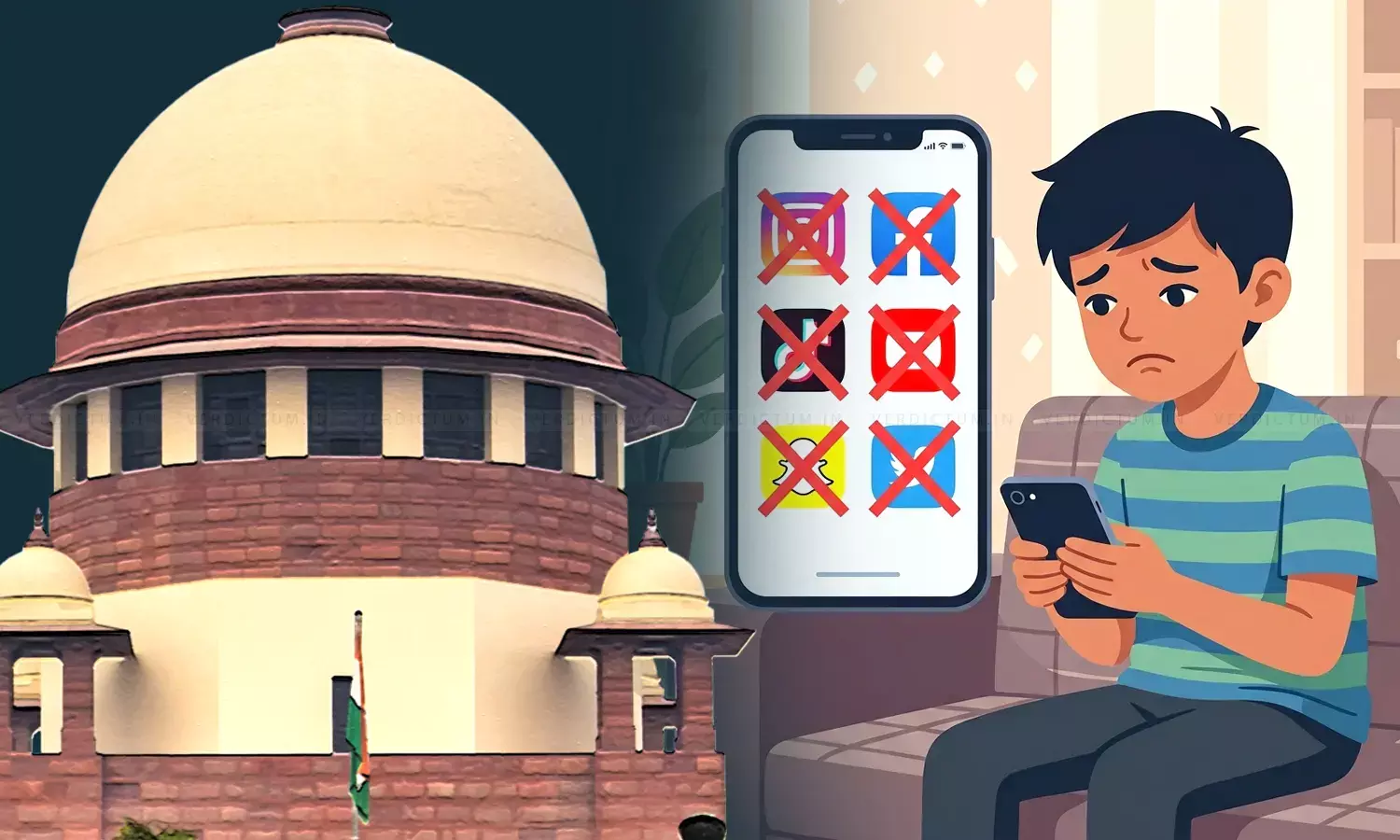
The Supreme Court has held that the right to access and use the internet is a fundamental right of every individual under Article 21 read with Article 19(1)(a) of the Constitution of India. It said children enjoy the same right irrespective of age, and that denying it altogether would be as absurd as saying children below a certain age have no conscience worth protecting or freedom of speech worth expressing. The Court observed that the safety of children and their freedom are not at odds, and that children are entitled to both.
While declining to endorse a blanket restriction on children’s access to social media, the Court laid out a wide framework for the detection, reporting and removal of Child Sexual Exploitation and Abuse Material (CSEAM). It proposed a national Hash and URL List Database with multi-tier human verification and set reporting timelines for intermediaries. It also proposed dedicated CSEAM grievance officers and a uniform, easily accessible reporting category, and asked the Union to consider exemplary fines and disgorgement of paywall revenue. It clarified that, for the IT Act and Rules, CSEAM is not confined to visual depictions.
A Bench of Justice J.B. Pardiwala and Justice K. Vinod Chandran categorically, observed, “…we have no hesitation in saying that the right to access and use the internet is a fundamental right of every individual under Article 21 read with Article 19(1)(a) of the Constitution. Our children, irrespective of their age enjoy the same rights, and to deny the same altogether would be as absurd as saying children below a certain age do not have a conscience worth protecting or a freedom of speech worth expressing. The safety of our children and their freedom are not at odds with each other. Our children are entitled to both”.
“All that we are trying to say is that any blanket restriction on the access of internet by children is nothing more than unproven measures of proven disproportionality. No jurisdiction has, so far, been able to demonstrate that children are any safer on account of such measures. Its efficacy is at best contested, and without question, not a substitute for the initiative and efforts required from all the stakeholders, be it the intermediaries, the law enforcement agencies, the Ministry of Electronics and Information Technology or the courts. However, this does not mean that there should be no age-based restrictions. We acknowledge that, some form of safeguards are necessary for the safety our children online and the moderation of the content accessible at their fingertips. In this regard, there could be a system that places greater emphasis on parental consent, guidance and oversight on the access to social media platforms by children along with a dedicated “child mode” for such accounts with measures proportionate to the object of ensuring their safety”, the Bench noted further.
Advocate Bhuwan Ribhu appeared for the applicant and Tushar Mehta, Solicitor General, K.M. Nataraj, A.S.G appeared for the opposite party.
The applications arise from the Court’s September 2024 judgment in Just Rights for Children Alliance v. S. Harish (2024 INSC 716), which warned that links to child sexual abuse material were being circulated and sold on social media to bypass penal provisions. It also held that intermediaries must report such material to the police units specified under the POCSO Act, failing which they lose safe harbour under Section 79 of the IT Act. In an earlier order this year, the Court recorded serious lapses in compliance.
News reports placed before it described paid promotions of CSEAM on social media through redirect links and websites. In one such report, of 55 reported advertisements, 43 were held not to violate the platform’s advertising standards.
The Court said that over two years after its judgment there had been no progress worth the name, and that it could not afford to wait any longer. With assistance from the Union through the Ministry of Electronics and Information Technology and the Ministry of Law and Justice, it proposed a workable framework. It examined the present mechanism, the position in other jurisdictions and the Union’s response.
On detection, the Court noted that platforms act in isolation, so content removed by one is not automatically flagged by others. It described perceptual hashing and URL listing as the globally used tools. It found Rule 4(4) of the IT Rules, which refers to content previously removed “on the computer resource of such intermediary”, too narrow, since it leaves out material already removed elsewhere and content merely circulated through external links. While a rigid statutory prescription may be impractical, it said periodically revisable guidelines on proven tools are necessary. It sought the Union’s response on the tools in use, industry-wide feasibility and guidelines.
On the database, the Court said sharing hashes and URLs across platforms is essential and suggested the Sahyog Portal as a possible foundation. Entries must follow software screening and independent human assessment, and must be made through encrypted channels, with only identifiers stored and never the material itself. It distinguished CSEAM of “Unknown Origin” from “Known Origin”. For the former, intermediaries must verify, report to the police authorities under the POCSO Rules and to the database authority, within two hours of removal or of resolving a complaint. For the latter, they must remove immediately and report weekly in consolidated form. Removal must be marked by a notice indicating its basis, so aggrieved persons know whether to approach the intermediary or the database authority. Safeguards include signed analyst reports, audit trails, independent audits and prompt de-listing of wrongful entries.
On reporting and grievances, the Court said CSEAM must have a distinct, plainly named category reachable within two steps, without compulsory personal details and with anonymity preserved. Every report must be acknowledged within twenty-four hours with a reference number. It held that intermediaries need dedicated, trained grievance officers, that no CSEAM complaint be disposed of without review by such an officer, and that reports follow a uniform machine-readable format.
On scope, the Court held that the POCSO emphasis on visual depiction applies to its penal provisions. The IT Act and Rules are largely regulatory, and for their purposes CSEAM covers any electronic material with the propensity to facilitate or enable child exploitation. Advertisements for tools that manipulate images into abusive material, or that redirect to such content, fall within Section 67B(d) and Rule 3(1)(b) and cannot hide behind advertising standards.
On penalties, it found Section 79 too drastic and too remote to deter routine default. Surveying regimes in the United States, United Kingdom, European Union, Australia and South Korea, it asked the Union to consider exemplary fines scaled to gravity, duration, recurrence and size. It also said revenue earned through paywalled CSEAM should be forfeited and disgorged, and put intermediaries on notice to scrutinise paywalled content rigorously.
“Before we close this matter, we must address ourselves on one another aspect. Our discussion thus far has largely been centred on the obligations of intermediaries in respect of CSEAM, the measures necessary to stop those who propagate and circulate such material, and the gaps within the existing framework that allow it to finds its way onto the internet. But this cannot be the end of the matter. The safety of our children is not complete without adequate efforts towards inculcating in them the awareness to recognise danger, the confidence to speak up and the safe practices to follow, on and off the internet. Our children today come onto the internet much before they come to understand it. A child is able to use a phone long before he or she is able to tell the difference between a friend and a stranger posing as one, an innocent request from an inappropriate one, a harmless game from a carefully laid trap. Those who prey upon our children are well aware of this, and it is this very gap which they exploit”, the Bench said.
Consequentially, the Court directed the Union, through the Ministries of Electronics and Information Technology and of Law and Justice, to oversee implementation. The Union must formulate guidelines, standard operating procedures and, where necessary, amendments to the IT Act and Rules. It must file an affidavit on progress and compliance before the next hearing, and the matter was listed on December 10, 2026.
Cause Title: Just Rights for Children Alliance & Anr. v. S. Harish & Ors. (Neutral Citation: 2026 INSC 1149)
Appearances:
Applicant: Bhuwan Ribhu, Saksham Maheshwari, AOR, Shashi, Taruna Panwar, Surabhi Katyal, Aditi Bhardwaj, Sankalp Saxena, Advocates.
Opposite Party: Tushar Mehta, Solicitor General, Juristrust Law Offices, AOR, K.M. Nataraj, A.S.G., Madhulika Upadhyay, AOR, Aashna Gill, Vaibhav Dwivedi, Madhav Sinhal, Anuj Udupa, Abhaid Parikh, AOR, Sunita Sharma, AOR, Nidhi Sharma, Aman Jaiswal, Hari Om Singh, Advocates.
Click here to read/download the Judgment