

Sec.161 CrPC Statements Can’t Be Relied On For Conviction: Supreme Court Acquits Man in Wife’s Burn Death Case
The Supreme Court was considering a case pertaining to the burn death of a woman.

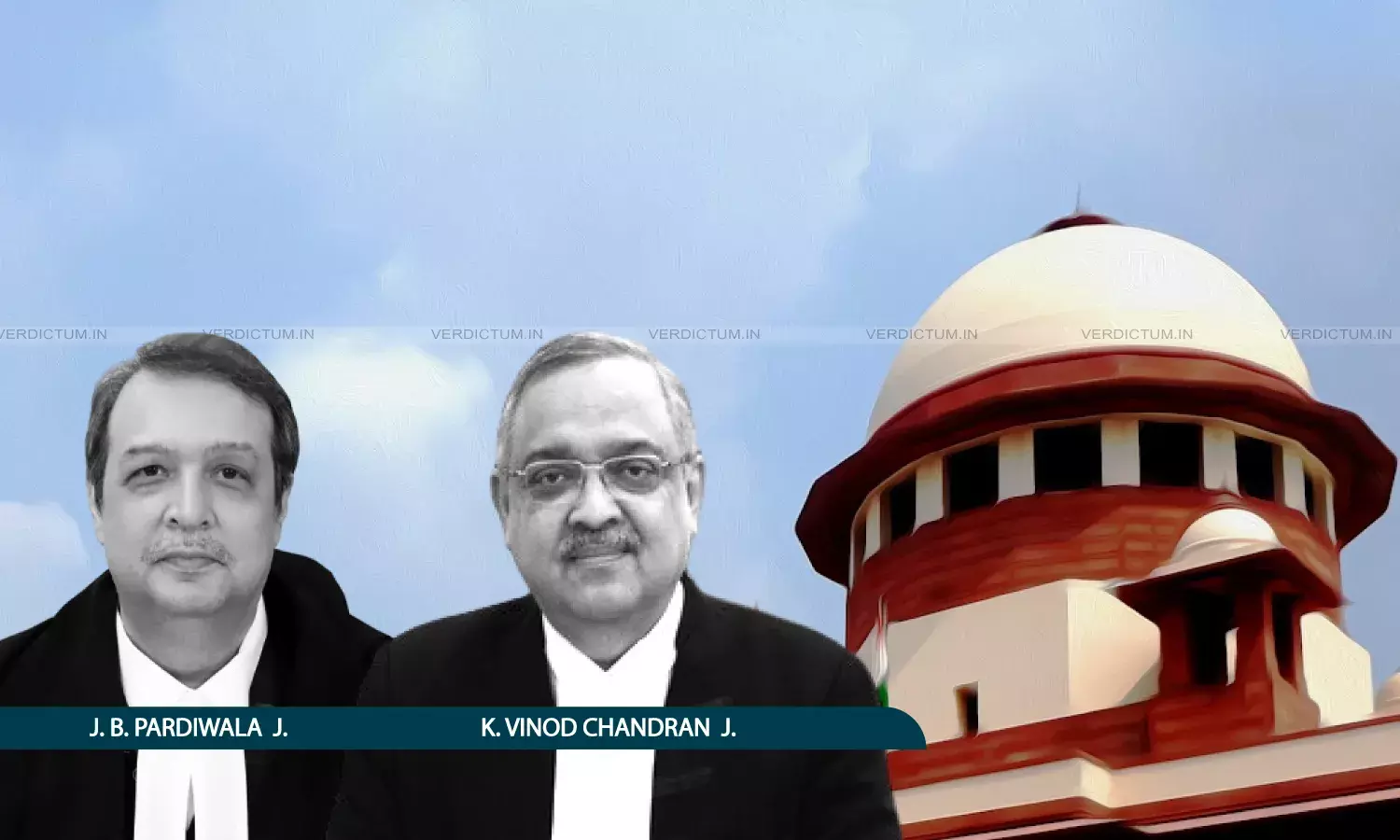
Justice J. B. Pardiwala, Justice K. Vinod Chandran, Supreme Court
While acquitting a man accused of burning his wife to death, the Supreme Court has held that the statements recorded under Section 161 of the CrPC(Code of Criminal Procedure) cannot be relied upon to convict the accused.
The Apex Court was considering a case pertaining to the burn death of a woman.
The Division Bench of Justice J. B. Pardiwala and Justice K. Vinod Chandran held, “The chief examination incriminates the accused only with a quarrel, not to the extent of a long-lasting marital discord. Even if the Court found the cross-examination to be not credible, it was not proper for the Court to assume that the version of PW1 to PW3 was an afterthought. Insofar as the earlier version referred to in the impugned judgement, obviously it is the Section 161 statements, which cannot be relied on for convicting an accused. Their testimony before Court is what has to be relied on for conviction or acquittal and earlier versions have to be put to the witnesses and the contradictions elicited as having occurred, by confirming such Section 161 statements from the Investigating Officer (IO).”
AOR Raj Kishor Choudhary represented the Appellant while Advocate Prerna Singh represented the Respondent.
Factual Background
The woman’s two children were orphaned and the father was accused of murdering her. It was the prosecution case that when the deceased had gone out for work, the accused, who was habituated to alcohol, took away the money kept by the deceased in the house. Finding that the money kept by her was missing, the deceased questioned the accused and the accused, enraged, poured kerosene and set ablaze his wife. The Trial Court relied upon certain circumstances including the alleged homicidal death, two dying declarations and the absence of an explanation under Section 106 of the husband, for the death by burns occurred in the marital house where the couple were residing. The Trial Court convicted the accused and sentenced him to life imprisonment, which was affirmed by the High Court.
Reasoning
On a perusal of the postmortem report, the Bench noted that the same indicated that the deceased had sustained burns of 96% of the surface area of the body. The burn injuries were present over the scalp, face, neck, front and back of the chest, front and back of both upper limbs, front and back of the abdomen, front and back of both lower limbs and genitalia. Unburnt patches were present only over the front of the abdomen.
“Looking at the post-mortem certificate, we had a doubt as to the theory of the accused having poured kerosene over the deceased to set her ablaze, since the burns were present even over the scalp of the head. The indication is more of the deceased having doused herself with kerosene, which could have resulted in the burn injuries on the scalp of the head. However, we see that the Doctor was not cross-examined on this aspect and there was no question put as to whether the death was by suicide; which is the defense coming out from the depositions of the various witnesses”, it added.
The Bench noted that in the cross-examination it was elicited from the Doctor who conducted the post-mortem that only a victim sustaining burns between 80 to 90% could speak well and this raised a suspicion insofar as the dying declaration was said to have been made by the victim who as per the post-mortem report suffered 96% injuries. The Bench took the view that the death was homicidal.
“From the evidence of PW1 to PW3, we have to find that there is nothing coming out on the motive or on the incident itself or even on the absence of the appellant from the scene of occurrence at the time of the incident that occurred”, the Bench mentioned.
The Bench further took note of the fact that the dying declaration was registered as an FIR more than 15 hours later. The Bench further found the dying declarations to be suspicious and the motive of constant quarrels between the couple as not established. It was also noticed that the relatives of the witnesses spoke of the accused being present and having attempted to douse the fire.
“There is no single circumstance proved by the prosecution in trial and the doubt regarding the death having been caused by suicide bring us to disbelieve the prosecution version, as a reasonable doubt lingers in our minds”, the Bench held while acquitting the accused.
Cause Title: Jupudi Suresh v. The State of Andhra Pradesh (Neutral Citation: 2026 INSC 832)
Appearance
Appellant: AOR Raj Kishor Choudhary
Respondent: Advocate Prerna Singh, AOR Guntur Pramod Kumar, Advocates Vanshika Singh, Rakshita Rana