

Section 5 Limitation Act Applies To Special Statutes Unless Excluded Expressly Or By Necessary Implication: Supreme Court
The Court held that the mere prescription of a distinct limitation period under a special statute does not automatically exclude the applicability of Section 5 of the Limitation Act, 1963, clarifying that exclusion must flow either from express statutory language or by necessary implication arising from the scheme and object of the special enactment.
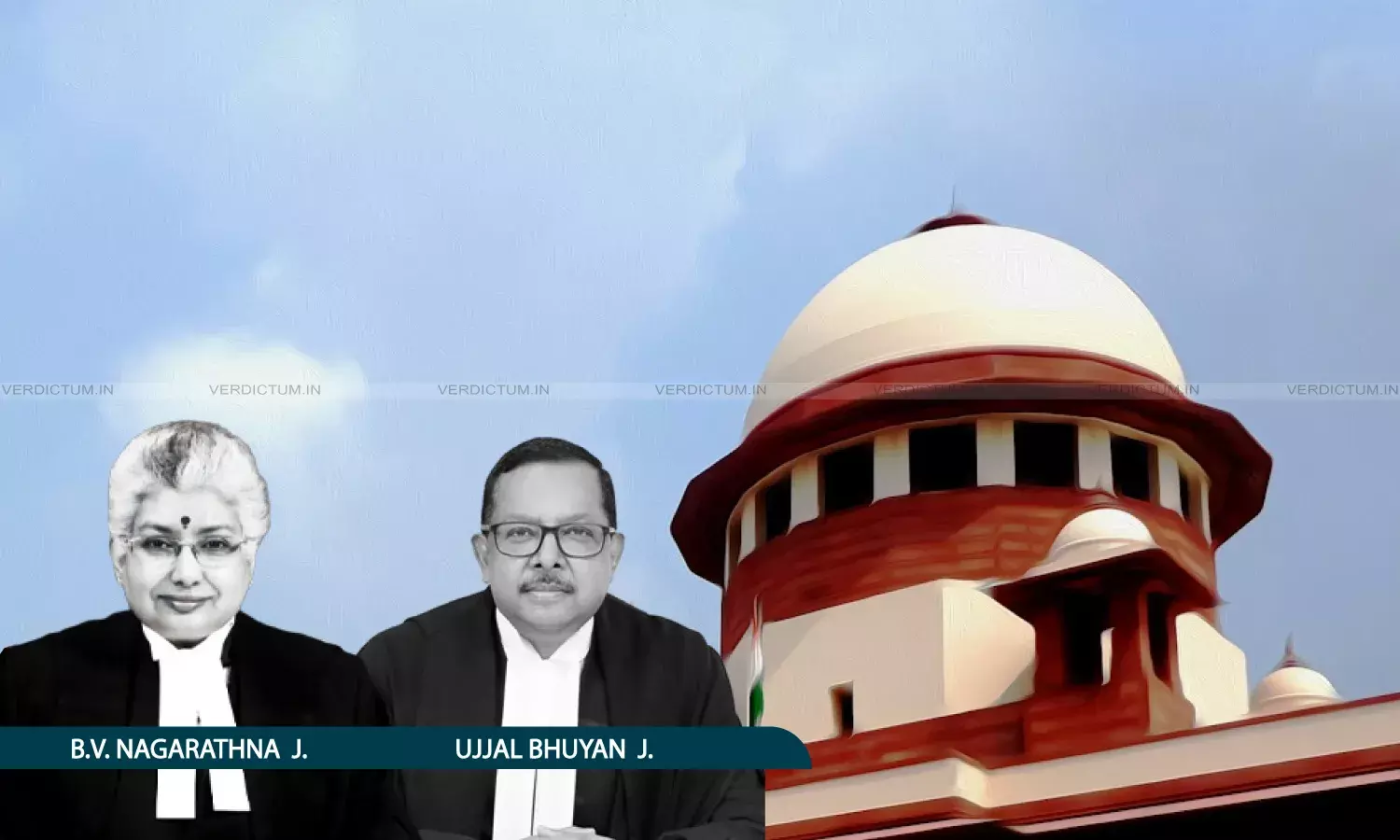
Justice B.V. Nagarathna, Justice Ujjal Bhuyan, Supreme Court
The Supreme Court has held that Section 5 of the Limitation Act, 1963 continues to apply to appeals under a special statute unless its applicability is excluded either expressly or by necessary implication from the language, object and scheme of that enactment.
Allowing an appeal arising under the Chhattisgarh Rajya Suraksha Adhiniyam, 1990, the Court held that the mere prescription of a separate limitation period under a special statute does not by itself bar condonation of delay under Section 5 of the Limitation Act.
A Bench of Justice B.V. Nagarathna and Justice Ujjal Bhuyan observed:" …what emerges from the above discussion is that whenever there is a special enactment prescribing a limitation period distinct from the Limitation Act, it falls for the courts to determine whether Section 5 of the Limitation Act is excluded. In Section 29(2) of the Limitation Act the expression that occurs is 'expressly excluded by special or local law'. But, with the passage of time, the expression 'expressly excluded' has been interpreted to also include 'exclusion by necessary implication', having regard to the scope, object and scheme of the special law."
Therefore, the Bench added: “the applicability of Section 5 of the Limitation Act must be decided from the language, object, and scheme of the special or local enactment in question, … while a special statute may prescribe a distinct period of limitation, that by itself will not automatically exclude the operation of Sections 4 to 24 of the Limitation Act."
Advocate Ashish Kumar Pandey appeared for the appellant. Rajat Nair, Additional Advocate General, appeared for the respondents.
Background
The appellant challenged an externment order passed under the Chhattisgarh Rajya Suraksha Adhiniyam, 1990, before the State Government under Section 9 of the Act. The appeal, however, was dismissed solely on the ground that it had been filed beyond the prescribed limitation period of thirty days.
The appellant thereafter approached the High Court, which also declined to interfere. Before the Supreme Court, the principal question was whether Section 5 of the Limitation Act stood excluded, either expressly or by necessary implication, from appeals filed under Section 9 of the Adhiniyam.
Court's Observations
The Court, at the outset, reiterated the settled principles governing the right of appeal. It was observed that the right to appeal is a substantive statutory right and not merely a matter of procedure. Referring to earlier precedents, the Court noted that while the legislature is competent to prescribe conditions governing appeals, such conditions must be gathered from the statute itself.
The Bench then examined the object and scheme of the Limitation Act. It was observed that limitation provisions regulate remedies rather than extinguish rights and are founded on considerations of public policy requiring parties to pursue remedies diligently.
Referring to N. Balakrishnan v. M. Krishnamurthy (1998), the Court noted: "Rules of limitation are not meant to destroy the rights of parties. They are meant to see that parties do not resort to dilatory tactics, but seek their remedy promptly."
The Court proceeded to examine the interplay between Section 29(2) and Section 5 of the Limitation Act. It explained that where a special or local law prescribes a limitation period different from that contained in the Limitation Act, Sections 4 to 24 continue to apply unless expressly excluded by the special enactment.
The Bench observed: "On a reading of Section 29(2) of the Limitation Act, it becomes clear that where any special or local law prescribes, inter alia, any appeal to be filed within a period of limitation different from the period prescribed by the schedule under the Act, Section 3 of the Limitation Act shall apply and the provisions contained in Sections 4 to 24 inclusive shall apply only insofar as, and to the extent to which, they are not expressly excluded by such special or local law."
Citing relevant precedents including Mukri Gopalan (1995), Hukumdev Narain Yadav (1974), Popular Construction Company (2001), Hongo India (2009), Chhattisgarh State Electricity Board (2010) and Bengal Chemists (2018), the Court explained that the expression "expressly excluded" occurring in Section 29(2) has consistently been interpreted to include exclusion by necessary implication arising from the statutory scheme.
Summarising the legal position, the Court held: “Under Section 29(2), those provisions continue to apply unless their applicability is expressly or by necessary implication excluded having regard to the scheme of the special or local enactment."
The Court clarified that the earlier decisions where Section 5 had been held inapplicable turned on the particular statutory language employed in those enactments.
The Court observed: "The aforesaid decisions of this Court, which we have referred to and where Section 5 of the Limitation Act had been held inapplicable, demonstrate that exclusion of Section 5 is not inferred merely because a special statute prescribes a distinct period of limitation. Rather, exclusion is to be founded on clear statutory language or a legislative scheme indicating that the prescribed limitation is absolute and incapable of enlargement."
Turning to Section 9 of the Chhattisgarh Rajya Suraksha Adhiniyam, the Bench found that it neither employed restrictive expressions such as "but not thereafter" or "not exceeding" nor prescribed any outer limit beyond which delay could not be condoned.
The Court observed: "Section 9 of the Adhiniyam merely prescribes that an appeal may be filed within thirty days and does not contain any expression akin to 'but not thereafter,' 'not exceeding,' or any other restrictive expression indicating that delay beyond the prescribed period cannot be condoned. Nor does the Adhiniyam prescribe any maximum outer limit in terms of period of time for condonation from which, legislative intent to exclude Section 5 may be inferred."
The Bench also noted that the Adhiniyam did not create a self-contained limitation code. On the contrary, Section 9(4) itself incorporated a recognised principle of the general law by excluding the time required for obtaining a certified copy while computing limitation.
The Court further held that the appellate remedy under Section 9 constituted an important safeguard because externment orders affected liberty, movement, livelihood and reputation.
The Court observed: "The nature of the remedy provided is also relevant. Section 9 of the Adhiniyam confers a right of appeal against orders of externment which have civil and criminal consequences affecting the liberty, movement, livelihood, and reputation of the aggrieved person. The appellate remedy, therefore, constitutes an important procedural safeguard against possible arbitrary or erroneous exercise of power under the Adhiniyam. In such a context, the right of appeal itself is to be treated as an integral component of fair procedure."
Emphasising that technicalities should not defeat valuable statutory remedies, the Court observed: "The law of limitation is intended to regulate the exercise of remedies and ensure diligence, but it is not meant to extinguish rights, particularly civil rights, in the absence of express legislative command. Consequently, where the statute is silent on the exclusion of condonation powers, as in the present case, the interpretation that preserves the appellate remedy and advances substantial justice ought to be preferred over one that defeats the remedy on that technicality alone."
Applying these principles, the Court concluded: "In our view, both from the text of Section 9 and from the overall statutory scheme of the Adhiniyam, there is no indication that the legislature intended to exclude the operation of Section 5 of the Limitation Act. There is no contra provision in the Adhiniyam expressly for not condoning the delay if an application is filed beyond thirty days under sub-section (1) of Section 9 of the Adhiniyam. In the absence of such exclusion, Section 5 of the Limitation Act operates, and delay in filing the appeal can be condoned upon sufficient cause being shown in accordance with Section 5 of the Limitation Act."
Conclusion
Holding that Section 9 of the Chhattisgarh Rajya Suraksha Adhiniyam does not exclude the applicability of Section 5 of the Limitation Act, the Supreme Court condoned the delay in filing the statutory appeal, restored the appellant's appeal before the State Government and directed that it be decided on merits expeditiously. The Court consequently set aside the judgment of the Chhattisgarh High Court.
Cause Title: Jittu Yadav v. State of Chhattisgarh & Others (Neutral Citation: 2026 INSC 657)
Appearances
Appellant: Advocates Ashish Kumar Pandey, Shivank Mishra, Suyash Rawat, Trevence Shankar Sahu, Yogisha Singh Rajput and Mayank Pandey, AOR.
Respondents: Rajat Nair, Additional Advocate General, Advocates Ambuj Swaroop, Prashant Singh, AOR, Prerna Dhall and Digvijay Singh.
