

Supreme Court Issues Notice On Plea Seeking Guidelines For Construction Safety; Proposes Welfare Corpus And Mandatory Licensing Conditions
The Court suggested making compliance with safety codes and contributing to a worker welfare corpus mandatory preconditions for granting construction licenses.

The Supreme Court has issued notice on a writ petition highlighting severe gaps in the safety framework for construction labourers under the Occupational Safety, Health and Working Conditions Code, 2020.
A writ petition was filed raising concerns over rising construction site accidents, citing the recent collapse at Gurugram's Signature Global project, and pointed out that current statutory standards cover basic hygiene rather than structural hazards like scaffolding, excavation, and lifting equipment.
The plea has also set out 'Proposed Guidelines to address Gaps in the Statutory Framework" to address Gaps in the Statutory Framework', and in particular excavation and trenching, work at height, scaffolding, formwork and falsework, demolition, piling, and the use of lifting appliances at construction sites.
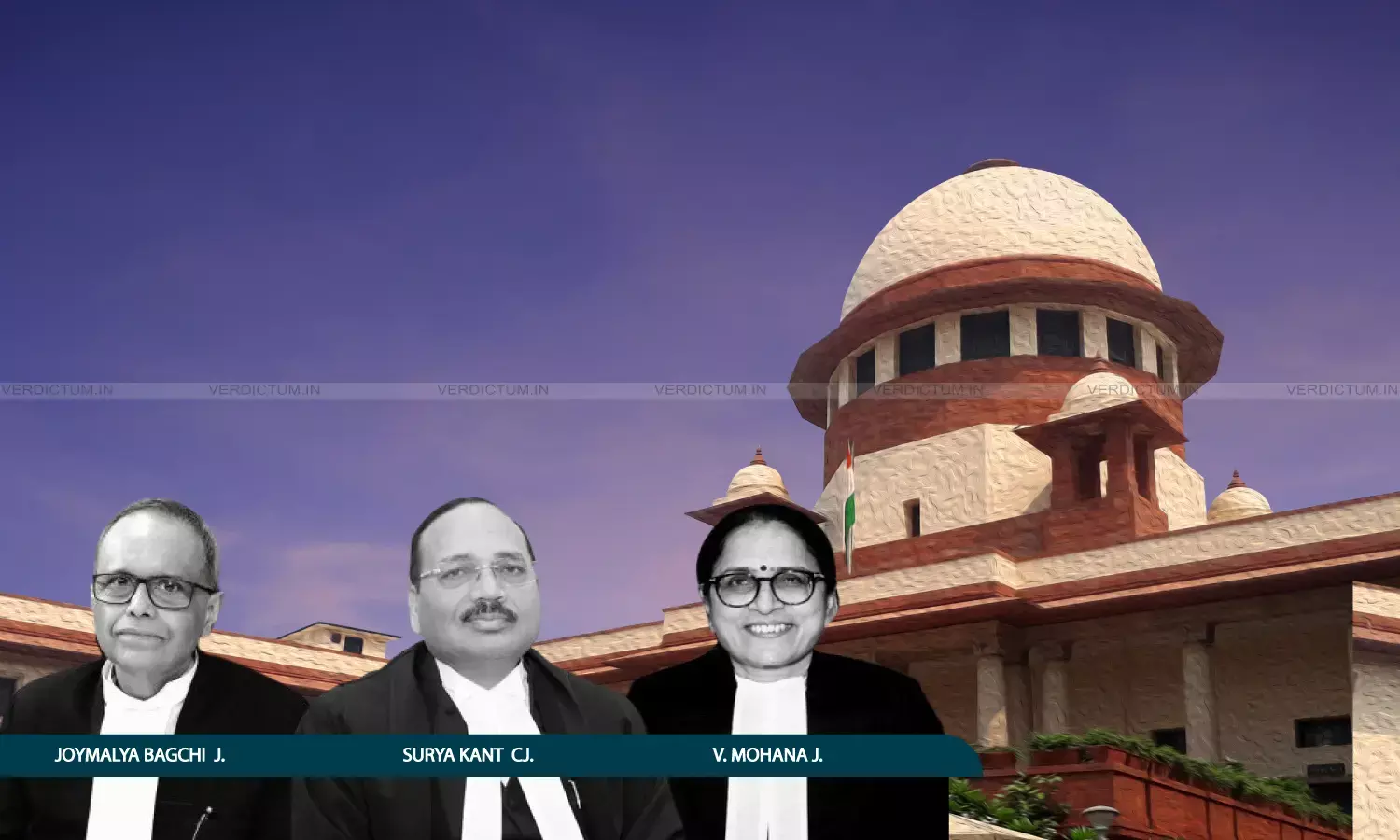
The Bench of Chief Justice Surya Kant, Justice Joymalya Bagchi and Justice V Mohana issued notice in the matter and asked the Petitioner to provide a chart highlighting the gap between the new rules and prior rules.
The Court remarked, "This is not an unoccupied field. 1998, there were rules under the earlier law. These rules have been repealed; the new law has come into effect. We are issuing notice; please give us a chart as to where the new rules have a gap in relation to the already occupied prior rules...If you can really create some obligation, then under that, the licensee, the builders, who are otherwise required to deposit a lot of different kinds of funds... so why not have even a corpus for the welfare of the construction worker? That can be a condition, a statutory obligation, precondition for grant of license itself."
Advocate Prashant Bhushan appeared for the Petitioners
Bhushan raised serious concerns regarding the safety of construction workers, highlighting the alarming rise in accidents at construction sites due to improper safety measures. He submitted that while the Occupational Safety, Health and Working Conditions Code had been published, it failed to address the core safety hazards faced by construction labourers.
He pointed out that although Section 18(1) of the Code mandated the framing of comprehensive safety standards, the existing provisions on page 126 were highly inadequate, as they merely covered basic elements like cleanliness, hygiene, ventilation, and dust precautions rather than actual structural safety, equipment standards, and site hazards.
"These kinds of guidelines need to be laid down, which is in accordance with the BIS standards. BIS has laid down some standards for construction. Each one of this has been borrowed from the BIS standards. So, something of this kind needs to be laid down, which will also require an inquiry into these kind of accidents, an independent inquiry, because today there is no provision. All that they have done—one of the cases that we have referred to is this collapse of a building in Gurgaon. Now, in that, what they do normally is register an FIR. FIR is not something which will determine as to how much compensation, which worker has to be paid", he argued.
The Court asked, "Maybe they can notify at least labor courts or the industrial tribunals to deal with these claim cases and all, because there can be two existing mechanisms which can be borrowed. Either... I think the industrial tribunal appears to be the only nearest one."
The Bench also highlighted the pivotal role of state Town and Country Planning departments, observing that compliance with labor safety standards and the Occupational Safety Code ought to be made a mandatory precondition at the time of granting construction licenses to developers.
"Have you pointed out that... in fact, because you are not impleading Town and Country Planning, when these licenses are granted, it must be a condition in the license itself—precondition—that the labor safety code will have to be followed", Chief Justice Kant said.
Bhushan said, "The Occupational Safety Code envisages that the Central Government will lay down some standards regarding building and construction work. Now, unfortunately, the only standards which have been laid down are regarding pollution, etc. They don't deal with this kind of safety."
Accordingly, the Court will hear the plea on a further date.
The plea prayed, "direct a complete, independent and time-bound investigation and statutory/technical inquiry into the construction-site collapse dated 09.03.2026 at Signature Global City of Colours, Sidhrawali, Gurugram, including examination of the role of the principal employer/developer, its responsible directors and management personnel, project and safety personnel, engineer/responsible person, contractor, sub-contractor and any other person concerned; the applicability of the Occupational Safety, Health and Working Conditions Code, 2020 including Sections 6 and 103; and preservation and examination of all relevant technical, contractual, inspection and safety records, and further direct that the result of such examination be placed before the competent court/authority before conclusion of the investigation"
It also sought direction for the competent labour, compensation and welfare authorities to identify and verify every deceased and injured worker and, in a coordinated and time-bound manner, determine, recover and disburse all compensation, medical/rehabilitation assistance.
Further, the Petitioner sought directions to Respondent No. 1 to declare standards on occupational safety and health for workplaces relating to building and other construction work under Section 18 (1) of the Occupational Safety, Health and Working Conditions Code, 2020.
Furthermore, it sought directions to the Union of India and all States and Union Territories to establish a uniform national mechanism for recording, compiling and periodically publishing construction fatalities and serious injuries, causes of accidents, inspections, statutory action/prosecutions, compensation and welfare benefits, and such other anonymised regulatory information as may be necessary for prevention, monitoring and public accountability.
Cause Title: National Campaign Committee For Central Legislation On Construction Labour v. Union of India & Ors. [W.P.(C) No. 1177/2026]