

Dishonest Intention At Inception Of Transaction Necessary For Offence Of Cheating; Criminal Character Can't Be Assumed: Supreme Court
The Supreme Court was considering an appeal arising from the judgment of the Gauhati High Court dismissing the petition filed by the appellant seeking quashing of a criminal case.

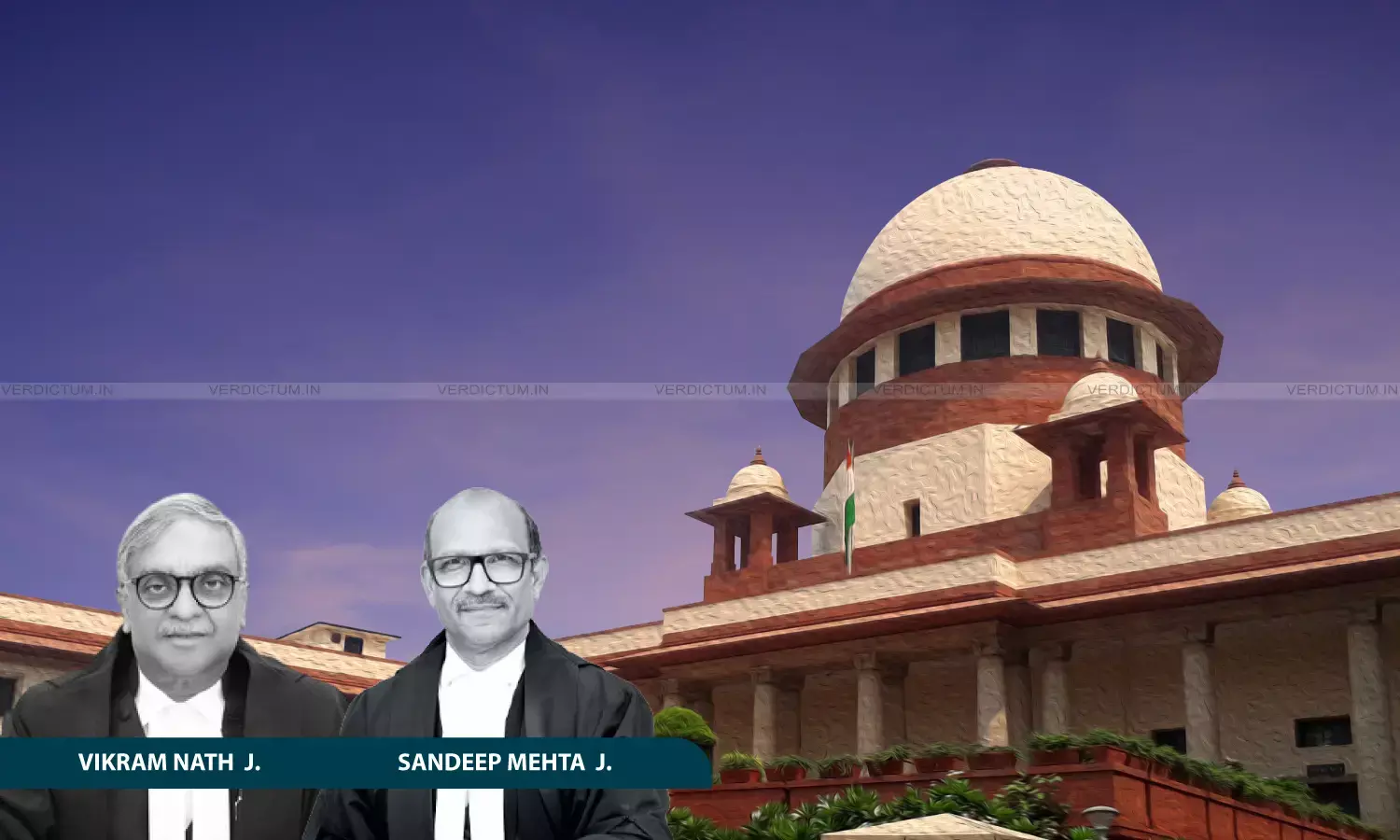
Justice Vikram Nath, Justice Sandeep Mehta, Supreme Court
The Supreme Court has quashed a criminal case registered against a Chief Executive Officer of a Tea Company while observing that criminal character of a dispute cannot be assumed merely because the contractual relationship subsequently failed.
The Apex Court was considering an appeal arising from the judgment of the Gauhati High Court dismissing the petition filed by the appellant under Section 482 of the Code of Criminal Procedure, 1973 seeking quashing of a case pending before the Court of the Judicial Magistrate First Class, Dimapur, Nagaland, for offences punishable under Sections 417 and 420 of the Indian Penal Code, 1860 (IPC).
The Division Bench of Justice Vikram Nath and Justice Sandeep Mehta held, “The subsequent events also bear the character of a contractual dispute. Differences arose regarding performance of the reciprocal obligations under the MoU, which was ultimately terminated on 26.07.2021. Whether such termination was valid and whether respondent No. 1 is entitled to refund of the amount paid or any other relief are matters carrying civil consequences. They cannot assume a criminal character merely because the contractual relationship subsequently failed.”
“The Court must first determine whether the allegations disclose the essential ingredients of the criminal offence alleged. In the present case, the material does not disclose sufficient factual foundation to infer that the appellant, at the inception of the transaction, acted with the dishonest intention necessary to constitute cheating”, it added.
Senior Advocate Sudip Sanyal represented the Appellant while Advocate Harpreet Singh represented the Respondent.
Factual Background
The appellant was serving as the Chief Executive Officer of Darjeeling Organic Tea Estates Private Limited (Company) and was authorised to act on its behalf. The first Respondent, who is the proprietor of C.R. Traders, entered into negotiations with the Company in relation to the Jamguri Tea Estate situated at Golaghat, Assam. Prior to the execution of the agreement, the first respondent addressed a communication to UCO Bank in relation to the Tea Estate and its mortgage with the Bank. A Memorandum of Understanding (MoU) was thereafter executed between the Company and C.R. Traders.
The appellant signed the MoU on behalf of the Company in his capacity as its authorised signatory. Pursuant thereto, the first respondent transferred an amount of Rs 40 lakh to the bank account of the Company in two transactions. Disputes subsequently arose between the parties and the MoU was terminated. The first respondent instituted a criminal complaint against the appellant before the Judicial Magistrate First Class. It was alleged that the appellant had induced the respondent to part with the amount of Rs 40 lakh by representing that the Jamguri Tea Estate belonged to the Company, whereas it was owned by Bhumya Tea Company Private Limited and was the subject matter of proceedings involving UCO Bank.
On the basis of these allegations, offences punishable under Sections 417 and 420 of IPC were alleged against the appellant. The complaint came to be registered and the Judicial Magistrate First Class found prima facie grounds to proceed against the appellant for offences punishable under Sections 417 and 420 IPC and issued summons to him. The appellant approached the High Court under Section 482 of CrPC seeking quashing of the criminal proceedings. By the impugned judgment dated 13.05.2025, the High Court dismissed the petition upon holding that a prima facie case under Sections 417 and 420 IPC was made out and that the existence of an arbitration clause in the MoU did not furnish a ground for quashing the criminal proceedings. Aggrieved thereby, the appellant approached the Apex Court.
Reasoning
The Bench reiterated the distinction between a breach of contract and the offence of cheating by observing, “For an offence under Sections 417 and 420 of IPC, the fraudulent or dishonest intention must exist at the inception of the transaction and must have induced the complainant to part with property. A subsequent failure to perform a contractual obligation cannot, by itself, give rise to an inference of such intention.”
Considering the facts of the case, the Bench noted that even prior to execution of the MoU, the first respondent was aware that the Tea Estate was mortgaged with UCO Bank. The MoU contemplated the clearance of the outstanding dues and encumbrances of UCO Bank and the eventual acquisition of the Tea Estate. It was further noticed that the Company was in possession of and operating the Tea Estate and had substantial claims concerning the same. “In these circumstances, a bare assertion that the appellant knew the representation to be false does not, without more, establish dishonest intention at the inception of the transaction”, it added.
The Bench further noted, “The High Court was correct in observing that the existence of an arbitration clause does not, by itself, bar criminal proceedings. That proposition, however, does not answer the real question.”
Thus, holding that the continuation of the criminal proceedings against the appellant would amount to giving a predominantly contractual dispute the colour of a criminal prosecution, the Bench held that the ingredients of the offences under Sections 417 and 420 IPC were not made out against the appellant and allowed the appeal.
Cause Title: Indroneel Goho v. Razouvonuo Thong & Anr. (Neutral Citation:2026 INSC 1115)
Appearance
Appellant: Senior Advocate Sudip Sanyal, AOR Arun K. Sinha, Advocates Rakesh Singh, Jayanta Kumar Sanyal
Respondent: AOR Harpreet Singh, AOR Praveen Kumar Jha, Advocates Jitin Singhal, Pravesh Bahuguna, Rudraksh Pandey, AOR K. Enatoli Sema, Advocates Amit Kumar Singh, Chubalemla Chang, Prang Newmai, Yanmi Phazang
Click here to read/download Order