Judicial Officer Should Not Be Castigated For Inadvertent Typographical Errors: Supreme Court Expunges Adverse Remarks
The Court said that the High Court’s supervisory jurisdiction under Article 227 should be exercised in a manner that guides, strengthens and nurtures the district judiciary.
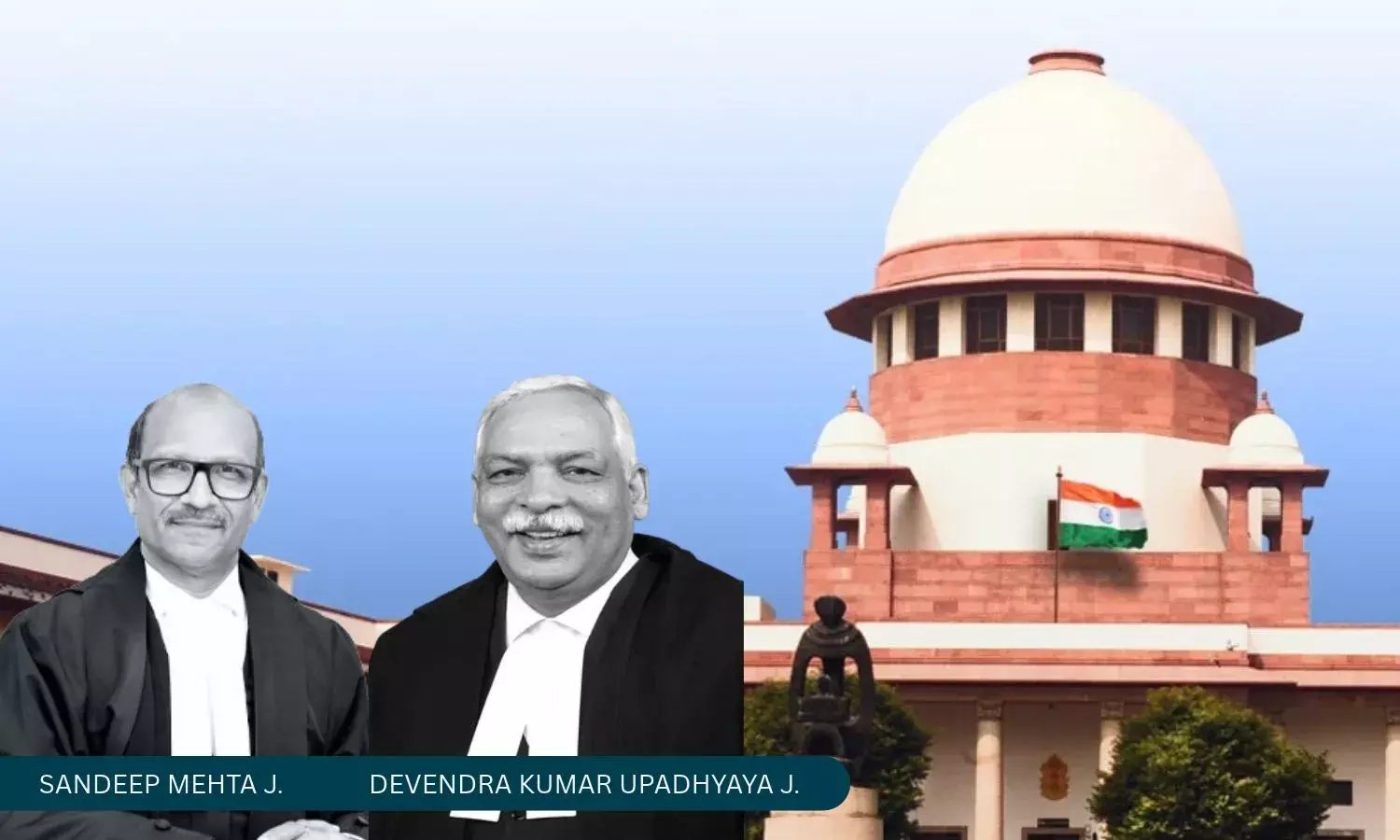
The Supreme Court has expunged adverse remarks and strictures passed by the Rajasthan High Court against a Judicial Officer over inadvertent typographical errors that did not affect the outcome of a case.
The Apex Court held that recording such remarks without first allowing the officer to explain the circumstances violated the principle of audi alteram partem.
The Court was hearing an appeal by a Judicial Officer from the District Judge Cadre of the Rajasthan Judicial Services against adverse observations made while the High Court was deciding a suspension-of-sentence application. Her identity was masked in the cause title.
A Bench of Justice Sandeep Mehta and Justice Devendra Kumar Upadhyaya observed: “To castigate a Judicial Officer for inadvertent typographical errors in a judgment, which did not, in any manner, affect the outcome of the case was avoidable.”
The Bench further held: “… even if the High Court was of the view that any error had occurred on part of the appellant-Judicial Officer in rendering the judgment, it ought not to have recorded adverse observations against her without first affording her an opportunity to explain the circumstances in which the error occurred. The course chosen by the High Court was contrary to the fundamental principle of ‘audi alteram partem’.”
Senior Advocate Gagan Gupta appeared for the Judicial Officer, while Advocate Saurabh Rajpal appeared for the respondent.
Background
The Judicial Officer had conducted two separate trials arising from the same FIR—one involving a child in conflict with law and the other involving an adult accused. Separate proceedings and judgments were required because Section 23 of the Juvenile Justice (Care and Protection of Children) Act, 2015 prohibits the joint trial of a child and an adult.
After considering the evidence separately, the Judicial Officer convicted both accused and imposed sentences of 20 years’ rigorous imprisonment. Some overlapping extracts of evidence and numerical particulars from one trial were, however, incorporated into the judgment delivered in the other.
While rejecting the child’s application for suspension of sentence, the High Court criticised the Judicial Officer for allegedly adopting a “cut, copy and paste” method. It inferred that the judgment had probably been written by the stenographer or clerk and signed without being read or corrected by the Presiding Officer.
The High Court further observed that a Judicial Officer who failed to dictate the entire judgment was not entitled to remain in judicial service. It directed that she receive training in judgment writing and that its order be placed in her Annual Confidential Report after obtaining her comments.
Before the Supreme Court, the Judicial Officer explained that the two cases arose from the same incident and involved substantially similar witnesses and evidence. She also referred to the limited resources of the POCSO Court and the statutory requirement for expeditious disposal. The Court was told that the sole stenographer had proceeded on leave, requiring part of the judgment to be dictated directly to a Lower Division Clerk on a computer.
Court’s Observations
Article 227 Supervision Should Nurture District Judiciary
The Supreme Court observed that High Courts perform an important supervisory role over courts within their jurisdiction under Article 227 of the Constitution. That authority had to be exercised in a manner that strengthened rather than discouraged the district judiciary.
The Bench observed: “The duty cast upon the High Courts under this constitutional provision is of the utmost importance and requires exercise of powers of superintendence in a manner that guides, strengthens and nurtures the district judiciary. The present case portrays a situation where the said supervisory power appears to have been exercised in a manner that could have been avoided by exercising the virtue of forgiveness and magnanimity.”
The Court found that the High Court should have acted with greater magnanimity and in the true spirit of its role as guardian of officers in the district judiciary.
Errors Were Explained As Bona Fide And Inconsequential
The Judicial Officer explained that the incorrect serial numbers of prosecution witnesses and overlapping factual portions were bona fide typographical errors arising while the two related judgments were being prepared with limited stenographic assistance.
The Court noted: “The errors in the judgment, including the incorrect serial numbers of the prosecution witnesses, are explained by the appellant-Judicial Officer as bona fide typographical errors which, according to her, neither altered nor affected the outcome or substance of the judgment.”
After considering the explanation and the impugned order, the Supreme Court declined to accept the High Court’s view that the officer had acted in dereliction of her duties.
Strictures Were Passed Without Opportunity To Explain
The Court found that the High Court had passed disparaging remarks on the judicial side without issuing notice or allowing the officer to place her explanation on record.
The Bench held: “Ex facie, we feel that the adverse observations and the strictures recorded by the High Court against the appellant-Judicial Officer were uncalled for and avoidable. These disparaging remarks and the strictures were recorded on the judicial side, without affording an opportunity to the appellant-Judicial Officer to show cause or to place her explanation on record before such observations and strictures were made, and hence, suffer from the vice of non-adherence to the principles of natural justice.”
Relying on Kaushal Singh v. State of Rajasthan (2025), In Re: ‘K’, A Judicial Officer (2001) and Sonu Agnihotri v. Chandra Shekhar (2024), the Court reiterated the distinction between criticism of an erroneous judicial order and adverse comments about the personal conduct or calibre of its author.
It observed that such remarks could destroy a Judicial Officer’s career and have a chilling effect across the district judiciary.
Concerns May Be Addressed On Administrative Side
Referring to Shuvendu Saha v. State of West Bengal (2026), the Court stated that concerns regarding the quality of a judgment or the conduct of its author could be documented through a remark slip and placed before the Administrative Judge or Chief Justice for appropriate action.
The Bench observed: “The appropriate procedure would be to record observations concerning the merits or quality of the judgment or the proceedings of the Presiding Officer in a remark slip which, in turn, would be placed before the administrative Judge or the Hon’ble Chief Justice of the High Court, as the case may be, for necessary follow-up action on the administrative side. Condemnation of the conduct of the Judicial Officer by the High Cout on the judicial side would undeniably lead to adverse consequences on the career of the Judicial Officer.”
The Court held that condemning a Judicial Officer on the judicial side without following natural justice was legally unsustainable.
Conclusion
The Supreme Court allowed the appeal and expunged the High Court’s adverse remarks and strictures against the Judicial Officer. It also set aside the directions requiring her to undergo judgment-writing training and placing the order in her Annual Confidential Report.
The Registry was directed to transmit a copy of the judgment to the Registrar General of the Rajasthan High Court for placement before its Chief Justice. Pending applications were disposed of.
Cause Title: In Re: XXX, A Judicial Officer in the District Judge Cadre of Rajasthan Judicial Services (Neutral Citation: 2026 INSC 1188)
Appearances
Appellant: Senior Advocate Gagan Gupta; Advocates Javed Khan, Saurabh Gupta and Shivendra Singh; Advocate-on-Record Vanya Gupta
Respondent: Advocate Saurabh Rajpal (AOR); Advocates Vinay Kumar Singh, Pallavi Raj and Vedant Arora