

Rampant Illegal Sand Mining Cannot Brook Prolonged “Administrative Delays”: Supreme Court Directs States Of MP, UP, Rajasthan To Fast-Track Enforcement In Chambal Sanctuary
The Bench also dealt extensively with illegal excavation near the bridge situated on National Highway-44 at the Morena–Dholpur border over the Chambal River.

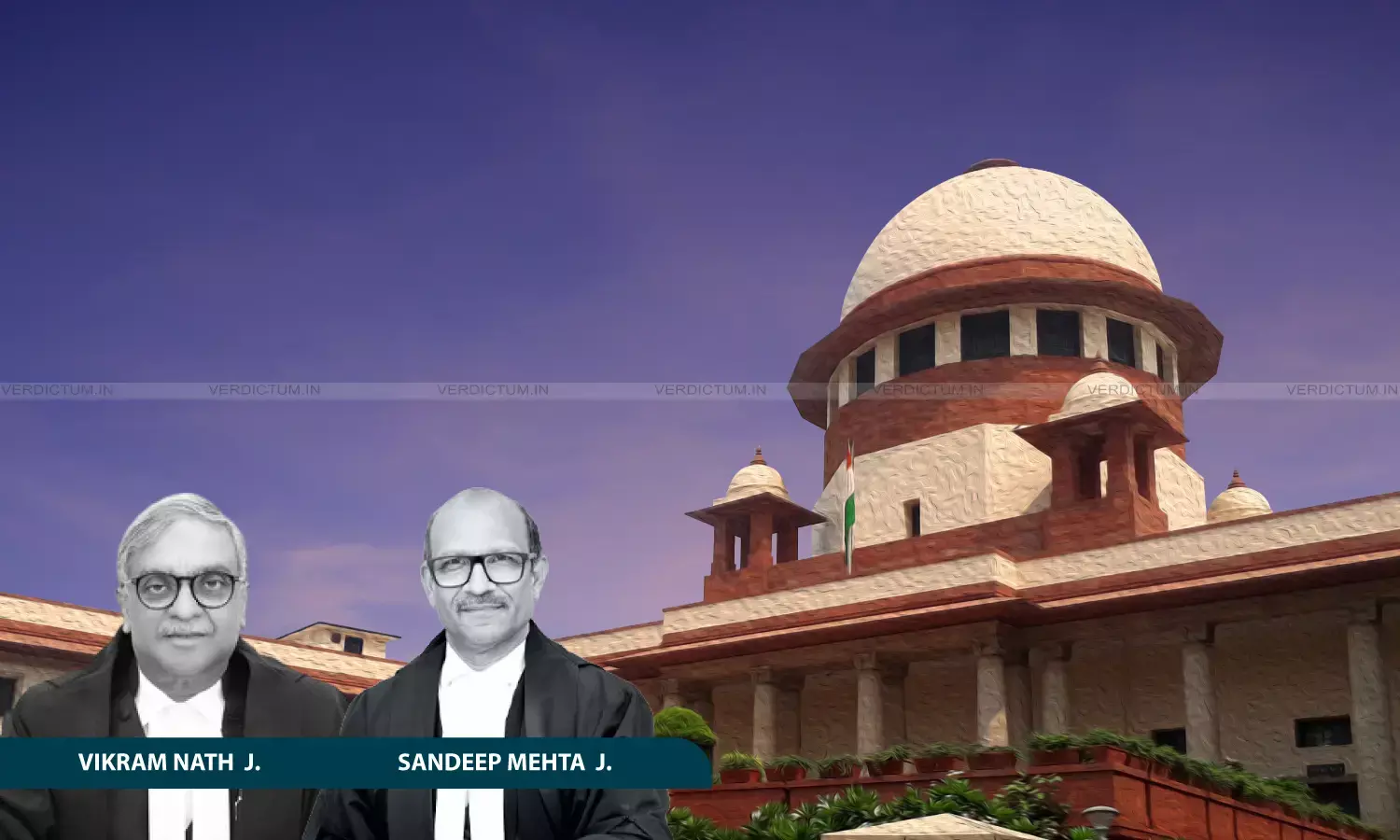
Justice Vikram Nath, Justice Sandeep Mehta, Supreme Court
The Supreme Court has issued a sweeping set of directions to the States of Rajasthan, Madhya Pradesh and Uttar Pradesh to intensify enforcement against illegal sand mining in and around the National Chambal Gharial Sanctuary, observing that continuing ecological degradation, destruction of protected wildlife habitats and threats to critical public infrastructure cannot be permitted to persist due to prolonged administrative timelines and weak enforcement.
The Bench noted that although the three States had initiated certain measures pursuant to earlier directions, including surveillance proposals, budgetary sanctions and enforcement steps, several critical measures remained at a preliminary stage and had not yet translated into effective on-ground implementation.
Accordingly, the Bench in a slew of directions, has directed immediate installation and operationalisation of CCTV surveillance systems across vulnerable stretches of the National Chambal Gharial Sanctuary, including high-resolution cameras near the NH-44 Morena–Dholpur bridge, and ordered stringent interception, seizure and confiscation proceedings against unregistered vehicles, vehicles with fake or tampered number plates, and machinery found involved in illegal mining and transportation activities.
A Bench of Justice Vikram Nath and Justice Sandeep Mehta observed, “…The continuing illegal mining activities, ongoing ecological degradation, destruction of protected wildlife habitats and risks posed to public infrastructure cannot brook prolonged administrative delays in implementation of essential surveillance and enforcement mechanisms. Measures intended to secure ecologically sensitive areas and ensure effective enforcement of law must be undertaken with a sense of immediacy and institutional urgency and cannot remain deferred over extended periods while illegal activities continue unabated on the ground”.
In the matter by courts motion Senior Advocate Nikhjil Goel, Advocate Rupali Samu appeared as amicus curiae, Advocate Umesh Kumar Shukla appeared for the petitioner, Aishwarya Bhati, A.S.G., Sharan Dev Singh Thakur, Sr. A.A.G., S.V. Raju, A.S.G. (V.C.) appeared for the respondents.
The Court observed that environmental governance in ecologically sensitive zones cannot be reduced to a reactive exercise triggered only by judicial scrutiny. It held that the constitutional obligations flowing from Articles 21, 48A and 51A(g) of the Constitution of India require the State machinery to anticipate environmental harm, prevent ecological degradation and preserve fragile ecosystems through sustained institutional action.
Taking note of continued illegal mining activity within and around the sanctuary, the Court expressed particular concern over the operation of unregistered and unidentified vehicles allegedly being used for illegal mining and transportation. The Bench held that the compliance affidavits did not disclose any coherent mechanism for identification, blacklisting, confiscation or prosecution of such vehicles and observed that mere challans or payment of nominal fines could not operate as an effective deterrent against organized environmental crime.
“…Permitting such vehicles to continue operations merely upon payment of nominal monetary penalties not only defeats the object and purpose of the statutory framework but also creates an atmosphere of complete impunity wherein illegal mining networks are able to treat penal consequences as insignificant operational costs. Effective enforcement in such matters necessarily requires a far more stringent, coordinated and deterrent approach involving immediate seizure, prosecution, tracing of ownership networks, cancellation of permits and accountability of officials responsible for permitting continued operation of such unidentified vehicles in the affected regions”, it noted.
The Court further remarked that illegal mining in the region had assumed dimensions beyond ordinary regulatory violations and had developed a direct nexus with organized networks systematically evading legal accountability. It held that effective enforcement required immediate seizure, confiscation, tracing of ownership patterns and prosecution not merely of drivers but also of owners, financiers, contractors and all persons connected with illegal mining operations.
The Bench also dealt extensively with illegal excavation near the bridge situated on National Highway-44 at the Morena–Dholpur border over the Chambal River. Though the National Highways Authority of India stated that the bridge was presently structurally safe, the Court held that NHAI could not adopt a passive role by merely reporting violations to State authorities. It observed that once illegal excavation near bridge foundations was brought to NHAI’s notice, a corresponding duty arose to anticipate and address foreseeable threats to infrastructure and public safety.
“…cannot lose sight of the fact that the NHAI, being a statutory authority entrusted with development, maintenance and management of National Highway infrastructure, cannot absolve itself of the responsibility of safeguarding infrastructure under its control from activities that pose a foreseeable threat to its safety, stability and long-term structural integrity…The issue, therefore, transcends a mere question of routine maintenance and directly implicates concerns relating to public safety, uninterrupted inter-State connectivity and protection of critical public infrastructure. Once serious concerns regarding illegal excavation activities in the immediate vicinity of the bridge were brought to the notice of the NHAI, a corresponding obligation arose upon the Authority, as well as the concessionaire entrusted with operation and maintenance of the highway stretch, to take all reasonable preventive, protective and surveillance measures necessary to safeguard the bridge and ensure its long-term structural security”.
Accordingly, the Court directed NHAI, in consultation with the Central Empowered Committee, to install high-resolution CCTV cameras with night-vision capability on the bridge and across vulnerable stretches extending one kilometre upstream and five hundred metres downstream, with live access to be shared with State enforcement agencies.
The Court also flagged waste dumping into the Chambal River from the bridge, recording that photographic material revealed accumulation of waste near bridge piers and visible impact on aquatic wildlife, including crocodiles and muggers. It directed immediate installation of tamper-proof fencing and protective barriers to prevent dumping and ordered strict enforcement against persons polluting the river ecosystem.
On the broader ecological issue, the Bench took note of concerns raised by the Central Empowered Committee regarding environmental flows in the Chambal River and declining lean-season discharge levels affecting habitat continuity for endangered riverine species including gharials, freshwater dolphins and turtles. The Ministry of Jal Shakti and the Central Water Commission were impleaded and directed to file affidavits detailing present and proposed measures to preserve environmental flows.
The Court further directed Rajasthan, Madhya Pradesh and Uttar Pradesh to urgently fill vacancies of Forest Guards and frontline enforcement personnel and complete recruitment, as far as practicable, within one year. It also called upon the Chief Secretaries of all three States to periodically review compliance and place status reports before the Court.
The matter has been directed to be listed on July 22, 2026.
Cause Title: In Re: Illegal Sand Mining In The National Chambal Sanctuary And Threat To Endangered Aquatic Wildlife v. The State Of Rajasthan (Neutral Citation: 2026 INSC 549)
Appearances:
Petitioner: Umesh Kumar Shukla, Pritam Singh, Ankit Bhatnagar, Rohit Kumar-I, AOR, Akanksha Singh, Advocates.
Respondent: Aishwarya Bhati, A.S.G., Shiv Mangal Sharma, A.A.G., Saurabh Rajpal, AOR, Arushi Rathore, and Nidhi Jaswal, AOR, Rohit K. Singh, AOR, Pritam Bishwas, Yashveer Singh and Kartikey Bansal, Sharan Dev Singh Thakur, Sr. A.A.G., Ruchira Goel, AOR, Rishika Rishabh, Sharanya, Ritika Rao, S. V. Raju, A.S.G. (V.C.), Manisha T. Karia, A.A.G., Nilesh Yadav, A.A.G., D. S. Parmar, A.A.G., Harmeet Singh Ruprah, AOR, Sarthak Raizada Ga, Kanishk Sharma, Karan Singh, Sudeep Kumar, AOR; Abhishek Saket; Manisha; and Rupali. Anil Kaushik, A.S.G., Gurmeet Singh Makker, AOR; Gaurav Arya; Pranjal Singh; Digvijay Dam; and Eklawya Dwivedi, Rohit Kumar-i, AOR, with Akansha Singh; Srishti Agnihotri, AOR, with D. P. Singh and Anchal Kanthed; Pawan Kumar Saxena, Jasveer Rana and Charan Dass; and lastly Pradeep Misra, AOR, assisted by Daleep Dhyani, Anupam Misra and Suraj Singh, Advocates.