

Lawful Lease Doesn't Absolve Environmental Safeguards In Riverbed Mining: Supreme Court Restrains New Industries Near Jojari-Luni Rivers
The Court deprecated Rajasthan’s attempt to legitimise illegal bajri mining through subsequent leases, ordered an SIT probe and restrained new industries near the Jojari-Bandi-Luni rivers.

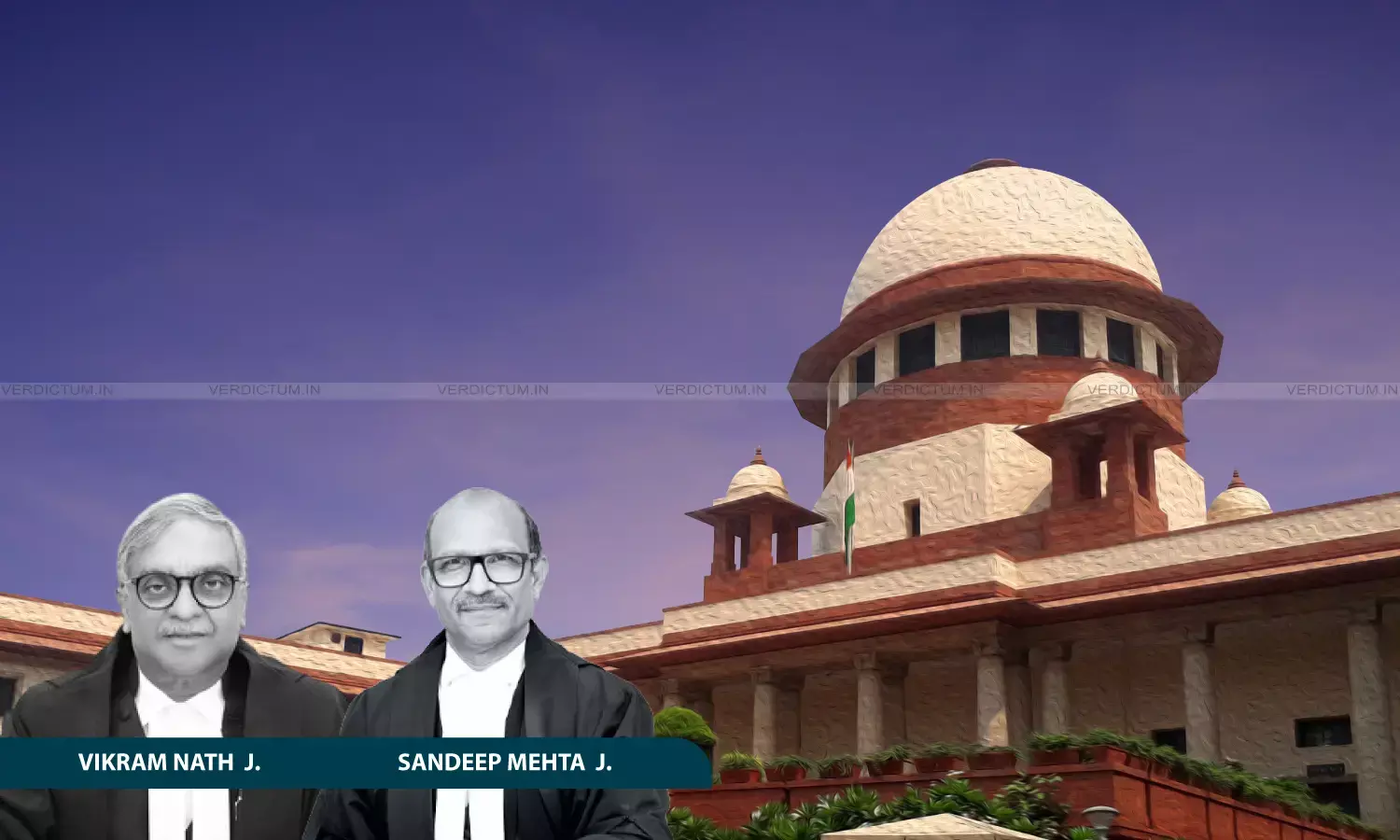
Justice Vikram Nath, Justice Sandeep Mehta, Supreme Court
The Supreme Court has held that compliance with the prescribed procedure for grant of a mining lease and compliance with environmental safeguards governing the actual conduct of mining are distinct requirements, and the former cannot substitute the latter. It held that where illegal mining has been detected, the subsequent grant of a lease over the same area cannot dispel the resulting concerns without an independent, scientific assessment of cumulative environmental impact.
The Court deprecated the State Mining Department’s apparent attempt to legitimise illegal riverbed mining by granting leases instead of acting against those responsible. It directed a Special Investigation Team to probe organised illegal bajri mining, including the role of public officials, and restrained the State from permitting new industrial units near the riverine ecosystem until the High Flood Line and buffer zones are determined.
A Bench of Justice Vikram Nath and Justice Sandeep Mehta observed, “The explanation furnished by the State, if accepted without further scrutiny, would risk reducing the problem of illegal mining to one of post facto regularisation and sanctioning of activities that were otherwise illegal, thereby lending legitimacy to such mining operations. Compliance with the prescribed procedure for grant of a mining lease and compliance with the environmental safeguards governing the actual conduct of mining are distinct requirements. The former cannot be a substitute for the latter. It is, therefore, necessary to ascertain whether the areas subsequently brought under mining leases were assessed with due regard to the natural flow of the rivers, the integrity of their beds and banks, replenishment capacity, groundwater recharge and the cumulative impact of mining across contiguous stretches”.
S.V. Raju, Additional Solicitor General, appeared for the State of Rajasthan; Senior Advocate Balbir Singh and Advocate Namit Saxena appeared as amicus curiae, and Advocate Rishabh Sancheti appeared for the Applicant.
The suo motu proceedings concern the degradation of the Jojari-Bandi-Luni river ecosystem in Rajasthan. By order dated September 29, 2026, the Court had issued directions on unauthorised discharge points, illegal industries and mining, effluent treatment infrastructure and a Comprehensive Resolution Plan.
The High-Level Ecosystem Oversight Committee thereafter flagged the Water Resources Department’s proposal to redetermine river widths on the basis of sewage flow, which would reduce the Luni from about 1,172 metres to about eight metres at Bhituja. It also flagged unscientific mining across 458.6 hectares at Village Kanana and slow progress on CETP and ZLD facilities. The State conceded that the width exercise was misconceived. Digvijay Singh Jasol, appearing in person, raised groundwater depletion in the over-exploited Balotra block.
The Bench noted that several initiatives remained under consideration and held that initiation of administrative processes cannot be treated as fulfilment of its directions. It observed that accepting the State’s explanation would reduce illegal mining to post facto regularisation, and that the State cannot discharge its obligation merely by reporting cases detected, FIRs registered or penalties recovered.
“The aforesaid position gives rise to a serious concern. The fact that mining leases may have subsequently been granted in accordance with the prescribed procedure does not, by itself, answer the question whether the grant of such leases is environmentally sustainable or consistent with the need to preserve and restore the natural course, riverbed and ecological integrity of the river systems. Where illegal mining has previously been detected, the subsequent grant of a lease over the same area cannot be treated as sufficient to dispel the concerns arising from the earlier activity, without an independent and scientifically informed assessment of the cumulative environmental impact”, the Bench said.
The Court directed a 100-metre protective zone on either side of the recorded river boundaries and barred Red Category industries within 500 metres. The SIT, headed by an officer not below the rank of Inspector General of Police, is to be constituted within three days. The Central Ground Water Authority was directed to be impleaded, the State was directed to respond to Jasol’s Note, and the grievance mechanism was directed to accept anonymous complaints. The State was also directed to frame a ZLD financial assistance policy and plan a redistribution pipeline for treated wastewater. Senior Advocate Balbir Singh and Advocate Namit Saxena were appointed Amici Curiae.
On an application by Bherawa Textile Industries, the Court clarified that its earlier orders do not extinguish the NGT’s appellate jurisdiction under Section 16(c) of the NGT Act, 2010, and granted liberty to seek restoration of the withdrawn appeal. The matter is listed on November 27, 2026.
Cause Title: In Re: 2 Million Lives At Risk, Contamination In Jojari River, Rajasthan (Neutral Citation: 2026 INSC 1203)
Appearances:
Additional Solicitor General S.V. Raju, Additional Advocate General Shiv Mangal Sharma, Advocate Rishabh Sancheti, Digvijay Singh Jasol, in person, Senior Advocate Balbir Singh, Advocate Namit Saxena, Amicus Curiae.