

Unsuccessful Party In Arbitration Can Seek Post-Award Interim Measures U/S 9 A&C Act: Supreme Court
The Court held relief to losing parties requires a high threshold and circumspection, to preserve the subject matter pending Section 34 challenge proceedings.

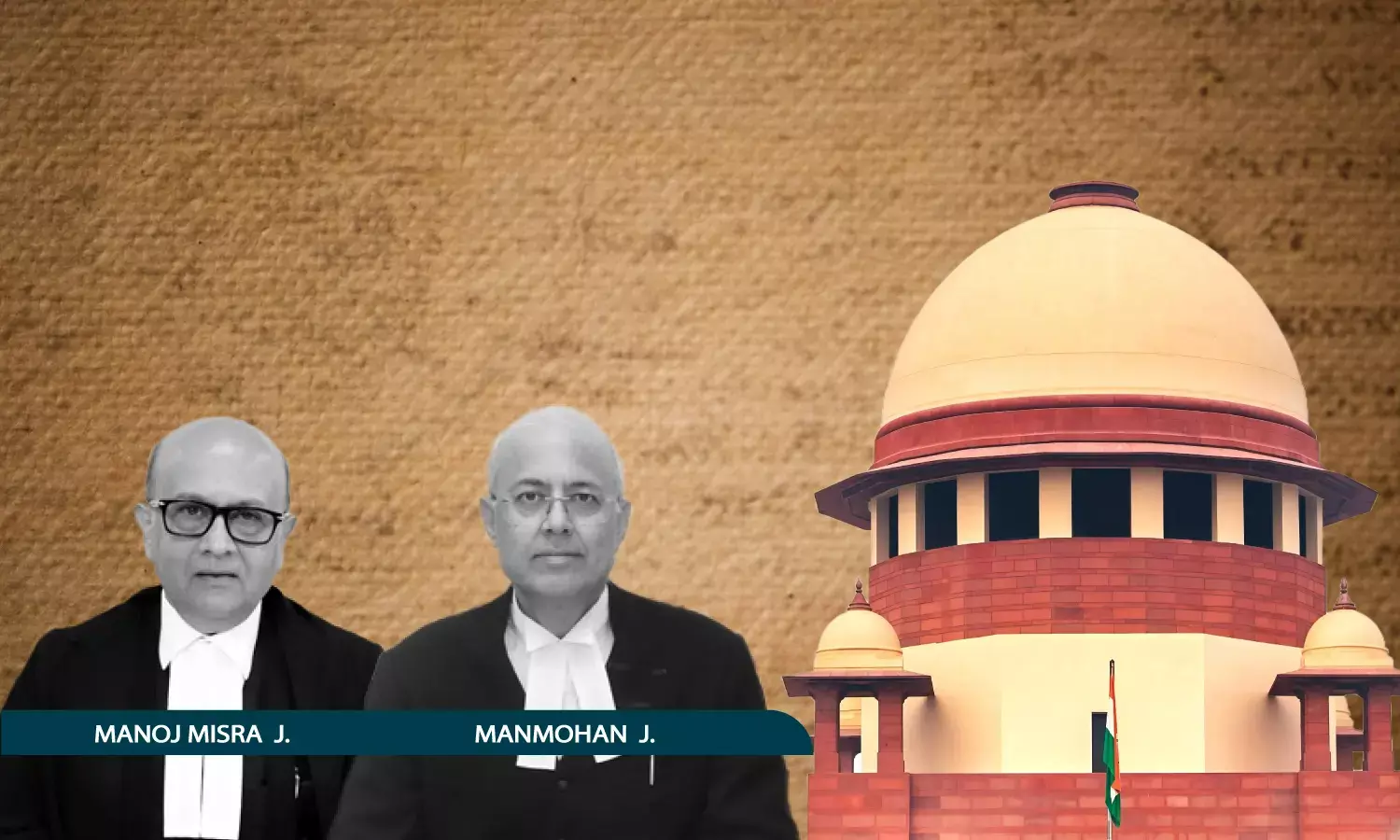
The Supreme Court has categorically held that the right to apply for interim measures under Section 9 of the Arbitration and Conciliation Act, 1996, is available to any party to an arbitration agreement, including those who have been unsuccessful in the arbitral proceedings. The Court clarified that the expression ‘a party’ as defined under Section 2(h) cannot be contextually modulated or narrowed to refer only to a ‘successful party’ or ‘award-holder’ once the award is rendered.
The Court expanding the locus, held that even an unsuccessful party challenging an award under Section 34 of the Act may seek interim relief, though subject to a significantly higher threshold and strict judicial scrutiny. It held such relief may be granted to protect the “subject matter of arbitration” or the “amount in dispute”, and is not confined merely to securing the fruits of an award.
Justice Manoj Misra and Justice Manmohan observed, “…this Court holds that any party to an arbitration agreement, including an unsuccessful party in arbitration, may invoke Section 9 of the Act at the post-award stage. However, the Courts would be well advised to exercise care, caution and circumspection while dealing with a Section 9 application filed by an unsuccessful party in arbitration”.
K.M. Nataraj, ASG, Senior Advocate Abhimanyu Bhandari appeared for the appellant and Senior Advocate Dr. Menaka Guruswamy appeared for the respondent.
The matter reached the Court through a series of Special Leave Petitions, while the present filed by Home Care Retail Marts Pvt. Ltd. against Haresh N. Sanghavi.
The appellants challenged a Bombay High Court order which had dismissed their Section 37 appeals by relying on Dirk India Pvt. Ltd. v. Maharashtra State Electricity Generation Co. Ltd., 2013 SCC OnLine Bom 481. That precedent held that post-award interim measures were strictly intended to protect the 'fruits of arbitral proceedings,' a benefit an unsuccessful party is not entitled to.
In a sharp divide, the High Courts of Bombay, Delhi, Madras, and Karnataka had consistently held that unsuccessful parties could not maintain such petitions. Conversely, the High Courts of Telangana, Gujarat, and Punjab & Haryana had taken a more inclusive view, holding that the statutory language of Section 9 does not distinguish between winners and losers at any of the three stages of arbitration.
In its reasoning, the Supreme Court applied a literal rule of statutory interpretation, noting that the Indian Parliament consciously departed from the UNCITRAL Model Law by adding a post-award stage to Section 9 without imposing restrictions on which party could invoke it.
The Court rejected the argument that Section 36, which deals with the stay of an award, suffices as a remedy, noting that Section 9 and Section 36 operate in distinct spheres; the former protects the subject matter while the latter addresses enforceability.
Furthermore, the Bench noted that since Gayatri Balasamy vs. ISG Novasoft Technologies Limited, 2025 SCC OnLine SC 986 allows for the modification or severance of awards, a party branded 'unsuccessful' might eventually see its rights revived or modified, necessitating interim protection in the interim to prevent final success from becoming illusory.
“Undoubtedly, the threshold for grant of interim relief will be higher in the case of an unsuccessful party in arbitration seeking such relief. In rare and compelling cases, permitting the unsuccessful party to invoke Section 9 of the Act would prevent irreparable prejudice and preserve the efficacy of the challenge proceedings. However, the rights of such a party cannot be curtailed merely on the apprehension of possible misuse of a statutory provision”, the Bench further noted.
The Court concluded that the restrictive interpretations adopted by the Bombay, Delhi, Madras, and Karnataka High Courts do not lay down good law.
“…this Court holds that the judgments of the Bombay, Delhi, Madras, and Karnataka High Courts insofar as they deny an opportunity to unsuccessful parties in arbitration to apply for relief under Section 9, do not lay down good law. The contrary views expressed by the Telangana, Gujarat, and Punjab & Haryana High Courts correctly reflect the statutory position”, the Bench, thus, noted.
Cause Title: Home Care Retail Marts Pvt. Ltd. v. Haresh N. Sanghavi (Neutral Citation: 2026 INSC 415)
Appearances:
Appellants: K.M. Nataraj, ASG, Abhimanyu Bhandari, Sr. Adv.
Respondent: Dr. Menaka Guruswamy, Sr. Adv.